

Daily Devotional
Thursday, November 23, 2034 (NS), November 10, 2034 (OS)
No Fasting.
Thursday of the Twenty-Sixth Week
The commemoration of the holy Apostles Olympas, Rodion, Sosipater, Tertius, Erastos, and Quartus of the Seventy.
Scripture Readings
Paschalion — Movable Calendar
Thursday of the Twenty-Sixth Week
Epistle
The Reading is from the First Epistle of Saint Paul to Saint Timothy [§ 283]. Child Timothy:
3 1Faithful is the word. If one reach out for the office of bishop, he is desirous of a good work. 2It is necessary then for the bishop to be blameless, the husband of one wife, sober, of sound mind, of good behavior, hospitable, apt at teaching, 3not given to behave ill at wine, not a striker, not sordidly greedy of gain, but gentle, not contentious, not a lover of money, 4one who manageth his own house well, having his children in subjection with all reverence 5(now if one know not to manage his own house, how shall he take care of a Church of God?); 6not a neophyte, lest having been puffed up with pride he should fall into the condemnation of the devil. 7But it is necessary for him also to have a good testimony from those outside, lest he should fall into reproach and a snare of the devil. 8It is necessary for deacons, in like manner, to be reverent, not double-tongued, not given to much wine, not sordidly greedy of gain, 9holding the mystery of the faith in a pure conscience. 10But first let these also be proved; then if they are blameless, let them serve as deacons. 11It is necessary for women deaconesses, in like manner, to be reverent, not double-tongued, sober, faithful in all things. 12Let deacons be husbands of one wife, managing their children and their own houses well. 13For they who have served well as deacons acquire a good degree for themselves and much boldness in faith which is in Christ Jesus.
Gospel
The Reading is from the Holy Gospel according to Saint Luke [§ 70]. At that time:
13 1There were present at that very season some that bore tidings to Jesus about the Galilæans whose blood Pilate mingled with their sacrifices. 2And Jesus answered and said to them, “Suppose ye that these Galilæans came to be sinners beyond all the Galilæans, because they have suffered such things? 3“By no means, I say to you; but unless ye be repenting, ye shall all perish in like manner. 4“Or those eighteen upon whom the tower in Siloam fell and killed them, suppose ye that these came to be debtors beyond all men who dwell in Jerusalem? 5“By no means, I say to you; but unless ye be repenting, ye shall all perish in like manner.” 6Also He was saying this parable: “A certain man had a fig tree which was planted in his vineyard; and he came seeking fruit on it, and did not find any. 7“And he said to the vinedresser, ‘Behold, three years I come seeking fruit on this fig tree and do not find any. Cut it out. Why is it also rendering the ground useless?’ 8“And answering, he saith to him, ‘Lord, let it alone also this year, until I dig about it, and put manure around it. 9“‘And if indeed it should produce fruit—well; but if not, in the future thou shalt cut it out.’”
Menaion — Fixed Calendar
The commemoration of the holy Apostles Olympas, Rodion, Sosipater, Tertius, Erastos, and Quartus of the Seventy.
No readings given.
Lives of the Saints (Prologue)
November 23rd – Civil Calendar
November 10th – Church Calendar
1. The Holy Apostles Olympas, Erastus, Quartus, Herodion, Sosipater and Tertius.
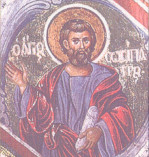 They were all among the Seventy. The last three are
also commemorated elsewhere: Herodion on April 8th, Sosipater on April 28th and Tertius on
October 30th. Ss. Olympas and Herodion were followers of the Apostle Peter, and when Peter
suffered, they suffered too, being beheaded at Nero’s command. Erastus was steward of
the Church in Jerusalem, and later became Bishop of Paneas in Palestine. Quartus was bishop
in Beirut; he suffered greatly and brought many to the Christian Faith. Sosipater was
bishop in Iconium, and Tertius followed him as bishop there. They strove in spirit, became
victors and were crowned with wreaths of glory. |
2. The Holy Martyr Orestes.
From the town of Tyana in Cappadocia, St. Orestes was a cradle Christian and a doctor by profession. He was harshly interrogated by a wicked governor, Maximinus, in the reign of Diocletian (284-305). When the governor urged him to deny Christ and worship idols, Orestes replied: ‘If you knew the power of the Crucified, you would reject idolatrous lies and worship the true God.’ For this he was harshly beaten, then flayed and cut about, then burned in boiling lead and finally thrown into prison to die of hunger. The young Orestes spent seven days without bread or water. On the eighth day, he was brought before the governor, who began to threaten him with terrible tortures. To this Orestes replied: ‘I am ready to undergo every torture, having the sign of my Lord Jesus Christ inscribed on my heart.’ Then the governor ordered that twenty nails be hammered into his legs and that he be bound behind a horse and dragged through thistles and rocks until he expired. In the place where Orestes’ body was thrown, a man radiant as the sun appeared, gathered the bones and took them to a hill near Tyana, burying them there. This great saint, Orestes, appeared to St. Dimitri of Rostov and showed him all his wounds.
3. St. Nonnus, Bishop of Heliopolis.
He was renowned as a great ascetic in the Tabennisiot monastery in Egypt, because of which he was chosen as bishop in 448, in the diocese of Edessa. He was later translated to the diocese of Heliopolis, and there brought thirty thousand Arabs to the Christian Faith. After the death of Bishop Ibo, St. Nonnus returned to Edessa, where he remained till his death in 471. Through his prayers, the notorious sinner Pelagia was brought to the Christian Faith. She was later glorified for the holiness of her life (see Oct. 8th).
FOR CONSIDERATION
The strange paths of God’s providence are demonstrated in an exceptional and strange event in the monastery of Docheiariou in the time of Blessed Neophytos, the nephew of St. Efthymios. When, after Efthymios’ death, Neophytos began to build a new, bigger church to St. Nicholas the Wonder-worker, he ran out of funds and prayed to God for help, and God helped him in a strange way. Near the monastery of Docheiariou there lay a peninsular called ‘Longos’. On this peninsular, Neophytos had a smallish patch of monastic land, near which there was a stone statue of a man. On the sculpture was written: ‘He who smites me on the head will find much gold.’ Many had struck at the statue’s head but had found nothing. Neophytos sent a novice, Basil, off on some task. This Basil was standing one day in front of the statue, ruminating on the mystery of this inscription. At that moment, the sun came out and the statue’s shadow was thrown to the west. Basil took a stone and smote the head of the shadow, then began to dig there, finding a metal pot of gold. He immediately ran and told Abbot Neophytos. The abbot told three trusted monks to go with Basil in the monastery’s boat and bring the gold. The monks set off, loaded the gold into the ship and started for home. But while they were on the sea, the devil put it into their heads to keep the gold for themselves.
The three older monks, deluded by the devil, bound Basil with cords, tied a rock round his neck and threw him into the sea. When Basil had sunk into the depths of the sea, the Archangels Michael and Gabriel suddenly appeared to him in the form of two resplendent youths, and taking hold of him, carried him to the church at Docheiariou, depositing him in front of the Beautiful Gates of the locked church. The next day, when the monks went into the church, they found Basil lying bound before the altar. The abbot questioned him, and learned of the strange thing that had happened to him. The three monks then arrived, and seeing Basil alive, were thunderstruck. The abbot punished them fittingly, took the gold, and completed the church. He dedicated it, not to St. Nicholas, but to the Archangels Michael and Gabriel. This is the reason why Efthymios’ old church at Docheiariou is dedicated to St. Nicholas, but the new one to the holy Archangels Michael and Gabriel.
Daily Scripture Readings taken from The Orthodox New Testament, translated and published by Holy Apostles Convent, Buena Vista, Colorado, copyright © 2000, used with permission, all rights reserved.
Daily Prologue Readings taken from The Prologue of Ochrid, by Bishop Nikolai Velimirovic, translated by Mother Maria, published by Lazarica Press, Birmingham, England, copyright © 1985, all rights reserved. Edited by Dormition Skete.