

Daily Devotional
Monday, November 13, 2034 (NS), October 31, 2034 (OS)
No Fasting.
Monday of the Twenty-Fifth Week
The commemoration of the holy Apostles Stachys, Amplias, Urbanos, Narcissus, Apelles, and Aristoboulos of the Seventy.
Scripture Readings
Paschalion — Movable Calendar
Monday of the Twenty-Fifth Week
Epistle
The Reading is from the Second Epistle of Saint Paul to the Thessalonians [§ 274].
1 1Paul, and Silouanos, and Timothy, to the Church of the Thessalonians in God our Father and the Lord Jesus Christ: 2Grace to you and peace from God our Father and the Lord Jesus Christ.
3We are bound to give thanks to God always concerning you, brethren, even as it is meet, because your faith increaseth exceedingly, and the love of each one of you all toward one another aboundeth, 4so that we ourselves boast in you in the churches of God for your patience and faith in all your persecutions and the afflictions which ye bear, 5which is a token of the righteous judgment of God, in order for you to be counted worthy of the kingdom of God, for which ye also suffer; 6since it is a righteous thing with God to repay affliction to those afflicting you, 7and to you who are afflicted rest with us, at the revelation of the Lord Jesus from heaven with the angels of His power, 8in a flaming fire rendering vengeance on those who know not God, and on those who obey not the Gospel of our Lord Jesus Christ, 9who shall pay the penalty, everlasting destruction from the face of the Lord “and from the glory of His might [Is. 2:10, 19, 21],” 10whenever He should come to be glorified in His saints, and to be marvelled at in all those who believe, because our testimony to you was believed in that day.
Gospel
The Reading is from the Holy Gospel according to Saint Luke [§ 59]. At that time:
11 29When the crowds were gathered together beside Jesus, He began to say, “This is an evil generation. It seeketh after a sign, and a sign shall not be given to it, except the sign of Jonas the prophet. 30“For even as Jonas came to be a sign to the Ninevites, thus also the Son of Man shall be to this generation. 31“A queen of the south shall be raised up in the judgment with the men of this generation and shall condemn them, for she came from the ends of the earth to hear the wisdom of Solomon; and behold, something more than Solomon is here. 32“Men of Nineve shall rise up in the judgment with this generation and shall condemn it, for they repented at the preaching of Jonas; and behold, something more than Jonas is here. 33“But no one, having lit a lamp, putteth it in a vault, nor under the bushel, but upon the lampstand, in order that those entering may see the light.”
Menaion — Fixed Calendar
The commemoration of the holy Apostles Stachys, Amplias, Urbanos, Narcissus, Apelles, and Aristoboulos of the Seventy.
No readings given.
Lives of the Saints (Prologue)
November 13th – Civil Calendar
October 31st – Church Calendar
1. The Holy Apostles Stachys, Amplias, Urban, Narcissus, Apelles and Aristobulus.
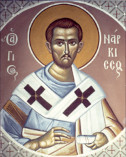 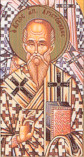 They were of the
Seventy. St. Stachys was a helper of St. Andrew the First-Called, who made him bishop of
Byzantium. He built a church in Argyropolis, and governed his flock with faithfulness and
zeal. After sixteen years as bishop, he entered peacefully into rest in the Lord. Amplias
and Urban were also fellow-workers with St. Andrew, and were made bishop by him, Amplias in
Lydda and Urban in Macedonia. They both died as martyrs for Christ the Lord. Narcissus was
made Bishop of Athens by the Apostle Philip, and holy Apelles was Bishop of Heraklion in
Trachis. Aristobulus, the brother of the Apostle Barnabas, preached the Christian Faith in
Britain and died peacefully there. He is also commemorated on March 16th. |
2. The Holy Martyr Epimachus.
Born in Egypt, he lived there in asceticism, and there finished his earthly course a martyr. In imitation of St. John the Baptist, he went off as a young man into the desert. In response to his great love for God, the Spirit of God instructed him in all truth, and with no other teacher, taught him how to live the ascetic life. Epimachus discovered how the pagans were torturing and slaughtering the Christians in Alexandria, so, all afire with zeal for the Faith, he went to the city and knocked down the idols. When the pagans began to torture him for this, he cried out: ‘Smite me, spit on me, put a crown of thorns on my head and a reed in my hand; give me gall to drink, crucify me and pierce me with a spear. The Lord endured all that, and I want to endure it!’ In the vast crowd that was watching the martyrdom of holy Epimachus, there was one woman with a blind eye. She wept bitterly on witnessing the soulless torture of the man of God, and when the torturers flayed his holy body, blood spurted from it and a drop fell on her eye. Suddenly she could see, and her blind eye became as whole as the other. Then the woman cried out: ‘Great is the God in Whom this sufferer believes!’ After that, St. Epimachus was beheaded and his soul entered into eternal joy, in about 250.
3. The Holy Martyr Nicholas of Chios.
A devout young man and a great zealot for the Christian Faith, Nicholas was born in the village of Karyes on the island of Chios. He was tortured and beheaded by the Turks in 1754, and gave his righteous soul into God’s hands.
4. Our Holy Fathers Spiridon and Nicodemus.
They were monks and prosphora-makers in the Monastery of the Caves in Kiev. Spiridon was illiterate, but he knew the whole Psalter by heart and worked miracles during his lifetime. He entered into rest in 1148.
FOR CONSIDERATION
‘He that taketh not his cross and followeth after Me is not worthy of Me’ (Matt. 10:38), says the Lord. Our holy father, the martyr Timothy of Esphigmenou (Oct. 29th) was at first a married man with two daughters. Later, as a monk, he resolved to suffer for Christ, and being already prepared for the road to suffering, asked his abbot’s blessing to return to his village of Kessana, to see his daughters and take leave of them. The abbot did not permit this, fearing that Timothy’s meeting with his daughters would soften him and turn him back from martyrdom for the Faith. But Timothy’s village lay on the way to Propontis, his destination. When he got to his village, he met one of his neighbors, chatted with him and sent greetings to his daughters through him. The neighbor urged him to turn back and see his daughters, and rest a little, but in vain; Timothy took his leave and hurriedly escaped, continuing on his way. His daughters, hearing from the neighbor about their father, hurried after him. And now a rare sight was seen: the daughters were hurrying to overtake and embrace their father, and the father was fleeing from his daughters in order not to sin against the abbot’s command. The daughters moved quickly, but he yet more quickly. The daughters hastened to embrace their father, and Timothy, fleeing from them, hastened to embrace death. The daughters became exhausted and turned back in despair, and the father slipped away. At the time of his death, Timothy asked his spiritual father, Germanos, to return to his village and tell his daughters of their father’s death by martyrdom. Germanos carried out the errand. The Turks beheaded Timothy and threw his body into a river, and Germanos managed to save only one of the martyr’s garments, which he took to Kessana. He found Timothy’s daughters and recounted to them the heroic death of their father, showing them the garment.
Daily Scripture Readings taken from The Orthodox New Testament, translated and published by Holy Apostles Convent, Buena Vista, Colorado, copyright © 2000, used with permission, all rights reserved.
Daily Prologue Readings taken from The Prologue of Ochrid, by Bishop Nikolai Velimirovic, translated by Mother Maria, published by Lazarica Press, Birmingham, England, copyright © 1985, all rights reserved. Edited by Dormition Skete.