

Daily Devotional
Wednesday, October 4, 2034 (NS), September 21, 2034 (OS)
Fast Day. No Meat, Fish, Dairy, Eggs, Alcohol or Olive Oil Allowed.
Wednesday of the Nineteenth Week
The commemoration of the Leave-taking of the Exaltation of the holy Cross, and the holy Apostle Quadratus of the Seventy, and our father among the saints, Demetrios, Metropolitan of Rostov, the Wonder-worker.
Scripture Readings
Paschalion — Movable Calendar
Wednesday of the Nineteenth Week
Epistle
The Reading is from the Epistle of Saint Paul to the Philippians [§ 237].
1 12Brethren, I wish you to know that the things concerning me have come rather to the advancement of the Gospel, 13so that my bonds in Christ have become manifest in all the Prætorium, and to all the rest; 14and the majority of the brethren in the Lord, having become confident by my bonds, more abundantly dare to speak the word without fear. 15Some on the one hand proclaim Christ even because of envy and strife, but some on the other hand also because of good will: 16The former announce Christ out of factiousness, not purely, supposing to bring affliction to my bonds; 17but the latter out of love, knowing that I am set for the defense of the Gospel. 18What then? Only that in every way, whether in pretense or in truth, Christ is announced. And in this I rejoice. Yes, and I will be rejoicing. 19For I know that this shall turn out to my salvation through your entreaty, and the supply of the Spirit of Jesus Christ, 20according to mine earnest expectation and hope, that in nothing shall I be ashamed, but in all boldness, as always, also now Christ shall be magnified in my body, whether by life or by death.
Gospel
The Reading is from the Holy Gospel according to Saint Luke [§ 12]. At that time:
4 1Jesus, full of the Holy Spirit, returned from the Jordan, and was being led in the Spirit into the wilderness, 2for forty days, being tempted by the devil. And in those days He ate nothing; and they having been brought to an end, afterwards He became hungry. 3And the devil said to Him, “If Thou art God’s Son, command this stone that it become bread.” 4And Jesus gave answer to him, saying, “It hath been written: ‘Man shall not live by bread alone, but by every word of God [cf. Deut. 8:3].’” 5And the devil, having brought Him up into a high mountain, showed Him all the kingdoms of the inhabited world in a moment of time. 6And the devil said to Him, “To Thee will I give all this authority, and the glory of them; for to me it hath been delivered up, and to whomsoever I may wish to give it. 7“Thou, therefore, if Thou wilt make obeisance before me, all shall be Thine.” 8And Jesus answered and said to him, “Get thee behind Me, Satan. For it hath been written: ‘Thou shalt make obeisance to the Lord thy God, and Him alone shalt thou worship [cf. Deut. 6:13].’” 9And he brought Him to Jerusalem, and set Him upon the wing of the temple, and said to Him, “If Thou art God’s Son, cast Thyself down from this place. 10“For it hath been written: ‘He shall enjoin His angels concerning Thee, to keep Thee [Ps. 90(91):11],’ 11“and, ‘Upon their hands shall they take Thee up, lest ever Thou strike Thy foot against a stone [Ps. 90(91):12].’” 12And Jesus answered and said to him, “It hath been said, ‘Thou shalt not tempt the Lord thy God [Deut. 6:16].’” 13And after the devil brought to an end every temptation, he departed from Him until an opportune time.
14And Jesus returned in the power of the Spirit into Galilee; and a common report concerning Him went out throughout all the country round about. 15And He was teaching in their synagogues, being glorified by all.
Menaion — Fixed Calendar
The commemoration of the Leave-taking of the Exaltation of the holy Cross, and the holy Apostle Quadratus of the Seventy, and our father among the saints, Demetrios, Metropolitan of Rostov, the Wonder-worker.
Epistle
The Reading is from the Epistle of Saint Paul to the Hebrews [§ 318]. Brethren:
7 26Such a High Priest was fitting for us: holy, guileless, undefiled, Who hath been separated from the sinners and hath become higher than the heavens, 27Who hath no need daily, even as the high priests, to offer up sacrifices, first for his own sins, then for those of the people; for this He did once for all after He offered up Himself. 28For the law appointeth men high priests who have weakness; but the word of the oath, which is after the law, appointeth the Son, Who hath been perfected forever.
8 1Now in reference to the things being spoken of, the chief point is: We have such a High Priest, Who sat down on the right of the throne of the majesty in the heavens, 2a Liturgist of the holies and of the tabernacle, the true one, which the Lord pitched, and not man.
Gospel
The Reading is from the Holy Gospel according to Saint John [§ 36]. The Lord said to the Jews who had come to Him:
10 9“I am the door; by Me if anyone should enter, he shall be saved, and shall go in and go out and find pasture. 10“The thief cometh not, except that he might steal, and slay, and destroy. I came that they may have life, and may have it abundantly. 11“I am the good shepherd. The good shepherd layeth down his life for the sheep. 12“But the hireling, who indeed is not a shepherd, whose own the sheep are not, seeth the wolf coming, and leaveth the sheep and fleeth; and the wolf seizeth them and scattereth the sheep. 13“Now the hireling fleeth, because he is a hireling and careth not about the sheep. 14“I am the good shepherd; and I know those that are Mine, and am known of those that are Mine. 15“Even as the Father knoweth Me, I also know the Father; and I lay down My life for the sheep. 16“And I have other sheep which are not of this fold; them also it is needful for Me to bring, and they shall hear My voice; and there shall be one flock and one Shepherd.”
Lives of the Saints (Prologue)
October 4th – Civil Calendar
September 21st – Church Calendar
1. The Holy Apostle Codratus.
One of the Seventy, he was a disciple of the great apostles. He preached the Gospel in Athens, and was at first bishop in Athens after St. Publius, and then in the city of Magnesia. He was very learned in the secular disciplines and rich with the grace of the Holy Spirit. His biographer says of him. ‘He was as a morning star among clouds,’ the clouds being the darkness of Hellenic paganism, lacking the light of devotion, and the holy Apostle Codratus shone to them—the Hellenes—as a great light, illumining the darkness, casting down the foul sacrifices and destroying demonic temples by his prayers. But darkness always hates the light, and the pagans hated holy Codratus. They first stoned him, as the Jews had earlier stoned St. Stephen, and then imprisoned him, leaving him without bread until his holy soul left his body and entered into the kingdom of Christ his God. St. Codratus wrote a defence of Christianity and gave it to the Emperor Hadrian. This defence acted so strongly upon the pagan emperor that he decreed that Christians should not be persecuted without especial cause. Holy Codratus suffered in about 130. He was buried in Magnesia, the place of his passion.
2. St. Dimitri, Bishop of Rostov.
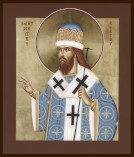 He is commemorated on October 28th, and on this
day is commemorated the finding of his wonder-working relics in 1752. |
FOR CONSIDERATION
If we begin, with firm intention, to live according to God’s law, we must not fear any sort of attack by those who do not understand, for to him who has truly begun to live according to God’s law, all that happens to him at the hands of men, happens for his help and to the glory of God. It is especially necessary not to fear a move from a place we like to a place we dislike, a place of fear and of a depressed uncertainty about God’s intentions towards us. Did the wickedness of Joseph’s brethren do him harm? Was not rather his involuntary departure for Egypt the means of his rise to glory, the saving of his brothers from famine and the establishing of the conditions for all the wonderful works of God through Moses in Egypt and in the wilderness? Pagans and heretics often chased Orthodox Christians into barbarian regions. What happened then? Did this annihilate Orthodoxy? No; it rather confirmed it in the souls that were exiled and scattered among the barbarian peoples. The evil heretic Lucius drove the famous Makarios and several of the Tabennisiot hermits out of Egypt to a barbarian island, where all the inhabitants were idol-worshipers. But these holy men, by their teaching and example, quickly succeeded in baptising the whole island, and it later became known as the Isle of Repentance.
Daily Scripture Readings taken from The Orthodox New Testament, translated and published by Holy Apostles Convent, Buena Vista, Colorado, copyright © 2000, used with permission, all rights reserved.
Daily Prologue Readings taken from The Prologue of Ochrid, by Bishop Nikolai Velimirovic, translated by Mother Maria, published by Lazarica Press, Birmingham, England, copyright © 1985, all rights reserved. Edited by Dormition Skete.