

Daily Devotional
Saturday, September 23, 2034 (NS), September 10, 2034 (OS)
No Fasting.
The Saturday Before The Exaltation of The Cross
Saturday of the Seventeenth Week
The commemoration of the Afterfeast of the Nativity, and the Martyrs Menodora, Metrodora, and Nymphodora.
Scripture Readings
Special Commemorations
The Saturday Before The Exaltation of The Cross
Epistle
The Reading is from the First Epistle of Saint Paul to the Corinthians [§ 126]. Brethren:
2 6We speak wisdom among the perfect, but a wisdom not of this age, nor of the rulers of this age, who are coming to nought. 7But we speak God’s wisdom in a mystery, which hath been hidden and which God foreordained before the ages to our glory, 8which not one of the rulers of this age hath known; for if they had known, they would not have crucified the Lord of the glory. 9But even as it hath been written: “Eye hath not seen, and ear hath not heard, and neither hath it entered into the heart of man the things which God prepared for those who love Him [cf. Is. 64:4].”
Gospel
The Reading is from the Holy Gospel according to Saint Matthew [§ 39]. The Lord said:
10 37“The one who loveth father or mother more than Me is not worthy of Me; and the one who loveth son or daughter more than Me is not worthy of Me. 38“And whosoever taketh not his cross and followeth after Me is not worthy of Me. 39“The one who findeth his life shall lose it; and the one who loseth his life on account of Me shall find it. 40“The one who receiveth you receiveth Me, and the one who receiveth Me receiveth the One Who sent Me forth. 41“The one who receiveth a prophet in the name of a prophet shall receive a prophet’s reward; and the one who receiveth a righteous man in the name of a righteous man shall receive a righteous man’s reward. 42“And whosoever shall give to one of these little ones only a cup of cold water to drink in the name of a disciple, verily I say to you, in no wise shall he lose his reward.”
11 1And it came to pass, when Jesus finished commanding His twelve disciples, He passed over from that place to teach and preach in their cities.
Paschalion — Movable Calendar
Saturday of the Seventeenth Week
Epistle
The Reading is from the First Epistle of Saint Paul to the Corinthians [§ 156].
14 20Brethren, cease becoming children in your minds, but be ye infants in malice; and keep on becoming mature in your minds. 21In the law it hath been written: “By other tongues and by other lips will I speak to this people; and not even thus will they hear Me [cf. Is. 28:11, 12],” saith the Lord. 22Therefore tongues are for a sign, not to those who believe, but to the unbelievers; and prophecy is not for the unbelievers, but to those who believe. 23If therefore the whole church should come together in the same place, and all be speaking with tongues, and those who are unlearned or unbelievers should come in, will they not say that ye are mad? 24But if all be prophesying, and some unbeliever or one unlearned should come in, he is reproved by all, he is examined by all. 25And thus are the secrets of his heart become manifest; and so falling upon his face, he will make obeisance to God, reporting that God is verily among you.
Gospel
The Reading is from the Holy Gospel according to Saint Matthew [§ 104]. The Lord said this parable:
25 1“The kingdom of the heavens shall be likened to ten virgins, who took their lamps and went forth to meet the bridegroom. 2“And five of them were prudent, and five were foolish. 3“Those who were foolish took lamps for themselves and took no oil with them; 4“but the prudent took oil in their vessels with their lamps. 5“But while the bridegroom tarried, they all dozed and went on sleeping. 6“But in the middle of the night, there came to pass a cry, ‘Behold, the bridegroom cometh; go ye out to meet him!’ 7“Then all those virgins were wakened and trimmed their lamps. 8“And the foolish said to the prudent, ‘Give us of your oil, for our lamps are going out.’ 9“But the prudent answered, saying, ‘Peradventure there might not be enough for us and you, but go rather to those who sell, and buy for yourselves.’ 10“But while they went away to buy, the bridegroom came, and they who were ready went in with him to the wedding festivities; and the door was shut. 11“And afterwards the remaining virgins came also, saying, ‘Lord, lord, open to us.’ 12“But he answered and said, ‘Verily I say to you, I know ye not.’ 13“Be watching then, for ye know not the day nor the hour in which the Son of Man cometh.”
Menaion — Fixed Calendar
The commemoration of the Afterfeast of the Nativity, and the Martyrs Menodora, Metrodora, and Nymphodora.
No readings given.
Lives of the Saints (Prologue)
September 23rd – Civil Calendar
September 10th – Church Calendar
1. The Holy Martyrs Menodora, Metrodora and Nymphodora.
They were three sisters from some place in Asian Bithynia. Brought up in a Christian spirit, they withdrew from the city into the desert, desiring to lift up their minds to God and free themselves from the illusory world, and thus to live their lives with purity and virginity as true brides of Christ. They gave themselves to fasting, prayer and toil, and God adorned them with the gift of wonder-working. When people began to bring the sick to them for healing, they became known against their will. A certain governor, Fronton, heard of them and brought them to trial. Seeing them, the governor was amazed at their beauty, for, although they were nuns and their bodies were withered, their faces were radiant, illumined by an inner peace and the grace of God. The governor at first flattered them and promised to send them to the emperor, who would give them in marriage to his nobles, but when he realized that his flattery and promises were having no effect on these brides of Christ the Lord, he ordered that Menodora be put to torture and her sisters be thrown into prison. After harsh torture, the governor cried to Menodora, all wounded and covered in blood: ‘Offer sacrifice to the gods!’ To this the holy martyr replied: ‘Don’t you see that I am doing nothing but offering myself in sacrifice to my God?’ When she expired under torture, the governor brought out her two sisters and stood them beside Menodora’s dead body, and pointing to it, urged them to deny Christ. As they remained steadfast, he tortured them to death. At that, a thunderbolt fell from the sky and killed the soulless Fronton and his servants. Christians buried the bodies of these holy martyrs, who suffered some time between 305 and 311, in the time of Galerius, and entered into rest in the kingdom of Christ.
2. St. Pulcheria the Empress.
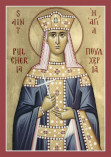 Daughter of the Emperor Arkadios, she vowed to remain in
perpetual virginity, and as an earnest of this vow, had a table of gold and precious stones
made for the cathedral. She reigned together with her brother Theodosios the Younger, and
was greatly zealous for the Orthodox Faith. It was at her instigation that the Third
Ecumenical Council in Ephesus was summoned, which condemned the Nestorian heresy. She built
the famous church of the Mother of God at Vlachernai in Constantinople. After
Theodosios’ death, she married Marcian, who was chosen as emperor, and lived with him
as a brother. It was she who found the relics of the Forty Martyrs of Sebaste. She entered
into rest in the Lord on September 10th, 453, at the age of fifty-five. |
3. Ss. Apollos, Lucius and Clement.
Apostles among the Seventy: Apollos (Acts 18:24-25) was bishop in Smyrna before St. Polycarp. St. Lucius (Rom. 16:21) was bishop in Laodicea and St. Clement was bishop in Sardis.
4. The Three Holy Women of Constantinople.
A noblewoman of Constantinople with her two handmaids, they scorned the vanity of the world and withdrew to solitude, where, after eleven years of asceticism, they entered into rest in the Lord.
FOR CONSIDERATION
The examples of courage and endurance that are given by the Christian martyrs—thousand upon thousand of them—shine with radiant glory through every page of the history of the Christian Church. But, as the examples of voluntary martyrs are given us to marvel at, so also (and no less) are the examples of the Christian ascetics, known and unknown, for asceticism is nothing other than a long-drawn-out martyrdom. Paul, Bishop of Monemvasia, has given to posterity the instructive example of a group of women ascetics. While he was still a layman and a tax-collector, he happened to stay in a monastery. Seeing ravens set about the fruit trees, stealing the fruit and carrying it off, he was curious, and together with the monks, set off after them to see where they were carrying the fruit. Going thus, they came to an impenetrable forest, into the depths of which the ravens disappeared, left their stolen fruit and quickly returned. Exploring, they found a cave, and in it, three nuns. The eldest of them told him of their life: how she had been a Constantinopolitan noblewoman whose husband had died and whom another noble had wanted to take by force as his wife. But she had decided, after her husband’s death, that she would spend the rest of her life in virginity, and had therefore given her goods away to the poor, and with her two handmaids, had fled to this remote spot. They had spent eleven years there in fasting and prayer, seeing no one and seen of no one but God. He, in His providence, had arranged for birds to bring them fruit to eat. They then begged the abbot to bring them holy Communion. When they had received Communion, three days later, all three holy women entered into rest, and the monks buried them.
Daily Scripture Readings taken from The Orthodox New Testament, translated and published by Holy Apostles Convent, Buena Vista, Colorado, copyright © 2000, used with permission, all rights reserved.
Daily Prologue Readings taken from The Prologue of Ochrid, by Bishop Nikolai Velimirovic, translated by Mother Maria, published by Lazarica Press, Birmingham, England, copyright © 1985, all rights reserved. Edited by Dormition Skete.