

Daily Devotional
Thursday, August 31, 2034 (NS), August 18, 2034 (OS)
No Fasting.
Thursday of the Fourteenth Week
The commemoration of the Afterfeast of the Dormition, and the holy Martyrs Florus and Laurus.
Scripture Readings
Paschalion — Movable Calendar
Thursday of the Fourteenth Week
Epistle
The Reading is from the Epistle of Saint Paul to the Galatians [§ 198].
1 1Paul, an apostle (not from men, neither through man, but through Jesus Christ, and God the Father, Who raised Him from the dead), 2and all the brethren with me, to the churches of Galatia: 3Grace to you and peace from God the Father and our Lord Jesus Christ.... 20Now the things which I write to you, behold, before the face of God, I lie not. 21Afterwards I came into the regions of Syria and Cilicia. 22And I was unknown by face to the churches of Judæa which are in Christ. But they were hearing only that “the one who once persecuted us now preacheth the faith as good tidings which once he used to ravage.” 23And they were glorifying God in me.
2 1Then after fourteen years, I went up again to Jerusalem with Barnabas, and took Titus with me also. 2And I went up according to revelation, and I laid before them the Gospel which I proclaim among the nations, but privately to those who were of repute, lest in any way I should be running, or ran, in vain. 3But not even Titus who was with me, being a Greek, was compelled to be circumcised. 4Now on this account false brethren were introduced privily—who came in secretly to spy out our freedom which we have in Christ Jesus—in order that they might bring us into bondage to themselves; 5to whom we did not yield submission even for an hour, in order that the truth of the Gospel might continue with you.
Gospel
The Reading is from the Holy Gospel according to Saint Mark [§ 19]. At that time:
5 1Jesus came to the other side of the sea, into the country of the Gergesenes. 2And after He came forth out of the ship, straightway there met Him out of the sepulchers a man with an unclean spirit, 3who had his dwelling among the sepulchers; and no one was able to bind him, not even with chains, 4because he often had been bound, and the chains had been torn asunder by him, and the fetters had been broken in pieces, and no one was able to tame him. 5And throughout the night and day, he was in the mountains and in the sepulchers, crying out and cutting himself to pieces with stones. 6But after he saw Jesus from afar, he ran and made obeisance to Him. 7And he cried out with a loud voice and said, “What is it to me and to Thee, Jesus, Son of God the Most High? I adjure Thee by God, do not begin to torment me.” 8For He was saying to him, “Come forth, thou spirit, the unclean one, out of the man!” 9And He was questioning him, “What is thy name?” And he answered, saying, “Legion is my name, because we are many.” 10And he was beseeching Him much that He would not send them away outside the country. 11Now there was there toward the mountains a great herd of swine feeding. 12And all the demons besought Him, saying, “Send us to the swine, that we might enter into them.” 13And straightway Jesus gave them leave. And the spirits, the unclean ones, went out and entered into the swine (now they were about two thousand); and the herd rushed down the cliff into the sea, and they were drowned in the sea. 14And they who fed the swine fled, and brought back tidings to the city and to the country. And they went out to see what it was that had taken place. 15And they came to Jesus, and beheld the one who had been possessed by demons and had the legion, sitting and clothed and of sound mind; and they were afraid. 16And they who saw related to them how it happened to the one who had been possessed by demons, and concerning the swine. 17And they began to beseech Him to depart from their borders. 18And while He embarked into the ship, the one who had been possessed by demons was beseeching Him that he might be with Him. 19And Jesus did not allow him, but saith to him, “Go to thy house and to thine own, and bring tidings to them how much the Lord did for thee, and pitied thee.” 20And he departed and began to proclaim in Decapolis how much Jesus did for him; and all were marvelling.
Menaion — Fixed Calendar
The commemoration of the Afterfeast of the Dormition, and the holy Martyrs Florus and Laurus.
Epistle
The Reading is from the Epistle of Saint Paul to the Colossians [§ 252]. Brethren:
1 24Now I rejoice in my sufferings on behalf of you, and fill up the things lacking of the afflictions of the Christ in my flesh, on behalf of His body, which is the Church, 25of which I became a minister, according to the dispensation of God which is given to me for you, to fulfill the word of God, 26the mystery which hath been hidden from the ages and from the generations, but now is made manifest to His saints, 27to whom God willed to make known what is the wealth of the glory of this mystery among the nations, which is Christ in you, the hope of the glory, 28Whom we announce, admonishing every man and teaching every man in all wisdom, in order that we might present every man perfect in Christ Jesus; 29for which I also labor, struggling according to the energy of Him Who Himself energizeth in me in power.
2 1For I wish you to know how great a struggle I have for you, and for those in Laodicea, and for as many as have not seen my face in the flesh.
for Sl. usage, see [Eph. 6:10-17].
Gospel
The Reading is from the Holy Gospel according to Saint Luke [§ 63]. The Lord said to His disciples:
12 2“There is nothing which hath been covered up which shall not be uncovered, nor hidden which shall not be known. 3“Wherefore, whatsoever ye said in the darkness shall be heard in the light; and what ye spoke in the ear in the closets shall be proclaimed upon the housetops. 4“And I say to you, My friends, do not become afraid because of those who kill the body, and after these things are not able to do anything more. 5“But I will show you Whom ye should fear: fear the One Who after the killing hath power to cast into Gehenna; yea, I say to you, this One fear. 6“Five sparrows are sold for two assaria, are they not? And not one of them is forgotten before the face of God. 7“Yea, even the hairs of your head have all been numbered. Therefore cease being afraid; ye excel many sparrows. 8“But I say to you, everyone who shall confess in Me before men, the Son of Man also shall confess in him before the angels of God. 9“But the one who denieth Me before the face of men shall be denied before the face of the angels of God. 10“And everyone who shall speak a word against the Son of Man, it shall be forgiven him; but to the one who blasphemeth against the Holy Spirit it shall not be forgiven. 11“And whenever they bring you in before the synagogues and the rulers and the authorities, cease being anxious how or what ye should speak in defense, or what ye should say; 12“for the Holy Spirit shall teach you in the same hour what things it is needful to say.”
Lives of the Saints (Prologue)
August 31st – Civil Calendar
August 18th – Church Calendar
1. Our Holy Father John of Rila.
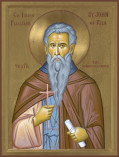 This great ascetic and light of the Orthodox Church was born
near Sophia, in a place called Skrino, in the time of the Emperor Boris. He was born of poor but
worthy parents. After their death, he became a monk and withdrew to a high mountain, where he
began to live the ascetic life in a cave. He endured many assaults both by demons and men, from
robbers and from his kinsmen. He afterwards moved to the mountain of Rila, and there took up
residence in a hollow tree. He ate only the herbs and berries that grew, by God’s
providence, in the vicinity. He saw no man’s face for many years until, again by
God’s providence, he was found by a herdsman searching for his lost sheep. The saint then
became known among men, and people began to come to him, seeking help in sickness or trouble. The
Bulgarian king, Peter, himself visited him, to ask his advice. Many who were seeking the
spiritual life settled near to John, and a church and monastery were soon built there. St. John
entered into rest in the Lord on August 18th, 946, at the age of seventy, and appeared to his
disciples after his death. His relics were first taken to Sophia, then to Hungary, to Trnovo and
finally to the monastery of Rila, where they are preserved to this day. The monastery of Rila
has, through the ages, been a lighthouse and a place of wonder-working power and spiritual
support to the Christian people of Bulgaria, most especially during the time of slavery under the
Turks.
2. The Holy Martyrs Florus and Laurus.
Brothers in both the flesh and the spirit, they were both zealous Christians, and stonemasons by craft. They lived in Illyria. Some pagan prince set them to build a pagan temple. It happened during the course of their work that a fragment of stone splintered off and flew into the eye of the pagan priest’s son, who was watching the building work with curiosity. Seeing his son blinded and bleeding, the priest shouted at Florus and Laurus and tried to thrash them. Then the holy brothers told him that, if he would believe in the God in Whom they believed, his son would be restored to health. The priest promised. Florus and Laurus prayed to the one, living Lord with tears and made the sign of the Cross over the child’s stricken eye. The child was healed instantly and his eye became whole as it had been before. Then the priest, Merentios, and his son were baptized, and they both very soon suffered for Christ in the flames. But Florus and Laurus, when they had finished the temple, put a Cross on it, called together all the Christians and consecrated it in the name of the Lord Jesus with an all-night vigil of hymns. Hearing of this, the governor of Illyria burned many of these Christians by fire and had Florus and Laurus thrown alive into a well, which was then filled with earth. Their relics were later discovered and taken to Constantinople. These two wonderful brothers suffered for Christ, and were glorified by Him, in the second century.
3. The Hieromartyr Emilian the Bishop.
He was born in Armenia. He sought martyrdom, and went to Italy to preach Christ in the time of Diocletian, being chosen as bishop in Trevi. Through the many miracles associated with his martyrdom, about a thousand pagans came to faith in Christ. He was slain with the sword along with his spiritual father, Hilary, and two brothers, Dionysius and Hermippus.
FOR CONSIDERATION
It is not a rare occurrence, especially in our day, for parents to be responsible for their children’s spiritual death. Whenever a child aspires to the spiritual life and its asceticism in monasticism, and the parent resists this aspiration instead of encouraging it, such a parent is the murderer of his child. And such children—as a punishment to their parents—often go to the other extreme and become dissolute. A child called Luke, nephew to St. John of Rila, heard of his uncle, and urged by a desire for the spiritual life, visited him on his mountain. John received him with love, and began to instruct him and accustom him to asceticism. But Luke’s father appeared one day at John’s cave, and furiously began to scold the saint for keeping his son in this desert place. John’s words and advice were of no avail. The father withdrew his son by force and took him home. On the way, a snake bit the boy and he died. The cruel father came to see the punishment of God in this, and repented, but it was all too late. He returned to John with grief and self-accusation, but the saint only told him to bury the child and return whence he had come.
Daily Scripture Readings taken from The Orthodox New Testament, translated and published by Holy Apostles Convent, Buena Vista, Colorado, copyright © 2000, used with permission, all rights reserved.
Daily Prologue Readings taken from The Prologue of Ochrid, by Bishop Nikolai Velimirovic, translated by Mother Maria, published by Lazarica Press, Birmingham, England, copyright © 1985, all rights reserved. Edited by Dormition Skete.