

Daily Devotional
Thursday, August 17, 2034 (NS), August 4, 2034 (OS)
Fast Day. No Meat, Fish, Dairy, Eggs, Alcohol or Olive Oil Allowed.
Thursday of the Twelfth Week
The commemoration of the holy Seven Youths ("the Seven Sleepers") of Ephesus: Maximilianos, Exakoustodianos, Iamvlichos, Martinianos, Dionysios, John, and Constantine.
Scripture Readings
Paschalion — Movable Calendar
Thursday of the Twelfth Week
Epistle
The Reading is from the Second Epistle of Saint Paul to the Corinthians [§ 183]. Brethren:
7 1Let us cleanse ourselves from all defilement of flesh and spirit, bringing to perfection holiness in the fear of God.
2Make room for us; we wronged no one, we corrupted no one, we defrauded no one. 3I speak not for condemnation; for I have said before that ye are in our hearts, to die together and to live together. 4Great is my boldness toward you, great is my boasting on your behalf; I have been filled with comfort, I am superabounding with joy over all our affliction. 5For, even after we came into Macedonia, our flesh hath had no rest, but in every way we were being oppressed: fights from outside, and fears from inside. 6But God, the One Who comforteth the humble, comforted us by the coming of Titus; 7and not by his coming only, but also by the comfort with which he was comforted over you, when he brought back tidings of your yearning, your mourning, your zeal for me; so as for me to rejoice the more. 8For though I sorrowed you in the epistle, I do not feel regret, though I was feeling regret; for I see that the epistle sorrowed you, though for an hour. 9Now I rejoice, not that ye were sorrowed, but that ye were sorrowed to repentance; for ye were sorrowed in accordance with God, that ye might suffer loss by us in nothing. 10For the sorrow in accordance with God worketh out repentance to salvation, not to be regretted.
Gospel
The Reading is from the Holy Gospel according to Saint Mark [§ 5]. At that time:
1 29Jesus came into the house of Simon and Andrew, with Iakovos and John. 30And the mother-in-law of Simon was lying down ill with a fever. And straightway they speak to Him about her. 31And He came and took hold of her hand, and raised her up. And immediately the fever left her, and she began ministering to them. 32And evening having come to pass, when the sun did set, they kept on bringing to Him all those who were ill, and those possessed by demons. 33And the whole city was gathered together at the door. 34And He cured many who were ill with various diseases, and cast out many demons; and He was not allowing the demons to talk, because they knew Him.
35And having risen up very early at night, He went out and departed into a desolate place, and was praying there.
Menaion — Fixed Calendar
The commemoration of the holy Seven Youths ("the Seven Sleepers") of Ephesus: Maximilianos, Exakoustodianos, Iamvlichos, Martinianos, Dionysios, John, and Constantine.
No readings given.
Lives of the Saints (Prologue)
August 17th – Civil Calendar
August 4th – Church Calendar
1. The Seven Holy Youths of Ephesus.
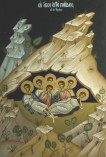 There was a great persecution of
Christians under the Emperor Decius. The emperor himself went to Ephesus, and there prepared a
riotous festival in honor of dead idols and also a vicious slaughter of Christians. Seven youths,
all of them soldiers, held themselves apart from the foul offering of sacrifice, and
wholeheartedly begged the one God to save the Christian people. They were the sons of the most
eminent nobles in Ephesus, and their names were: Maximilian, Iamblichus, Martinian, John,
Dionysius, Exacustodian, and Antoninus. When they were accused before the emperor, they hid on a
hill called Ochlon outside Ephesus, concealing themselves in a cave. When the emperor discovered
this, he commanded that the cave be walled-in. God then, in His far-seeing providence, let a
miraculous and long-lasting sleep fall on the young men. The imperial courtiers Theodore and
Rufinus, secret Christians, caused a copper catafalque with leaden plaques to be made, on which
were written the names of these young men and their death by martyrdom under the Emperor Decius.
One hundred ninety-four years then passed. In the time of the Emperor Theodosios the Younger
(408-450), there arose a great dispute about the resurrection of the dead, for there were some
who doubted the resurrection. Emperor Theodosios was greatly grieved at this dispute among the
faithful, and prayed God that He would in some way reveal the truth to the people. At that time
of altercation in the Church, some shepherds of a certain Adolios, who owned Ochlon, began
building pens for their sheep and took stone after stone from this cave. Then the youths awoke
from their sleep, young and in full health as they had fallen asleep. This marvel was noised
abroad on all sides, and Theodosios himself came with a great retinue and spoke apart with the
young men. After a week, they prayed to God to take them from the clamor of the world, and again
entered into sleep, the sleep of death, to await the general resurrection. The emperor wanted to
place their bodies in golden coffins, but they appeared to him in a dream and told him to leave
them in the earth, as they had been.
2. The New-Hieromartyr Kosmas, Equal to the Apostles.
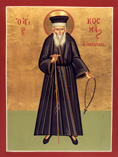 Born in Aitolia, in the village of
Megadendron (Great Tree), he went off to the Holy Mountain as a young man and there, in the
monastery of Philotheou, was tonsured as a monk. But, urged by a constant desire to preach
the Gospel to the people, he went to Constantinople, where he asked the blessing of
Patriarch Seraphim II for this. He visited all the Danube area, preaching the Gospel,
working especially in Albania, where he suffered at the hands of a certain Kurt Pasha, who
was stirred up by the Jews against Kosmas. Kosmas was strangled by the Turks and then cast
into a river, in 1779. His wonder-working relics are preserved in the village of
Kalikontasi, in the church of the holy Mother of God, not far from the town of Berati. He
suffered for his Lord at the age of sixty-five. |
FOR CONSIDERATION
‘Keep on asking, and it shall be given you,’ says the Lord (Matt. 7:7). As parents give to their children all that they ask for that is good for them, so our God, in His love for mankind, gives to men all that they ask of Him that is of aid to their salvation. St. Kosmas, as a monk of the Holy Mountain, begged two things of God: to preach the Gospel to the people and to suffer a martyr for the Faith. For a monk of the Holy Mountain, linked by obedience to his monastery, these two desires might have seemed unlikely of fulfillment. But God is almighty. God perfectly fulfilled both of Kosmas’ desires. His joy when he received the patriarch’s blessing to leave the Holy Mountain and go among the people to preach the Gospel was indescribable, and he had another similar moment of joy when the servants of the Turkish pasha announced that, according to the pasha’s orders, he must die. Full of joy, the saint fell to his knees, thanking God for having fulfilled this wish also, and he gave his body to death and his soul to the living God.
Daily Scripture Readings taken from The Orthodox New Testament, translated and published by Holy Apostles Convent, Buena Vista, Colorado, copyright © 2000, used with permission, all rights reserved.
Daily Prologue Readings taken from The Prologue of Ochrid, by Bishop Nikolai Velimirovic, translated by Mother Maria, published by Lazarica Press, Birmingham, England, copyright © 1985, all rights reserved. Edited by Dormition Skete.