

Daily Devotional
Saturday, July 29, 2034 (NS), July 16, 2034 (OS)
No Fasting.
Saturday of the Ninth Week
The commemoration of Hieromartyr Athenogenes, Bishop of Pedachtoe, and his ten disciples.
Scripture Readings
Paschalion — Movable Calendar
Saturday of the Ninth Week
Epistle
The Reading is from the Epistle of Saint Paul to the Romans [§ 113]. Brethren:
14 6The one who mindeth the day, mindeth it to the Lord; and the one who mindeth not the day, mindeth it not to the Lord. The one who eateth, eateth to the Lord, for he giveth thanks to God; and the one who eateth not, to the Lord he eateth not, and giveth thanks to God. 7For none of us liveth to himself, and no one dieth to himself. 8For if we live, we live to the Lord; and if we die, we die to the Lord. Therefore, whether we live or die, we are the Lord’s. 9For to this purpose Christ both died and rose and came to life again, in order that He might become Lord both of the dead and the living.
Gospel
The Reading is from the Holy Gospel according to Saint Matthew [§ 64]. At that time:
15 32Jesus called to Himself His disciples and said, “I am moved with compassion toward the crowd, because they continue with Me now three days, and have nothing that they might eat. And I am not willing to dismiss them fasting, lest they should be faint in the way.” 33And His disciples say to Him, “From what place should come so many loaves in a wilderness, as to fill so great a crowd?” 34And Jesus saith to them, “How many loaves have ye?” And they said, “Seven, and a few small fish.” 35And He commanded the crowds to recline on the ground. 36And having taken the seven loaves and the fish, He gave thanks and broke them and gave to His disciples, and the disciples to the crowd. 37And they did all eat, and were filled; and they took up of the fragments that which was over and above—seven large provision baskets full. 38And they who ate were four thousand men, apart from women and children. 39And He dismissed the crowds, and embarked into the ship, and came to the borders of Magdala.
Menaion — Fixed Calendar
The commemoration of Hieromartyr Athenogenes, Bishop of Pedachtoe, and his ten disciples.
No readings given.
Lives of the Saints (Prologue)
July 29th – Civil Calendar
July 16th – Church Calendar
1. The Hieromartyr Athenogenes, Bishop of Sebaste in Armenia.
He lived in a monastery near the town with ten of his disciples. In the time of Diocletian, a fierce persecutor of Christians called Philomarchus came to Sebaste. He arrested and killed many of the Christians in the town. When he saw Athenogenes and his disciples, he told the elder to sacrifice to idols, that they should not perish as had the other Christians. Athenogenes replied: ‘O torturer, those whom you describe as having perished have not perished, but are in heaven and make merry with the angels!’ There was a touching moment when a deer, which had been hand-fed by the compassionate Athenogenes, ran up to him, and seeing him in such straits, shed tears. Wild animals of the hills had more pity on the martyrs than did the pagans! After harsh torture, during which an angel of God comforted them, they were all beheaded, first the priests and fellow-workers of Athenogenes and then Athenogenes himself, and went to their heavenly home in the year 311.
2. The Holy Martyr Julia the Virgin.
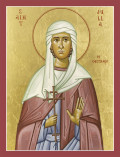 She was born in Carthage of noble parents. When the
Persians overran Carthage, many of the people were taken into slavery. St. Julia was one of
these, and was given to a Syrian merchant, who was a pagan. Seeing that Julia was a Christian, he
urged her many times to deny Christ and become of one faith with him, but Julia steadfastly
refused. As Julia was faithful and reliable in her work, the merchant left her in peace and spoke
no more about faith. One day, the merchant loaded his ship with goods, took Julia with him and
set off across the sea to a distant land to ply his trade. When they arrived at Corsica, there
was a pagan festival in progress, and the merchant took part in the foul idolatry while Julia
remained in the ship, weeping that so many people lived in foolish error, not knowing the truth.
The pagans somehow came to know about her, dragged her off the ship in spite of her owner’s
efforts to prevent them, and began to torture her in terrible ways. They cut off her breasts and
threw her onto the rock, then crucified her, at which Julia gave her soul to God. Her death was
revealed to some monks on the nearby island of Margarita (or Gorgona), and they went and buried
the martyr’s body. Many miracles were worked over St. Julia’s grave through the ages,
and she herself appeared to various people from the other world. She suffered with honor and went
to the kingdom of God in the sixth century.
After many years had passed, the faithful wanted to build a new church in honor of St. Julia in another place, because the old church was small and dilapidated. They prepared the materials: the stone, bricks, sand and everything else that was needed, on the new site. But it happened that, at night, on the night before the day on which the foundations were to be laid, that the materials were carried by invisible hands back to the old church. In great perplexity, the people carried them to the new site again, but again the same thing happened: the materials were taken to the old site and left beside the church. The night watchman saw a maiden bathed in light, using white oxen to carry the materials to the old church. By this, they understood that St. Julia did not wish her church to be built in another place, so they pulled down the old church and built the new one on the same spot.
3. The Fifteen Thousand Holy Martyrs of Persia.
They were beheaded for the Christian Faith in Persia.
4. The Holy Martyr Athenogenes.
The composer of the Vespers hymn ‘O Joyous Light,’ he perished for Christ in the flames and was made worthy of eternal glory in the kingdom of God.
Daily Scripture Readings taken from The Orthodox New Testament, translated and published by Holy Apostles Convent, Buena Vista, Colorado, copyright © 2000, used with permission, all rights reserved.
Daily Prologue Readings taken from The Prologue of Ochrid, by Bishop Nikolai Velimirovic, translated by Mother Maria, published by Lazarica Press, Birmingham, England, copyright © 1985, all rights reserved. Edited by Dormition Skete.