

Daily Devotional
Wednesday, July 26, 2034 (NS), July 13, 2034 (OS)
Fast Day, but Wine and Olive Oil Allowed.
Wednesday of the Ninth Week
The commemoration of the Synaxis of the holy Archangel Gabriel, and our venerable Father Stephen of the Monastery of St. Savvas.
Scripture Readings
Paschalion — Movable Calendar
Wednesday of the Ninth Week
Epistle
The Reading is from the First Epistle of Saint Paul to the Corinthians [§ 154]. Brethren:
13 4Love is long-suffering, is kind; love is not jealous; love vaunteth not itself, is not puffed up; 5doth not behave unseemly, seeketh not its own, is not provoked, thinketh no evil; 6rejoiceth not in unrighteousness, but rejoiceth with the truth; 7covereth all things, believeth all things, hopeth all things, endureth all things. 8Love never falleth away. But whether there be prophesies, they shall be done away; whether tongues, they shall cease; whether knowledge, it shall be done away. 9For we know in part, and we prophesy in part; 10but whenever that which is perfect should come, then that which is in part shall be done away. 11When I was an infant, as an infant I used to talk, as an infant I used to understand, as an infant I used to reason; but when I became a man, I did away with the things of the infant. 12For now we see by means of a mirror, darkly, but then face to face. Now I know in part, but then I shall fully know even as I also was fully known. 13And there now abideth faith, hope, love, these three things; but the greatest of these is love.
14 1Keep on pursuing love and emulously desiring spiritual gifts, but much more that ye may prophesy. 2For the one who speaketh in a tongue, speaketh not to men, but to God; for no one heareth, but in spirit he speaketh mysteries. 3But the one who prophesieth to men speaketh for edification, and exhortation, and consolation. 4The one who speaketh in a tongue edifieth himself; but the one who prophesieth edifieth a church. 5Now I wish for you all to speak in tongues, but much more that ye may prophesy; for greater is the one who prophesieth than the one who speaketh in tongues, unless he be interpreting in order that the Church might receive edification.
Gospel
The Reading is from the Holy Gospel according to Saint Matthew [§ 80]. The Lord said this parable:
20 1“The kingdom of the heavens is like a man, a master of a house, who went out early in the morning to hire for himself laborers for his vineyard. 2“And after he made an agreement with the laborers for a denarius for the day, he sent them forth into his vineyard. 3“And he went out about the third hour and saw others standing idle in the marketplace. 4“And he said to them, ‘Go ye also into the vineyard, and whatsoever is right I will give you.’ And they went forth. 5“Again he went out about the sixth and ninth hour, and did likewise. 6“And about the eleventh hour he went out and found others standing idle, and saith to them, ‘Why stand ye here idle all the day?’ 7“They say to him, ‘Because no one hired us for himself.’ He saith to them, ‘Go ye also into the vineyard, and whatsoever is right ye shall receive.’ 8“And evening having come to pass, the lord of the vineyard saith to his steward, ‘Call the laborers and pay them their hire, beginning from the last unto the first.’ 9“And after they came who were hired about the eleventh hour, they received a denarius apiece. 10“But the first, having come, thought that they should receive more; and they themselves also received a denarius apiece. 11“And after they received their hire, they began to murmur against the master of the house, 12“saying, ‘These last did work but one hour, and thou madest them equal to us who have borne the burden of the day and the heat.’ 13“But he gave answer to one of them and said, ‘Comrade, I do thee no wrong. Thou didst agree with me for a denarius, didst thou not? 14“‘Take that which is thine own and go thy way. But I wish to give to this last one, even as to thee. 15“‘Or is it not lawful for me to do what I wish with mine own things? Or is thine eye evil, because I am good?’ 16“Thus shall the last be first, and the first last; for many are called, but few are chosen.”
Menaion — Fixed Calendar
The commemoration of the Synaxis of the holy Archangel Gabriel, and our venerable Father Stephen of the Monastery of St. Savvas.
Epistle
The Reading is from the Epistle of Saint Paul to the Hebrews [§ 305]. Brethren:
2 2If the word spoken by angels was confirmed, and every transgression and disobedience received a just recompense, 3how shall we escape, if we neglect so great a salvation, which received a beginning to be spoken of by the Lord, and was confirmed to us by those who heard, 4God also bearing them witness with both signs and wonders, and various works of power, and by distributions of the Holy Spirit, according to His will?
5For not to angels did He subject the coming inhabited world about which we speak; 6but one bore witness somewhere, saying, “What is man that Thou art mindful of him or the Son of Man that Thou visitest Him [Ps. 8:4]? 7“Thou didst make Him for a short time less than the angels; Thou didst crown Him with glory and honor [Ps. 8:5], 8“Thou didst subject all things under His feet [Ps. 8:6].” For in subjecting all things to Him, He left nothing not subject to Him. But now we see not yet all things subjected to Him. 9But we see Jesus, Who for a short time was made less than the angels on account of the suffering of death, crowned with glory and honor, so that He, by the grace of God, should taste death for everyone. 10For it was becoming to Him, because of Whom are all things and by means of Whom are all things, bringing many sons to glory, to have perfected the originator of their salvation through sufferings.
Gospel
The Reading is from the Holy Gospel according to Saint Luke [§ 51]. The Lord said to His disciples:
10 16“The one who heareth you heareth Me, and the one who rejecteth you rejecteth Me, and the one who rejecteth Me rejecteth the One Who sent Me forth.”
17And the seventy returned with joy, saying, “Lord, even the demons are being made subject to us in Thy name.” 18And He said to them, “I was beholding Satan as lightning having fallen out of the heaven. 19“Behold, I give you the authority to tread upon serpents and scorpions, and upon all the power of the enemy; and nothing in anywise shall injure you. 20“However cease rejoicing in this, that the spirits are being made subject to you; but be rejoicing that your names were written in the heavens.” 21In the same hour Jesus rejoiced in the Spirit, and said, “I give thanks to Thee, O Father, Lord of the heaven and of the earth, that Thou didst hide these things from the wise and intelligent, and didst reveal them to babes. Yea, Father, for thus it was well-pleasing before Thee.”
Lives of the Saints (Prologue)
July 26h – Civil Calendar
July 13th – Church Calendar
1. The Holy Archangel Gabriel.
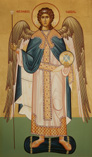 This great archangel of God is commemorated on March 26th. On
this day his appearances and marvels through the whole history of the salvation of mankind are
commemorated. It is reckoned that this observance was first instituted on the Holy Mountain in
982, during the patriarchate of Nicholas Chrysoverges (979-91), and was occasioned by the
Archangel’s appearing in a cell near Karyes, where, with his finger, he wrote the hymn to
the Mother of God: ‘Axion Estin’ (It Is Verily Worthy). As a result of this
occurrence, the cell was named, and is called to this day, ‘Axion Estin’. Linked with
this, other appearances of the Archangel Gabriel are commemorated, such as his appearing to Moses
when he revealed to this great man, chosen by God, how the world was created and all the rest
that Moses later wrote down in the Book of Genesis; his appearing to Daniel and the imparting of
the mystery of the kingdoms to come and the coming of the Savior; his appearing to St. Anna and
the promise of a daughter, the most blessed and pure Virgin Mary; his appearing to the holy
Virgin while she was living in the Temple in Jerusalem; his appearing to Zacharias the high
priest and the news of the birth of John the Forerunner, and the punishing of the same with
dumbness because he did not believe the angel’s words; his appearing once again to the holy
Virgin in Nazareth, and the annunciation of the conception and birth of the Lord Jesus Christ;
his appearing to righteous Joseph, to the shepherds near Bethlehem, to the Lord Himself in the
Garden of Gethsemane when he strengthened the Lord, as Man, before His Passion: his appearing to
the myrrh-bearing women, and his other appearances.
2. St. Julian, Bishop of Cenomanis (Le Mans).
Some think that he is none other than that Simon the Leper whom the Lord healed. The Apostle Peter made him bishop and sent him to pagan Gaul, where St. Julian endured great privation, but succeeded in bringing many of the people to the Christian Faith. When the prince, Defenson, was baptized, many of his subjects embraced the true Faith. By the grace of God, Julian worked many miracles: healing the sick, driving out demons and raising the dead. He departed this life peacefully, and at the time of his death, appeared to Prince Defenson in full daylight, while the latter was at lunch.
3. The Holy Martyr Golinduc.
A Persian, she married a Persian noble and lived three years in wedlock. She then had a vision of an angel, who revealed the other world to her: the torment of sinners and unbelievers and the joy of the righteous. She left her husband and received Baptism, being given the name Maria. As a result of her husband’s persecution, she was condemned to lifelong imprisonment and spent eighteen years in prison, being steadfast in the Faith. She was then thrown into a pit, but was saved by God; then before a venomous snake, but the snake did not harm her. When some wicked youths were sent to her to defile her, God made her invisible to their eyes. Amazed at her sufferings, many Persians were converted to the Christian Faith. She visited Jerusalem, where she denounced the Severian heresy which taught that Christ’s divinity suffered, and therefore recited the Trisagion in this form: ‘Holy God, Holy Mighty, Holy Immortal, Who was crucified for us, have mercy on us.’ Preaching the true Faith up to the end of her life, she died peacefully near the town of Nisibis in 587.
4. Our Holy Father Stephen of St. Sava’s.
Nephew to St. John Damascene, he lived in asceticism in the monastery of St. Sava the Sanctified, and is therefore known as ‘of St. Sava’s’. He was a great imitator of the life of St. Sava and a resplendent star among the monks of Palestine. He entered into rest in the Lord in 794, at the age of sixty-nine.
5. Our Holy Mother Sarah the Egyptian.
She embraced asceticism as a young girl, and thus spent sixty years on the bank of the Nile not far from Alexandria. By her example, she drew many women to the monastic life. She entered into rest in the Lord in 370.
FOR CONSIDERATION
A man adorns simple clothing, but magnificent clothing adorns a man. Simple clothing attracts attention to the man, but magnificent clothing attracts attention only to itself. A passion for magnificent clothing simply dries up and consumes a man’s soul. This is the reason why the Church has always stood against magnificence in dress and urged simplicity. Among the innumerable horde of Christian saints, there is not one commemorated who was helped to sanctity by the magnificence of his apparel. Many great and wise kings, Christian and pagan alike, have loved simplicity of dress. Thus, it is said of the Emperor Augustus Octavius, during whose reign the Lord Jesus was born, that he wore one single garment, woven by his wife, his sister or his daughter. Of the Emperor Charles V it is said that he wore such simple clothing that ordinary citizens, his subjects, were better-dressed. The famous Greek general, Philopomenes, was once invited to lunch by some man, into whose house he had never previously been. Philopomenes arrived rather early. His host had not yet arrived, and his hostess, not knowing him personally and seeing this man in such simple garb, thought that he must be one of Philopomenes’ servants whom he had sent ahead to warn the household of his coming with his host. She therefore set him to chop wood. Philopomenes obeyed willingly, and began to chop the wood. When his host arrived and saw his honored guest thus employed, he was horrified, and asked him: ‘Who ventured to give such a task to Philopomenes?’ The general replied quietly: ‘My clothes.’
Daily Scripture Readings taken from The Orthodox New Testament, translated and published by Holy Apostles Convent, Buena Vista, Colorado, copyright © 2000, used with permission, all rights reserved.
Daily Prologue Readings taken from The Prologue of Ochrid, by Bishop Nikolai Velimirovic, translated by Mother Maria, published by Lazarica Press, Birmingham, England, copyright © 1985, all rights reserved. Edited by Dormition Skete.