

Daily Devotional
Wednesday, July 19, 2034 (NS), July 6, 2034 (OS)
Fast Day. No Meat, Fish, Dairy, Eggs, Alcohol or Olive Oil Allowed.
Wednesday of the Eighth Week
The commemoration of our venerable Father Sisoes the Great.
Scripture Readings
Paschalion — Movable Calendar
Wednesday of the Eighth Week
Epistle
The Reading is from the First Epistle of Saint Paul to the Corinthians [§ 145]. Brethren:
10 12The one who thinketh he standeth, let him take heed lest he should fall. 13No temptation hath taken you except what belongeth to man; but faithful is God, Who will not let you be tempted above what ye are able, but with the temptation will also make the way out, in order that ye may be able to bear up under it.
14On which very account, my beloved, be fleeing from idolatry. 15I speak as to prudent ones; judge ye what I say. 16The cup of blessing which we bless, is it not communion of the blood of the Christ? The bread which we break, is it not communion of the body of the Christ? 17For we, who are many, are one bread, one body; for we all partake of the one bread. 18See Israel according to the flesh: They who eat the sacrifices of the altar are communicants, are they not? 19What say I then? That an idol is anything, or that a sacrifice to idols is anything? 20But I say that what the nations sacrifice they sacrifice to demons, and not to God; and I do not wish you to become communicants of the demons. 21Ye cannot drink the cup of the Lord and the cup of demons; ye cannot partake of the table of the Lord and the table of demons. 22Or do we provoke the Lord to jealousy? We are not stronger than He, are we?
Gospel
The Reading is from the Holy Gospel according to Saint Matthew [§ 68]. At that time:
16 20Jesus gave express orders to His disciples that they should say to no one that He is Jesus the Christ.
21From that time, Jesus began to show to His disciples that it is necessary for Him to go away to Jerusalem, and to suffer many things from the elders and chief priests and scribes, and to be killed, and to be raised the third day. 22And Peter took Him to himself and began to rebuke Him, saying, “May God be gracious to Thee, Lord; this in no wise shall be to Thee.” 23But He turned and said to Peter, “Get thee behind Me, Satan; thou art an offense to Me, for thou mindest not the things of God, but the things of men.” 24Then Jesus said to His disciples, “If anyone is willing to come after Me, let him deny himself, and take up his cross, and keep on following Me.”
Menaion — Fixed Calendar
The commemoration of our venerable Father Sisoes the Great.
No readings given.
Lives of the Saints (Prologue)
July 19th – Civil Calendar
July 6th – Church Calendar
1. Our Holy Father Sisoës the Great.
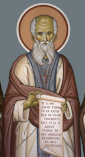 An Egyptian by birth, he lived
at first in Sketis then, after St. Anthony’s death, settled on the desert mountain on which
Anthony had earlier lived in asceticism and which was named after him. He learned humility
through great struggles with himself, becoming meek and guileless as a lamb. Therefore God gave
him the great gifts of healing the sick, driving out unclean spirits and raising the dead.
Sisoës lived in the desert for sixty years, and was a fount of living wisdom for all the
monks and lay folk who came to him for advice. At the time of his death, his face shone like the
sun. The monks stood around him and marvelled at this sight, and when the saint gave up his soul,
the whole chamber was filled with a wonderful fragrance. He entered into rest in great old age,
in about 429. St. Sisoës taught his monks: ‘When temptation comes to a man, that man
must give himself over to the will of God, and acknowledge that the temptation comes upon him
because of his sins. If something good comes to pass, he must acknowledge that it comes about by
the providence of God.’ A monk asked him: ‘How can I please God and be saved?’
The saint replied: ‘If you desire to please God, withdraw from the world, separate yourself
from the earth, leave aside creation and draw near to the Creator, unite yourself to God with
prayers and tears, and you will find rest in this world and in the next.’ A monk asked
Sisoës: ‘How can I acquire humility?’ The saint replied: ‘When a man
learns to regard every man as better than himself, he thus acquires humility.’ Ammon
complained to Sisoës that he could not memorise the wise sayings that he had read, to be
able to quote them in conversation with others. The saint replied: ‘It is not necessary.
That which is necessary is to acquire purity of mind and to speak from this purity, placing
one’s hope in God.’
2. The Holy Martyrs Marinus and Martha, with their sons Audifax and Habakkuk, the Priest Valentine, Cyrinus, Asterius and many others.
They all suffered in the time of the Emperor Claudius Flavius in Rome, in the year 269. Marinus and Martha were rich Persians, who had sold all their goods in Persia and gone with their sons to Rome to venerate the relics of the holy apostles and other martyrs. When the emperor asked them why they had come such a distance, forsaking their household gods to seek the dead in Rome, they replied: ‘We are servants of Christ, and are come to venerate the holy apostles whose immortal souls are alive with God, that they may be our intercessors with Christ our God.’ Cyrinus was thrown into the Tiber, whence Marinus retrieved his body and buried it. The priest Valentine was committed to a General Asterius, whose task it was to urge him to deny Christ. But Valentine healed Asterius’ daughter, who had been blind for two years, by his prayers, and then baptized Asterius and his whole household. These all, in diverse ways, received torture and death for Christ the Lord, Who welcomed them into His immortal kingdom to rejoice eternally.
3. The Finding of the Relics of St. Juliana the Virgin.
The daughter of a prince of Olshansk, Juliana died in about 1540, as a girl of sixteen. Two hundred years after her death, some men digging a grave near the great church in a monastery in Kiev found the relics of this holy virgin, whole and incorrupt as though she had just fallen asleep. Many wonders were worked over these relics, and Juliana herself appeared several times to various people. The famous Peter Moghila was one of those who saw her.
4. The Holy Martyr Lucy.
The barbarian King Austius made her a slave in Campania. He wanted to have her live with him, but she resisted. The king left her in peace, to live in asceticism. She brought the king to the Faith because, by her prayers, he was victorious in battle. Later, they both suffered for Christ in Rome, in about 300.
FOR CONSIDERATION
Whence do we know that there is life after death? We know from Christ the Lord, on the foundation of His words, His Resurrection and His appearances after His death. Philosophers who recognize life after death accept it on the foundation of their own reasoning, but we recognize it on the foundation of experience, especially the experience of holy men and women who were unable to proclaim a lie. When St. Sisoës lay on his deathbed, his face was suffused with light. The monks, his disciples, stood around him. Suddenly the saint’s gaze became intent, and he said: ‘Behold, the prophets are coming!’ His countenance became yet more radiant, and he said: ‘Behold, the apostles are coming!’ Then he said: ‘Behold, the angels are coming to take my soul!’ Finally, his face shone like the sun and all were in great fear, then the elder said: ‘Behold, the Lord is coming; look, all of you! Listen! He’s saying: “Bring Me the chosen vessel from out of the wilderness”!’ After this, the saint gave up his soul. How many similar visions have there been—and all by reliable witnesses!
Daily Scripture Readings taken from The Orthodox New Testament, translated and published by Holy Apostles Convent, Buena Vista, Colorado, copyright © 2000, used with permission, all rights reserved.
Daily Prologue Readings taken from The Prologue of Ochrid, by Bishop Nikolai Velimirovic, translated by Mother Maria, published by Lazarica Press, Birmingham, England, copyright © 1985, all rights reserved. Edited by Dormition Skete.