

Daily Devotional
Thursday, July 13, 2034 (NS), June 30, 2034 (OS)
No Fasting.
Thursday of the Seventh Week
| The commemoration of the Synaxis of the holy, glorious, and all-praised Twelve Apostles. |
Scripture Readings
Paschalion — Movable Calendar
Thursday of the Seventh Week
Epistle
The Reading is from the First Epistle of Saint Paul to the Corinthians [§ 138].
7 24Brethren, wherein each was called, in this let him abide with God.
25Now concerning the virgins, I have no command of the Lord, but I give an opinion, as one who hath been shown mercy by the Lord to be faithful. 26I think therefore this to be good on account of the present necessity—that for a man to be so is good. 27Hast thou been bound to a wife? Cease seeking to be loosed. Hast thou been loosed from a wife? Cease seeking a wife. 28But even if thou marry, thou hast not sinned. And if the virgin should marry, she did not sin. But such shall have affliction in the flesh, but I am trying to spare you. 29Now this I say, brethren, the time hath been shortened henceforth, that even they who have wives be as though they did not have. 30And they who weep, as though they wept not; and they who rejoice, as though they rejoiced not; and they who buy, as though they possess not; 31and they who make use of this world, as though they did not use it to the full; for the fashion of this world passeth away. 32But I wish you to be without care. The unmarried careth for the things of the Lord, how he shall please the Lord. 33But he who is married careth for the things of the world, how he shall please his wife. 34The wife and the virgin also differ. The unmarried woman careth for the things of the Lord, that she may be holy both in body and spirit, but she who is married careth for the things of the world, how she shall please her husband. 35And this I say for your own profit, not that I might cast a noose upon you, but for that which is seemly, and for constant waiting on the Lord without distraction.
Gospel
The Reading is from the Holy Gospel according to Saint Matthew [§ 61]. At that time:
15 12The disciples of Jesus came to Him and said to Him, “Knowest Thou that the Pharisees were offended after they heard the saying?” 13But He answered and said, “Every plant which My Father, the heavenly One, did not plant shall be rooted out. 14“Let them alone. They are blind guides of the blind. And if the blind guide the blind, both shall fall into a pit.” 15And Peter answered and said to Him, “Explain this parable to us.” 16And Jesus said, “Are ye also still without understanding? 17“Do ye not yet perceive that everything that entereth into the mouth goeth into the belly, and is cast out into the privy? 18“But the things which proceed out of the mouth come forth from the heart, and those defile the man. 19“For out of the heart cometh forth evil thoughts, murders, adulteries, fornications, thefts, false testimonies, blasphemies. 20“These are the things which defile the man; but to eat with unwashed hands defileth not the man.”
21And Jesus went from that place and withdrew into the parts of Tyre and Sidon.
Menaion — Fixed Calendar
The commemoration of the Synaxis of the holy, glorious, and all-praised Twelve Apostles.
Epistle
The Reading is from the First Epistle of Saint Paul to the Corinthians [§ 131]. Brethren:
4 9I think that God showed forth us the apostles last, as condemned to death; for we became a spectacle to the world, both to angels and to men. 10We are fools for Christ’s sake, but ye are wise in Christ. We are weak, but ye are strong. Ye are held in honor, but we are dishonored. 11Until the present hour, we both hunger and thirst, and are naked, and are being buffeted, and never at rest. 12And we toil working with our own hands. Being reviled, we bless; being persecuted, we bear up; 13being evilly spoken of, we beseech. We became as the filth of the world, the off-scouring of all until now. 14I do not write these things shaming you, but admonishing you as my beloved children. 15For if ye have myriads of tutors in Christ, yet ye have not many fathers; for in Christ Jesus I begot you through the Gospel. 16Therefore, I beseech you, keep on becoming imitators of me.
Gospel
The Reading is from the Holy Gospel according to Saint Matthew [§ 34]. At that time:
9 36Jesus, having seen the crowds, was moved with compassion for them, because they were wearied and cast down, as sheep not having a shepherd. 37Then He saith to His disciples, “The harvest indeed is great, but the workers are few. 38“Entreat therefore the Lord of the harvest that He would send forth workers into His harvest.”
10 1And after He called to Himself His twelve disciples, He gave to them authority over unclean spirits, so as to cast them out, and to cure every disease and every weakness. 2Now the names of the twelve apostles are these: first, Simon, who is called Peter, and Andrew his brother; Iakovos the son of Zebedee, and John his brother; 3Philip and Bartholomew; Thomas and Matthew the tax collector; Iakovos the son of Alphæos, and Lebbæos, who was surnamed Thaddæos; 4Simon the Cananite, and Judas the Iscariote, who also delivered Him up. 5These twelve Jesus sent forth, and commanded them, saying, “Do not begin to go into the way of the nations, and do not begin to enter into a city of the Samaritans. 6“But go rather to the sheep, the lost of the house of Israel. 7“And as ye go, be preaching, saying, ‘The kingdom of the heavens hath drawn near.’ 8“Be healing the sick, cleansing lepers, raising the dead, casting out demons; freely ye received, freely give.”
For Sl. usage, see [Mk. 3:13-19].
Lives of the Saints (Prologue)
July 13th – Civil Calendar
June 30th – Church Calendar
1. The Assembly of the Holy, Glorious and All-praised Apostles.
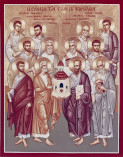 Although each of the Twelve
Apostles has his own feast day during the year, the Church has set aside this day for a general
feast of all of them together, including St. Paul. The names and feast days of the Twelve
are:
Peter—June 29th and January 16th.
Andrew—November 30th.
Iakovos the Son of Zebedee—April 30th.
John the Theologian—September 26th and May 8th.
Philip—November 14th.
Bartholomew—June 11th and August 25th.
Thomas—October 6th.
Matthew the Evangelist—November 16th.
Iakovos the Son of Alphaeus—October 9th.
Thaddeus (or Jude the brother of Iakovos)—June 19th.
Simon the Zealot—May 10th.
Matthias—August 9th.
Paul—June 29th.
Let us also remember here how these most holy and selfless men in the history of the world died and finished their earthly course:
Peter was crucified upside-down.
Andrew was crucified.
Iakovos was beheaded.
John the Theologian died peacefully in a miraculous way.
Philip was crucified.
Bartholomew was crucified, then flayed and beheaded.
Thomas was pierced with five spears.
Matthew was burned by fire.
Iakovos the Son of Alphaeus was crucified.
Thaddeus was crucified.
Simon the Zealot was crucified.
Matthias was stoned, then beheaded with an axe when dead.
Paul was beheaded.
2. Blessed Peter the Heir.
A Tartar by race and the nephew of the Tartar King Berkai, he once listened to a sermon on salvation by Kiril, Bishop of Rostov, and the words embedded themselves deeply in his heart. When he saw the miraculous healing of Berkai’s son by Kiril’s prayers, he secretly left the Cossack (Golden) Horde and ran off to Rostov, where he was baptized and devoted himself heart and soul to the ascetic life and to training himself in faith and devotion. Once he spent the night on the shore of a lake, and the Apostles Peter and Paul appeared to him in his sleep and told him to build a church dedicated to their memory on that spot, giving him the money he would need to accomplish this. Peter built a beautiful church there, and was there made a monk in old age, after the death of his wife. He finished his earthly course peacefully on June 29th, 1290, and his church became and remains the Petrovski monastery.
3. Our Holy Father George the Georgian.
Born in Iberia or Georgia in 1014, he was a kinsman of the Georgian king, Bagrat. He received a good classical education in his early years, but his heart ever drew him towards the spiritual life. He labored in asceticism under the renowned spiritual teacher George on the Black Mountain. He then went off to the Holy Mountain and continued his asceticism in the monastery of Iviron, becoming the abbot of that monastery. With the assistance of the Byzantine emperor, Constantine Monomachus, he restored Iviron and roofed the church with lead. This same leaden roof remains to this day. He translated the holy Scriptures, the Prologue and the books for divine services into Georgian. Bagrat summoned him back to Georgia to teach the people, and he received a royal welcome in his homeland. He travelled far and wide, instructing the clergy and the people. Reaching old age, he desired to depart this life on the Holy Mountain and set out on the road, but death overtook him in Constantinople in 1067. His relics were taken to Iviron. Although he died on May 24th, the Georgians celebrate his memory on June 30th, counting him as equal to the apostles.
FOR CONSIDERATION
Concern for the good of all men. Such concern filled the exalted spirits and noble hearts of the apostles to overflowing. St. John Chrysostom wrote about the Apostle Paul, calling him ‘the father of all the world, as if he himself had given birth to all men, for he was so concerned and strove so greatly to bring all into the kingdom’. ‘Father of all the world’ is indeed a very high title, and if there is anyone, under God, to whom this title should be given, it is the apostles of Christ. Having the concern of a parent for the whole world, they were truly ‘fathers of all the world’. There are many mothers in the world who care less for their own children than did the apostles for the good of their persecutors and adversaries. The Apostle Peter twice saved his most bitter adversary, Simon the Magician, from death; once when the crowd wanted to set fire to him and once when a dog tried to tear him to pieces. Just think of the way that the world paid its debt to these workers of good! As if they were the greatest robbers and evil-doers! How true are St. Cyprian’s words: ‘While we are in the body, we Christians look the same on the surface as pagans. The difference lies in the spirit.’
Daily Scripture Readings taken from The Orthodox New Testament, translated and published by Holy Apostles Convent, Buena Vista, Colorado, copyright © 2000, used with permission, all rights reserved.
Daily Prologue Readings taken from The Prologue of Ochrid, by Bishop Nikolai Velimirovic, translated by Mother Maria, published by Lazarica Press, Birmingham, England, copyright © 1985, all rights reserved. Edited by Dormition Skete.