

Daily Devotional
Wednesday, June 21, 2034 (NS), June 8, 2034 (OS)
Fast Day. No Meat, Fish, Dairy, Eggs, Alcohol or Olive Oil Allowed.
Wednesday of the Fourth Week
The commemoration of the translation of the relics of the Great-martyr Theodore the General.
Scripture Readings
Paschalion — Movable Calendar
Wednesday of the Fourth Week
Epistle
The Reading is from the Epistle of Saint Paul to the Romans [§ 105]. Brethren:
11 2God did not thrust away His people whom He foreknew. Or do ye not know what saith the Scripture in the case of Elias, how he pleadeth with God against Israel, saying, 3“Lord, they killed Thy prophets and dug down Thine altars, and I am left alone, and they seek my life [cf. 3 Kgs. (1 Kgs.) 19:10, 14]”? 4But what saith the divine answer of God to him? “I left to Myself seven thousand men, who bowed not a knee to Baal [cf. 3 Kgs. (1 Kgs.) 19:18].” 5So then, also in the present time there hath come to be a remnant according to an election of grace. 6And if by grace, it is no longer of works; otherwise grace no longer becometh grace. But if it is of works, it is no longer grace; otherwise the work is no longer work. 7What then? What Israel seeketh for, this it did not obtain; but the election obtained it, and the rest were hardened. 8Even as it hath been written: “God gave them a spirit of stupefaction, eyes so as not to see, and ears so as not to hear, unto this day [cf. Is. 29:10].” 9And David saith, “Let their table be for a snare, and for a trap, and for a stumbling block, and for a recompense to them [cf. Ps. 68(69):27]. 10“Let their eyes be darkened, so as not to see, and bow down their back continually [Ps. 68(69):28].” 11I say then, they did not stumble that they should fall, did they? May it not be! But by their falling away, salvation is come to the nations, so as to provoke them to jealousy. 12Now if their falling away is the wealth of the world, and their loss the wealth of the nations, how much more their fullness?
Gospel
The Reading is from the Holy Gospel according to Saint Matthew [§ 42]. At that time:
11 20The Lord began to reproach the cities in which the most works of His power took place, because they repented not. 21“Woe to thee, Chorazin! Woe to thee, Bethsaida! For if the works of power which have taken place in you took place in Tyre and Sidon, they would have repented long ago in sackcloth and ashes. 22“But I say to you that it shall be more tolerable for Tyre and Sidon in the day of judgment than for you. 23“And thou, Capernaum, which hath been lifted high unto the heaven, shalt be brought down as far as Hades; for if the works of power which took place in thee took place in Sodom, it would have remained until today. 24“But I say to you that it shall be more tolerable in the day of judgment for the land of Sodom than for thee.”
25At that time Jesus answered and said, “I give thanks to Thee, O Father, Lord of the heaven and of the earth, that Thou didst hide these things from the wise and intelligent, and didst reveal them to babes. 26“Yea, Father, for thus it was well-pleasing before Thee.”
Menaion — Fixed Calendar
The commemoration of the translation of the relics of the Great-martyr Theodore the General.
Epistle
The Reading is from the Epistle of Saint Paul to the Ephesians [§ 220]. Brethren:
2 4God, Who is rich in mercy, because of His great love with which He loved us, 5even when we were dead in transgressions, made us alive together with the Christ—by grace have ye been saved— 6and raised us up together, and made us sit together in the heavenlies in Christ Jesus, 7that He might show forth Himself in the ages which are coming the surpassing wealth of His grace in kindness upon us in Christ Jesus. 8For by grace are ye saved through faith, and this not of yourselves; the gift is of God, 9not of works, lest anyone should boast. 10For we are His work, created in Christ Jesus for good works, which God prepared beforehand, in order that we should walk in them.
for Sl. usage, see [2 Tim. 2:1-10].
Gospel
The Reading is from the Holy Gospel according to Saint Matthew [§ 36]. The Lord said to His disciples:
10 16“Behold, I send you forth as sheep in the midst of wolves. Become therefore wise as the serpents and guileless as the doves. 17“But continue being on guard against men; for they will deliver you up to councils, and they will scourge you in their synagogues. 18“And also ye shall be brought before governors and kings on account of Me, for a testimony to them and to the nations. 19“But whenever they deliver you up, do not become anxious about how or what ye should speak; for it shall be given to you in that hour what ye shall speak. 20“For ye are not the ones who are speaking, but the Spirit of your Father Who is speaking in you. 21“Now a brother shall deliver up a brother to death, and a father a child; and children shall rise up against parents and shall put them to death. 22“And ye shall be hated by all for My name’s sake; but the one who endureth to the end, this one shall be saved.”
Lives of the Saints (Prologue)
June 21st – Civil Calendar
June 8th – Church Calendar
1. St. Ephraim, Patriarch of Antioch.
During the reign of the Byzantine Emperor Anastasios, Ephraim was governor of the eastern regions. He was famed for his great piety and compassion, and was much esteemed for these virtues. When the rebuilding of Antioch, which had been destroyed by earthquake and fire, was put in hand, the emperor ordered Ephraim to oversee the work. Ephraim performed this work with diligence and love. There was among the ordinary workers a certain bishop who had left his see for unknown reasons and was working as a laborer. Not a soul knew that the man was a bishop. One day he lay down to take a rest from the exhausting work with the other laborers, and fell asleep. Ephraim glanced at him, and saw a flaming pillar rising above the man and reaching up to heaven. Amazed and frightened, Ephraim summoned him and bound him under oath to reveal who he was. The man hesitated a long time, but finally admitted that he was a bishop and foretold that Ephraim would shortly be consecrated Patriarch of Antioch (the patriarchal throne having been empty since the old patriarch, Ephrasios, perished in the earthquake). Ephraim was indeed elected and consecrated as patriarch. For his goodness, purity and zeal for Orthodoxy, a great gift of wonder-working was given him by God. Once, in order to convince some heretic that Orthodoxy is the true Faith, he placed his omophorion in the flames and prayed to God. The omophorion remained unharmed in the fire for three hours. When the heretic saw this, he was afraid and cast his heresy aside. Ephraim entered peacefully into rest in 546.
2. Our Holy Father Zosimas of Phoenicia.
This saint was born in Synda, in the neighborhood of Tyre, and labored in asceticism in his monastery nearby. Having not the shadow of a cloud on his conscience, he could prophesy, see far into distant things and behold what was happening in the world. In this way he was able to witness the fall of Antioch during the earthquake, and weeping bitterly, he prostrated himself on the ground and prayed to God that the city should not be completely destroyed. It once happened that a lion met him on a path and killed and ate his mule. The saint commanded the lion to serve him in the mule’s place, and to carry the load. The lion became as meek as a lamb, took the load upon itself and carried it to the gates of Caesarea, where Zosimas gave it back its liberty and let it go. St. Zosimas entered peacefully into rest in the sixth century.
3. The Holy and Great Martyr Theodore Stratelates.
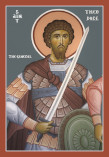 This saint is commemorated on
February 8th, and his life is recounted there. However, June 8th commemorates the translation of
his relics from Heraklion to Efchaita. St. Theodore’s last request to his servant Varus
before his martyrdom was: ‘Bury my body on the estate of my ancestors at Efchaita.’
St. Anastasios of Mount Sinai has recorded the following miracle by an icon of St. Theodore: At a
place called Karsat, close to Damascus, there was a church dedicated to St. Theodore. When the
Saracens conquered Damascus, a party of them, with their wives and children, turned the church
into their lodging. There was a fresco of St. Theodore on the wall, and one of the Saracens let
fly an arrow and struck the image of St. Theodore in the face. At once blood flowed from it. Soon
after that, the entire group of Saracens in that church died. St. Anastasios says that he had
been in that church himself, and had seen the traces of blood on the saint’s face on the
wall.
FOR CONSIDERATION
Fear of suffering and fear of an absence of suffering—this is one and the same fear, and is the fear of a spiritual man that God has departed from him. When St. Katharine was enduring many terrible torments, the Lord appeared to her and she asked Him: ‘Where wast Thou, Lord, until now, to comfort me in my great sufferings?’ and the Lord replied to her: ‘I was here, in thy heart.’ But as great a fear may overtake a spiritual man when no sufferings come his way for a long time. A monk came to a church in Alexandria and saw a woman kneeling before an icon of the Savior, weeping and crying out to God: ‘Thou hast abandoned me, O Lord; have mercy on me, O merciful One.’ When her prayer was finished, the monk asked the woman: ‘Who has so wronged you, that you are complaining so bitterly to God?’ The woman answered: ‘Until now, no one has wronged me; and for that very reason I am weeping, since God has abandoned me and has not visited me with any suffering for three years. During this time, neither I nor my son has fallen ill, neither has anything befallen my cattle or poultry.’
Daily Scripture Readings taken from The Orthodox New Testament, translated and published by Holy Apostles Convent, Buena Vista, Colorado, copyright © 2000, used with permission, all rights reserved.
Daily Prologue Readings taken from The Prologue of Ochrid, by Bishop Nikolai Velimirovic, translated by Mother Maria, published by Lazarica Press, Birmingham, England, copyright © 1985, all rights reserved. Edited by Dormition Skete.