

Daily Devotional
Wednesday, June 7, 2034 (NS), May 25, 2034 (OS)
Fast Day, but Wine and Olive Oil Allowed.
Wednesday of the Second Week
The commemoration of the third finding of the precious head of the holy and glorious prophet, forerunner, and Baptist John.
Scripture Readings
Paschalion — Movable Calendar
Wednesday of the Second Week
Epistle
The Reading is from the Epistle of Saint Paul to the Romans [§ 87]. Brethren:
4 13The promise that he should be the heir of the world was not to Abraham or to his seed through the law, but through the righteousness of faith. 14For if the heirs be of the law, faith is made void, and the promise made of no effect, 15for the law worketh out wrath; for where there is no law, neither is there transgression. 16On this account it is of faith, in order that it be according to grace, to the end that the promise be made sure to all the seed, not to that of the law only, but to that also of the faith of Abraham, who is the father of us all 17(even as it hath been written: “I have made thee a father of many nations [Gen. 17:5]”) before Him Whom he believed—God, Who giveth life to the dead, and calleth the things not existing as existing; 18who against hope believed upon hope, in order for him to become the father of many nations, according to that which was spoken, “So shall thy seed be [Gen. 15:5].” 19And not becoming weak in faith, he considered not his own body, already dead, when he was about a hundred years old, neither yet the deadness of Sarah’s womb. 20And in regard to the promise of God he was not made to doubt by unbelief, but was empowered in faith, giving glory to God, 21and was fully persuaded that what He had promised, He was able also to do. 22And wherefore it was reckoned to him for righteousness. 23Now it was not written on account of him only, that it was reckoned to him, 24but on account of us also, to whom it is about to be reckoned, to those who believe on Him Who raised Jesus our Lord from the dead, 25Who was delivered up for our offenses, and was raised for our justification.
Gospel
The Reading is from the Holy Gospel according to Saint Matthew [§ 23]. The Lord said:
7 21“Not everyone who saith to Me, ‘Lord, Lord,’ shall enter into the kingdom of the heavens, but the one who doeth the will of My Father in the heavens. 22“Many will say to Me in that day, ‘Lord, Lord, we prophesied in Thy name, and cast out demons in Thy name, and did many works of power in Thy name, did we not?’ 23“And then will I profess to them, ‘I never knew you; depart from Me, ye who work lawlessness.’”
Menaion — Fixed Calendar
The commemoration of the third finding of the precious head of the holy and glorious prophet, forerunner, and Baptist John.
Epistle
The Reading is from the Second Epistle of Saint Paul to the Corinthians [§§ 176, 177]. Brethren:
4 6It is God Who said, “Let there be light [cf. Gen. 1:3]” to shine out of darkness, Who shined in our hearts, for the illumination of the knowledge of the glory of God in the face of Jesus Christ.
7But we have this treasure in earthen vessels, that the preeminence of the power may be of God, and not from us. 8In every way we are afflicted, but not straitened; we are at a loss, but not utterly at a loss; 9persecuted, but not abandoned; cast down, but not destroyed— 10always bearing about in the body the dying of the Lord Jesus, that the life also of Jesus might be made manifest in our body. 11For we, the living, are always being delivered to death on account of Jesus, that also the life of Jesus might be made manifest in our mortal flesh. 12So that indeed death energizeth itself in us, but life in you. 13But having the same spirit of faith, according to that which hath been written: “I believed, wherefore I spoke [Ps. 115(116):1(10)],” we also believe, and therefore speak, 14knowing that the One Who raised up the Lord Jesus shall raise up us also through Jesus, and shall present us with you. 15For all things are for your sakes, that the grace, which abounded through the majority, might cause the giving of thanks to abound more to the glory of God.
Gospel
The Reading is from the Holy Gospel according to Saint Matthew [§ 40]. At that time:
11 2After John heard in the prison the works of the Christ, he sent two of his disciples, 3and said to Him, “Art Thou the coming One, or do we look for another?” 4And Jesus answered and said to them, “Go and report to John what ye are hearing and seeing: 5“the blind are recovering their sight and the lame are walking; the lepers are being cleansed and the deaf are hearing; the dead are being raised and the poor are being preached the Gospel. 6“And happy is he, whosoever shall not be offended in Me.” 7And as these went their way, Jesus began to say to the crowds concerning John, “What went ye out into the wilderness to behold? A reed being shaken by the wind? 8“But what went ye out to see? A man who hath been clothed in soft garments? Behold, those wearing soft garments are in the houses of kings. 9“But what went ye out to see? A prophet? Yea, I say to you, and much more than a prophet. 10“For this is he about whom it hath been written: ‘Behold, I send forth My messenger before Thy face, who shall prepare Thy way before Thee [cf. Mal. 3:1].’ 11“Verily I say to you, there hath not arisen among those born of women a greater than John the Baptist; but the least in the kingdom of the heavens is greater than he. 12“And from the days of John the Baptist until now the kingdom of the heavens is being taken by force, and the forceful seize it. 13“For all the prophets and the law prophesied until John. 14“And if ye are willing to receive it, he is Elias, who is about to come. 15“The one who hath ears to hear, let him hear.”
Lives of the Saints (Prologue)
June 7th – Civil Calendar
May 25th – Church Calendar
1. The Third Finding of the Head of St. John the Baptist.
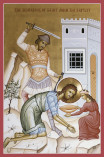 In the eighth century, during a period of
fierce iconoclasm, the head of St. John the Baptist was taken to Comana, the place of St.
John Chrysostom’s exile. When the iconoclast persecution ended in 850, in the time of
the Emperor Michael and Patriarch Ignatius, the honored head of St. John was taken to
Constantinople and placed in the church at the imperial court. |
2. The Hieromartyr Therapon, Bishop of Cyprus.
A monk and ascetic on the island of Cyprus, he was worthy of episcopal rank, and during a persecution of Christians, was found worthy of a yet higher crown: that of martyrdom. His body at first rested in a church in Cyprus, but during the reign of the Emperor Nikephoros, in 806, the Hagarenes fell upon Cyprus. Therapon appeared to the verger, told him that the infidel was about to attack Cyprus and ordered him to have his relics transferred to Constantinople. The verger saw to this at once. When the ship with the casket put to sea, a great storm arose, but the sea around the ship remained calm and a sweet perfume spread from the casket around the whole ship and the surrounding area. Then the verger opened it, and they saw that it was full of myrrh, which flowed from the saint’s relics. Many of the sick anointed themselves with this myrrh and were restored to health. A church was built in Constantinople over the relics of the wonder-working saint, which continued to give healing to all who gathered round them with faith. The gravest diseases were healed by St. Therapon’s relics: paralysis, cancer, hemorrhage, insanity, blindness, tuberculosis and other maladies.
3. The Holy Martyrs Pasikratees, Valention, Julius and others.
They were Roman soldiers, and suffered for Christ in about 302 in Macedonian Dorostolon (Silistra). When Pasikratees’ brother, Papianos (who had apostatised from Christ through fear), came to his brother and tried to persuade him to renounce Christ and stay alive, St. Pasikratees replied: ‘Get away from me; you are no brother of mine!’ Pasikratees and Valention (Valentine) were beheaded together. At his trial, Julius said: ‘I am a war veteran, and have served the emperor faithfully for twenty-six years. And, having been faithful till now in lesser things, how can I not be faithful in the things that are greater, to the heavenly kingdom and its King?’ Then Nikanor was brought before the prefect, Maximus. Nikanor’s wife encouraged her husband to die for the sake of Christ. ‘You stupid old woman,’ Maximus hurled at her, ‘Are you after a better husband?’ She replied: ‘If you think that of me, give the order to have me killed now, before my husband!’ Marcian also perished with Nikanor. His wife came to the place of execution, carrying their son in her arms. Marcian kissed his son and prayed: ‘O almighty God, do Thou take care of him!’ And they were all then slain and entered into the kingdom of Christ.
FOR CONSIDERATION
Some ignorant people think more about the end of the world than that of their own lives, although it is evident that, when a man comes to the end of his life, he reaches the end of the world also. A certain brother standing in the presence of St. Seraphim of Sarov was turning over in his mind how he would ask the saint about the end of the world. St. Seraphim perceived his thoughts and said to him: ‘My joy, you rate poor Seraphim too highly; how could I know when the end of the world will be, and that great day when the Lord shall judge the living and the dead, giving to each according to his works? No, no; it is impossible for me to know about it.’ And if the saints could not know, how could we poor sinners find out? And to what purpose would we know that which the Savior Himself did not find it needful for us to know? It is far better to consider that our death will come before the end of the world than to contemplate the possibility of the world’s ending before we die.
Daily Scripture Readings taken from The Orthodox New Testament, translated and published by Holy Apostles Convent, Buena Vista, Colorado, copyright © 2000, used with permission, all rights reserved.
Daily Prologue Readings taken from The Prologue of Ochrid, by Bishop Nikolai Velimirovic, translated by Mother Maria, published by Lazarica Press, Birmingham, England, copyright © 1985, all rights reserved. Edited by Dormition Skete.