

Daily Devotional
Sunday, June 4, 2034 (NS), May 22, 2034 (OS)
No Fasting.
Sunday of the First Week, of All Saints
Mode Plagal Four — First Eothinon
The commemoration of the holy Martyr Vasiliskos of Comana.
Scripture Readings
Paschalion — Movable Calendar
Sunday of the First Week, of All Saints
Mode Plagal Four — First Eothinon
Epistle
The Reading is from the Epistle of Saint Paul to the Hebrews [§§ 330, 331]. Brethren:
11 33All the saints through faith struggled against kingdoms, wrought righteousness, attained to promises, stopped mouths of lions, 34quenched the power of fire, escaped the edges of the sword, were empowered out of weakness, became strong in battle, turned back encampments of aliens. 35Women received their dead by resurrection. And others were tortured, not accepting release, that they might attain a better resurrection. 36And others received trial of mockings and of scourgings, and, moreover, of bonds and of imprisonment. 37They were stoned, they were sawn asunder, were tempted; they died, murdered by the sword. They went about in sheepskins, in goatskins, being in need, afflicted, ill-treated— 38of whom the world was not worthy. They were made to wander in deserts, and in mountains, and in caves, and in the holes of the earth. 39And these all, having been approved by testimony through faith, received not for themselves the promise, 40God having foreseen some better thing concerning us, that they should not be made perfect without us.
12 1Therefore we also, having so great a cloud of witnesses which is set around us, and having laid aside every weight and sin that is easily circumvented, let us by means of patience be running the course which is set before us, 2looking to Jesus, the originator and accomplisher of our faith, Who, in exchange for the joy set before Him, endured a cross, having despised the shame, and hath sat down on the right of the throne of God.
Gospel
The Reading is from the Holy Gospel according to Saint Matthew [§§ 38, mid 79]. The Lord said to his disciples:
10 32“Everyone who shall confess in Me before men, I also will confess in him before My Father Who is in the heavens. 33“But whosoever shall deny Me before men, him will I also deny before My Father Who is in the heavens.... 37“The one who loveth father or mother more than Me is not worthy of Me; and the one who loveth son or daughter more than Me is not worthy of Me. 38“And whosoever taketh not his cross and followeth after Me is not worthy of Me.”...
19 27Peter answered and said to Him, “Behold, we left all things and followed Thee; what then shall be for us?” 28And Jesus said to them, “Verily I say to you, that ye who followed Me, in the regeneration, whenever the Son of Man shall have taken His seat upon the throne of His glory, ye also shall sit upon twelve thrones, judging the twelve tribes of Israel. 29“And everyone who leaveth houses, or brothers, or sisters, or father, or mother, or wife, or children, or lands, on account of My name, shall receive a hundredfold, and shall inherit life everlasting. 30“But many who are first shall be last, and the last first.”
Menaion — Fixed Calendar
The commemoration of the holy Martyr Vasiliskos of Comana.
No readings given.
Lives of the Saints (Prologue)
June 4th – Civil Calendar
May 22nd – Church Calendar
1. The Holy Martyr Vasiliskos.
A kinsman of St. Theodore the Tyro, he was martyred together with Eftropios and Kleonikos (March 3rd). When these two were crucified and gave up the spirit, Vasiliskos was taken back to prison. A change of governors occurring at this time, Vasiliskos remained a long time confined in prison. He besought God with tears that He would not deprive him of a martyr’s death for His sake. After he had prayed at length, the Lord Jesus appeared to him and promised to fulfill his desire, sending him to his village to say farewell to his mother and brothers. Thereupon the new governor, Agrippa, arrived and sent to have Vasiliskos brought from the village immediately. On the way to the city of Amaseia, the Lord worked great wonders through His martyr, bringing many of the people to faith in Christ. Agrippa ordered the martyr to offer sacrifice to Apollyon. ‘“Apollyon” means “Destroyer”,’ said Vasiliskos, and with fervent prayer, he knocked the idol to dust and burned the temple with fire from heaven. The terrified Agrippa attributed this all to magic, and ordered that Vasiliskos be beheaded with the sword. Agrippa immediately became insane, and in his madness, went to the place of execution, found a little of the martyr’s blood in the dust and smeared it on himself under his belt, being restored to health by it. Having come to his senses, he was baptized. Later, a certain Marinus, a citizen of Comana (the place of Vasiliskos’ execution) built a church over the martyr’s relics, and many of the sick found healing there.
2. The Holy Martyr John (Jovan) Vladimir, King of Serbia.
He came of a princely family from Zahumlje. His grandfather was named Hvalimir and his father Petrislav. He was a wise ruler—merciful, meek, chaste and courageous. He was fervent in prayer and a devoted builder and benefactor of churches. But he had major battles to fight, both inside and outside his realm; internally with heretics and Bogomils, and externally with invaders, with King Samuel of Bulgaria and the Emperor Basil. Samuel captured him by guile and threw him into prison. While he was in prison, an angel of God appeared to him and foretold that he would soon be released from prison, but that he would die a martyr’s death. Getting to know Vladimir better, Samuel became attached to him and gave him his daughter Kosara in marriage. When Samuel died, his son Radomir became king, but his twin brother Radislav killed him and then summoned Vladimir on some pretext and beheaded him as well, in 1015. The relics of this holy martyr-king are preserved incorrupt in his monastery near Elbasan, and numerous wonders have been worked over them through the ages and to this day. In 1925, a church was built to this royal martyr near the monastery of St. Naum, which famous monastery he founded.
3. The Second Ecumenical Council.
This council was held in Constantinople in 381, in the time of the Emperor Theodosios the Great. Its purpose was to confirm the teaching of the Orthodox Church about the Holy Spirit. Makedonios (Macedonius), Bishop of Constantinople (d. 362), had taught wrongly that the Holy Spirit is God’s creature and not a divine Person, equal to the Persons of the Father and the Son and one in being with Them. Makedonios was condemned by this council and the Nicene Creed was amplified with teaching on the Holy Spirit.
4. Holy and Righteous Melchisedek, King of Salem.
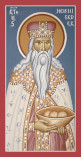 He was a contemporary of our
forefather Abraham. According to the Apostle Paul, he was, as king and priest, a type of
the Lord Jesus (Heb. 7). |
FOR CONSIDERATION
How was Moses able to fast for forty days? How were many Christian ascetics able to live, and live long, with prolonged periods of abstinence from food and drink? A carnal man, unacquainted with the spiritual life, finds this impossible to believe. It is impossible to prove it to him, for it can be understood only from experience. When St. Vasiliskos’ torturers left him for three days without food or water, and then urged him to eat, he refused, saying that he was not hungry. ‘I am,’ he said, ‘filled with immortal nourishment and will not receive mortal food. Earthly bread feeds you, but I am fed by the heavenly word of God; the universe gives you wine, but I receive the grace of the Holy Spirit. You are nourished by meat, but I by fasting; bodily power strengthens you, but me the Cross of Christ; gold enriches you, but me the love of Christ; clothing beautifies you, but me good works. You are made merry by laughter, but I am comforted in my spirit through prayer.’ Behold this man, one of many, in whom the words of Christ are confirmed: ‘Man does not live by bread alone, but by every word that proceedeth out of the mouth of God’ (Matt. 4:4).
Daily Scripture Readings taken from The Orthodox New Testament, translated and published by Holy Apostles Convent, Buena Vista, Colorado, copyright © 2000, used with permission, all rights reserved.
Daily Prologue Readings taken from The Prologue of Ochrid, by Bishop Nikolai Velimirovic, translated by Mother Maria, published by Lazarica Press, Birmingham, England, copyright © 1985, all rights reserved. Edited by Dormition Skete.