

Daily Devotional
Sunday, May 28, 2034 (NS), May 15, 2034 (OS)
No Fasting.
| Eighth Sunday, or the Sunday of Holy Pentecost |
The commemoration of our venerable Father Pachomios the Great, founder of cenobitic monasticism, and our holy father among the saints, Achilles, Bishop of Larisa.
Scripture Readings
Paschalion — Movable Calendar
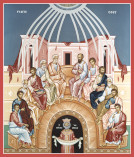
Eighth Sunday, or the Sunday of Holy Pentecost
Epistle
The Reading is from the Acts of the Apostles [§ 3].
2 1While the day of Pentecost was being fulfilled, they were all with one accord in the same place. 2And suddenly there came to be a sound out of the heaven, like as of a violent wind borne along, and it filled the whole house where they were sitting. 3And there appeared to them tongues, as if of fire, being distributed; and it sat upon each one of them. 4And they were all filled with the Holy Spirit, and began to speak in other tongues, even as the Spirit was giving them to utter. 5And there were Jews abiding in Jerusalem, pious men, from every nation of those under the heaven. 6And the report of this having arisen, the multitude came together and was confounded, because they were hearing, each one of them, speaking in his own dialect. 7And they were all amazed and wondering, saying to one another, “Behold, all these who are speaking are Galilæans, are they not? 8“And how do we each hear in our own dialect in which we were born? 9“Parthians and Medes and Elamites and those who dwell in Mesopotamia, also Judæa and Cappadocia, Pontos and Asia, 10“also Phrygia and Pamphylia, Egypt and the parts of Libya which are in the region of Cyrene, and the Romans, both Jews and proselytes, who sojourn here, 11“Cretans and Arabians—we hear them speaking in our own tongues the magnificent works of God.”
Gospel
In the Orthros
The Reading is from the Holy Gospel according to Saint John [§ 65].
20 19When it was evening on that day, the first of the week—and the doors were closed where the disciples were gathered together for fear of the Jews—Jesus came and stood in the midst, and saith to them, “Peace be to you.” 20And after He said this, He showed them His hands and His side. Then were the disciples glad, after they saw the Lord. 21Then Jesus said to them again, “Peace be to you; even as the Father hath sent Me forth, I also send you.” 22And after He said this, He breathed on them, and saith to them, “Receive ye the Holy Spirit: 23“if ye forgive the sins of any, they are forgiven to them; if ye retain the sins of any, they are retained.”
In the Liturgy
The Reading is from the Holy Gospel according to Saint John [§ 27].
7 37In the last day, that great day of the feast, Jesus was standing and cried out, saying, “If anyone thirst, let him come to Me and drink. 38“The one who believeth in Me, even as the Scripture said—rivers of living water shall flow out of his belly.” 39But this He said concerning the Spirit, Whom those who believe in Him were about to receive; for the Holy Spirit was not yet given, because Jesus was not yet glorified. 40Many therefore of the crowd, having heard the utterance, were saying, “This is truly the Prophet.” 41Others were saying, “This is the Christ.” But others were saying, “The Christ is not coming out of Galilee, is He? 42“Hath not the Scripture said that of the seed of David and from the village of Bethlehem, where David was, the Christ is coming?” 43Therefore a division occurred in the crowd on account of Him. 44And some of them were wishing to lay hold of Him, but no one laid hands on Him. 45Then came the officers to the chief priests and Pharisees, and they said to them, “Why did ye not bring Him?” 46The officers answered, “Never did a man so speak as this Man.” 47Then the Pharisees answered them, “Ye have not also been deceived, have ye? 48“Not one of the rulers believe in Him or of the Pharisees, doth he? 49“But this people who knoweth not the law are accursed!” 50Nicodemos (the one who came by night to Him, being one of them) saith to them, 51“Our law doth not judge the man, unless it should first hear him, and know from the man himself what he doeth, doth it?” 52They answered and said to him, “Thou art not also of Galilee, art thou? Search and look, for a prophet hath not been raised out of Galilee.”...
8 12Then Jesus spoke again to them, saying, “I am the light of the world; the one who followeth Me in no wise shall walk in the darkness, but shall have the light of the life.”
Menaion — Fixed Calendar
The commemoration of our venerable Father Pachomios the Great, founder of cenobitic monasticism, and our holy father among the saints, Achilles, Bishop of Larisa.
Epistle
For the venerable Father:
The Reading is from the Epistle of Saint Paul to the Galatians [§ 213]. Brethren:
5 22The fruit of the Spirit is love, joy, peace, long-suffering, kindness, goodness, faith, 23meekness, self-control; against such things there is no law. 24But they who are of the Christ crucified the flesh with the passions and the lusts. 25If we live by the Spirit, let us also be walking by the Spirit. 26Let us not become vainglorious, provoking one another, envying one another.
6 1Brethren, even if a man should be overtaken in some transgression, ye, the spiritual ones, be restoring such a one in the spirit of meekness, looking out for thyself, lest thou also be tempted. 2Keep on bearing one another’s burdens, and thus fill up the law of the Christ.
for Sl. usage, see [2 Cor. 4:6-15].
Gospel
The Reading is from the Holy Gospel according to Saint Matthew [§ 10]. At that time:
4 23Jesus was going around all Galilee, teaching in their synagogues, and proclaiming the Gospel of the kingdom, and curing every disease and every sickness among the people. 24And the report of Him went out into all Syria. And they brought to Him all those who were ill, constrained by various diseases and torments, and possessed by demons, and lunatics, and paralytics; and He cured them. 25And great crowds followed Him from Galilee, and Decapolis, and Jerusalem, and Judæa, and beyond the Jordan.
5 1And seeing the crowds, He went up into the
mountain; and after He sat down, His disciples came to Him. 2And He opened His mouth
and began to teach them, saying:
3“Blessed are the poor in spirit, for theirs is the
kingdom of the heavens.
4“Blessed are they who mourn, for they shall be
comforted.
5“Blessed are the meek, for they shall inherit the
earth.
6“Blessed are they who hunger and thirst after
righteousness, for they shall be filled.
7“Blessed are the merciful, for they shall find mercy.
8“Blessed are the pure in heart, for they shall see
God.
9“Blessed are the peacemakers, for they shall be called
sons of God.
10“Blessed are they who have been persecuted on account
of righteousness, for theirs is the kingdom of the heavens.
11“Blessed are ye whenever they reproach you and persecute
you, and say every evil word against you falsely on account of Me.
12“Be rejoicing and be exceedingly glad, for your reward
is great in the heavens. For so they persecuted the prophets who were before
you.
13“Ye are the salt of the earth; but if the salt should become insipid, with what shall it be salted? For it is no longer good for anything, except to be cast out and to be trampled underfoot by men.”
for Sl. usage, see [Lk. 14:25-35].
Lives of the Saints (Prologue)
May 28th – Civil Calendar
May 15th – Church Calendar
1. Our Holy Father Pachomios the Great.
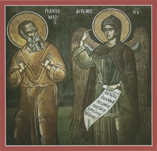 He was an Egyptian by birth and was a pagan in his
youth. As a soldier, he took part in the Emperor Constantine’s war against Maxentius. After
that, learning from Christians about the one God and seeing their devout life, Pachomios was
baptized and went to the Tabennisiot desert, to the famous ascetic Palamon, with whom he lived in
asceticism for ten years. Then an angel appeared to him in the robes of a monk of the Great Habit
at the place called Tabennisi and gave him instructions on the rule of a cenobitic monastery,
commanding him to found such a monastery in that place and prophesying to him that many monks
would come to it seeking the salvation of their souls. Obeying the angel of God, Pachomios began
building many cells, although there was no one in that place but himself and his brother John.
When his brother grumbled at him for doing this unnecessary building, Pachomios simply told him
that he was following God’s command, without explaining who would live there, or when. But
many men soon assembled in that place, moved by the Spirit of God, and began to live in
asceticism under the rule that Pachomios had received from the angel. When the number of monks
had increased greatly, Pachomios, step by step, founded six further monasteries. The number of
his disciples grew to seven thousand. St. Anthony is regarded as the founder of the eremitic
life, and St. Pachomios of the monastic, communal life. The humility, love of toil and abstinence
of this holy father were and remain a rare example for the imitation of monks. St. Pachomios
performed innumerable miracles, and also endured innumerable temptations from demons and men. And
he served men as both father and brother. He roused many to set out on the way of salvation, and
brought many into the way of truth. He was and remains a great light in the Church and a great
witness to the truth and righteousness of Christ. He entered peacefully into rest in 346, at the
age of sixty. The Church recognizes many of his followers as saints: Theodore, Job, Paphnutios,
Pecusius, Athenodorus, Eponichus, Soutus, Psois, Dionysius, Petronius and others.
2. St. Achillios, Bishop of Larissa.
This great hierarch and wonder-worker was born in Cappadocia. He took part in the First Ecumenical Council, at which he put the heretics to shame, and both by his great learning and his great purity, gave cause for much wonder. Taking up a stone, Achillios called to the Arians: ‘If Christ is a creature of God, as you say, tell oil to flow from this stone.’ The heretics kept silent, amazed at this demand by St. Achillios. Then the saint continued: ‘And if the Son of God is equal to the Father, as we believe, then let oil flow from this stone.’ And oil flowed out, to the amazement of all. St. Achillios entered peacefully into rest in Larissa in the year 330. Samuel, King of Macedonia, when he conquered Thessaly, translated the relics of Achillios to Prespa, to an island in a lake that was named, and is called to this day, Achillios or Ailus.
3. Our Holy Father Silvanos.
He was at first a comedian, mimicking each and all, but then, inflamed by the love of Christ, he became a disciple of St. Pachomios. ‘I would be ready to give my life,’ he said, ‘to receive the forgiveness of my sins.’
FOR CONSIDERATION
When a tyrant exercises tyranny over a righteous man from covetousness, then the tyrant brings both a gain and a loss: a loss for the tyrant and a gain for him who suffers the tyranny. Boris Godunov murdered the eight-year-old Tsarevich Dimitri in order to seize the throne without a rival. The days of his reign were quickly ended, and the tyrant was given over to corruption and damnation; but Dimitri was sanctified. After lying in the grave for fifteen years, Dimitri’s body was found to be incorrupt and wonder-working. There are forty-five miracles of healing recorded over his grave. Whose, then, was the loss and whose the gain from this tyranny? If the tyrant thought that he would, by tyranny, help his opponent to be included in the ranks of the saints and would prepare destruction and damnation for himself, he would change his mind about his planned tyranny. But wrong thinking is the forerunner and companion of tyranny.
Daily Scripture Readings taken from The Orthodox New Testament, translated and published by Holy Apostles Convent, Buena Vista, Colorado, copyright © 2000, used with permission, all rights reserved.
Daily Prologue Readings taken from The Prologue of Ochrid, by Bishop Nikolai Velimirovic, translated by Mother Maria, published by Lazarica Press, Birmingham, England, copyright © 1985, all rights reserved. Edited by Dormition Skete.