

Daily Devotional
Thursday, May 18, 2034 (NS), May 5, 2034 (OS)
No Fasting.
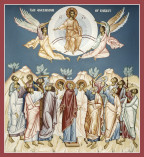
| The Thursday of the Ascension |
The commemoration of the Great-martyr Irene of Magedon.
Scripture Readings
Paschalion — Movable Calendar
The Thursday of the Ascension
Epistle
The Reading is from the Acts of the Apostles [§ 1].
1 1The first account indeed I made for myself concerning all which, O Theophilos, Jesus began both to do and teach, 2until the day in which He was taken up, after He gave command to the apostles whom He chose for Himself through the Holy Spirit, 3to whom also He presented Himself alive after He had suffered by many proofs, being seen by them during forty days and speaking the things concerning the kingdom of God. 4And being assembled together with them, He ordered them not to depart from Jerusalem, but to wait for the promise of the Father, “which,” He said, “ye heard of Me; 5“for John indeed baptized with water, but ye shall be baptized in the Holy Spirit not many days after these.” 6Indeed therefore, after they came together, they kept on questioning, saying, “Lord, dost Thou at this time restore the kingdom to Israel?” 7And He said to them, “It is not yours to know times or seasons which the Father Himself put in His own authority. 8“But ye shall receive power, after the Holy Spirit is come upon you; and ye shall be witnesses to Me both in Jerusalem, and in all Judæa and Samaria, and unto the ends of the earth.” 9And having said these things, while they looked, He was taken up; and from before their eyes, a cloud took Him up from under. 10And while they were gazing intently into the heaven as He went, then behold, two men stood by them in white raiment, 11who also said, “Men, Galilæans, why do ye stand looking into the heaven? This Jesus, the One Who was taken up from you into the heaven, so shall He come in the manner ye beheld Him going into the heaven.” 12Then they returned to Jerusalem from the mount which is called the Mount of Olives, which is near Jerusalem, being a sabbath’s day journey.
Gospel
In the Orthros
The Reading is from the Holy Gospel According to Saint Mark. [§ 71]. At that time:
16 9After Jesus rose early the first day of the week, He appeared first to Mary Magdalene, from whom He had cast out seven demons. 10She went and brought tidings to those who had been with Him, who were mourning and weeping. 11And they, having heard that He liveth and was seen by her, disbelieved. 12And after these things He was made manifest in a different form to two of them as they were walking and went into the country. 13And they went and brought tidings to the rest; neither did they believe them. 14Afterwards He was made manifest to the eleven themselves as they reclined at table; and He reproached their unbelief and hardness of heart, because they believed not those who saw Him after He was raised. 15And He said to them, “Go into all the world and proclaim the Gospel to the whole creation. 16“The one who believeth and is baptized shall be saved; but the one who believeth not shall be condemned. 17“And these signs shall accompany those who believe: In My name they shall cast out demons; they shall speak in new tongues; 18“they shall take up serpents; and if they should drink anything deadly, in no wise shall it harm them; they shall lay hands on the sick, and they shall be well.”
19Then indeed, after speaking to them, the Lord was taken up into the heaven, and sat on the right of God. 20And they went forth and preached everywhere, the Lord working with them, and confirming the word by the accompanying signs. Amen.
In the Liturgy
The Reading is from the Holy Gospel according to Saint Luke [§ 114]. At that time:
24 36After Jesus rose from the dead, He stood in the midst of His disciples, and saith to them, “Peace be to you.” 37But they were terrified and affrighted, and kept on thinking that they saw a spirit. 38And He said to them, “Why are ye troubled? And why do reasonings come up in your hearts? 39“Behold My hands and My feet, that I am He. Touch Me and see, for a spirit hath not flesh and bones, even as ye see Me having.” 40And having said this, He showed them His hands and His feet. 41And while they yet disbelieved from the joy, and wondered, He said to them, “Have ye anything to eat here?” 42And they gave Him a portion of a broiled fish and of a honeycomb. 43And He took these and ate in their presence. 44And He said to them, “These are the words which I spoke to you while I was yet with you, that it is needful for all the things to be fulfilled, which were written in the law of Moses, and in the prophets, and in the psalms concerning Me.” 45Then He thoroughly opened their mind to understand the Scriptures, 46and said to them, “Thus it hath been written, and thus it was needful for the Christ to have suffered, and to have risen from the dead the third day, 47“and repentance and forgiveness of sins to have been preached in His name to all the nations, beginning from Jerusalem. 48“And ye are witnesses of these things. 49“And behold, I send forth the promise of My Father upon you; but sojourn in the city of Jerusalem, until ye are clothed with power from on high.”
50And He led them out as far as to Bethany. And having lifted up His hands, He blessed them. 51And it came to pass, as He was blessing them, He stood apart from them and was carried up into the heaven. 52And they made obeisance to Him, and returned to Jerusalem with great joy. 53And they were continually in the temple, praising and blessing God. Amen.
Menaion — Fixed Calendar
The commemoration of the Great-martyr Irene of Magedon.
No readings given.
Lives of the Saints (Prologue)
May 18th – Civil Calendar
May 5th – Church Calendar
1. The Holy and Great Martyr Irene.
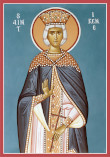 She lived in the Balkans in apostolic times, in the town
of Magedon where her father Licinius was governor of a small region. She was born a pagan of
pagan parents. Penelope—for that was her pagan name—learned the Christian Faith from her teacher,
Appelianus. St. Timothy, the disciple of the Apostle Paul, baptized her and her lady-in-waiting,
and brought her a letter from the Apostle Paul to read. She infuriated her father by her
embracing Christianity, and he intended to have her trampled to death by horses. The horses
turned on him, however, slaying him. She prayed to God on behalf of her father, who had just
tried to kill her, and the Lord resurrected him. He subsequently embraced Christianity. Irene was
tortured in different ways by four kings, other than her father, but God saved her through His
angels. King Sedekias had her cast headlong into a deep pit full of snakes and reptiles. The
saint persevered there for fourteen days, and emerged unscathed. Then the same king attempted to
saw off her feet, but the sword broke against her body as against stone. This same king once
again bound her to the wheel of a water-mill, then let the water in to drown her, but the water
would not flow, but stood still, and the maiden remained whole and alive. After Sedekias was
ousted from his domain, Sapor, his son, marched against those who deposed his father. St. Irene
met Sapor and his army in the city of Magedon. By her prayers, his entire army was stricken
blind. Again, she prayed and their eyesight was restored by divine grace. Nonetheless, the
ungrateful ones shod her with nails, loaded a sack of sand onto her, put a bridle on her and
commanded that she be led like an animal far outside the city. ‘Truly I am as a beast
before Thee, O Lord!’ said the holy martyr as she ran bridled behind her torturers. But an
angel of God caused an earthquake, and the earth opened and swallowed up ten thousand
infidels—but brought thirty thousand to the Faith. Despite this, the king persisted in his
paganism, for which he was smote by an angel of the Lord. Surviving all these tortures, by which
an enormous number of pagans were brought to Christianity, Irene went to the city of Kallinikos,
where she preached the Christian Faith. The local king, Numerian, tried to kill her, throwing her
into three burning metal oxen one after the other. But the maiden was preserved and remained
alive, and many saw and believed. The eparch, Vavdonos, sought to kill her by putting her onto a
burning grid, but this did not harm St. Irene, and brought him to the true Faith. She then went
to the city of Constantina, where Shapur II the Great, King of the Persians, had her head cut
off. But she was resurrected by an angel of God. The king, seeing this, together with many of the
people, believed in Christ and was baptized. And thus St. Irene, by her sufferings and miracles,
brought over 100,000 pagans to faith in Christ. At last she laid herself in a grave and commanded
Appelianus, her former teacher, to close it. After four days, when the grave was opened, her body
was not in it. Thus God glorified forever the maiden and martyr Irene, who had sacrificed all and
endured all, that God should be the more greatly glorified among men.
2. Ss. Martin and Heraclius.
Slavs, they were persecuted by heretical Arians in Illyria. Sent into exile, these knights of Orthodoxy finished their earthly course in the 4th century and went to the Lord.
FOR CONSIDERATION
Prayer with words is of no use if the heart does not participate. God only hears prayer from the heart. Abba Zoilos of the Thebaid, returning once from Mount Sinai, met a monk who complained that in the monastery, they were greatly suffering from drought. Zoilos asked: ‘Why don’t you pray to God, and implore Him?’ The monk replied: ‘We have prayed and implored, but there is no rain!’ To this Zoilos answered: ‘It is obvious that you are not praying from the heart. Do you want to be convinced that this is so?’ And, thus speaking, the elder raised his hands to heaven and began to pray, and abundant rain fell onto the earth. Seeing this, the marveling monk fell to the ground before the elder and did him reverence, but the elder, fearing the praise of men, quickly fled from him. ‘Ask, and it shall be given you,’ said the Lord Himself. But vain are mouthfuls of prayers if the heart is empty. God does not stand and listen to the lips, but to the heart. Let the heart be filled with prayer and the lips be silent. God will hear and receive the prayer, for He only hearkens to heartfelt prayer.
Daily Scripture Readings taken from The Orthodox New Testament, translated and published by Holy Apostles Convent, Buena Vista, Colorado, copyright © 2000, used with permission, all rights reserved.
Daily Prologue Readings taken from The Prologue of Ochrid, by Bishop Nikolai Velimirovic, translated by Mother Maria, published by Lazarica Press, Birmingham, England, copyright © 1985, all rights reserved. Edited by Dormition Skete.