

Daily Devotional
Tuesday, May 16, 2034 (NS), May 3, 2034 (OS)
No Fasting.
Tuesday of the Sixth Week
The commemoration of the holy Martyrs Timothy the Reader and Mavra of Antinoe in Egypt, and our venerable Father Theodosios, Abbot of the Monastery of the Caves, initiator of the cnobitic monastic life in Russia.
Scripture Readings
Paschalion — Movable Calendar
Tuesday of the Sixth Week
Epistle
The Reading is from the Acts of the Apostles [§ mid 40]. In those days:
17 19The Athenians, having taken hold of Paul, led him to the Areopagos, saying, “May we come to know what this new teaching is which is spoken by thee? 20“For thou bringest in certain surprising things to our ears. We wish therefore to know what these things may mean.” 21Now all Athenians and the strangers living there have leisure for nothing else other than to say something and to hear newer things. 22And Paul stood in the midst of the Areopagos, and said, “Men, Athenians, I perceive how in all things ye are most religious. 23“For passing through and carefully observing the objects of your veneration, I also found an altar on which it had been written: ‘To an unknown God.’ Therefore since ye know not Whom ye reverence, I proclaim this One to you. 24“The God Who made the world and all things in it, this same One, being Lord of heaven and of earth, dwelleth not in temples made by hand; 25“neither is He being serviced to by the hands of men, as though in need of anything, because He Himself giveth to all life, and breath, in all respects. 26“And He made of one blood every nation of mankind, to dwell on all the face of the earth, having determined preappointed seasons and the boundaries of their dwelling, 27“to seek the Lord, if perhaps they might feel about for Him and find Him, though indeed He is not far from each one of us. 28“For in Him we live, and move, and exist.”
Gospel
The Reading is from the Holy Gospel according to Saint John [§ 42]. At that time:
12 19The Pharisees took counsel against Jesus, and said among themselves, “Observe ye that ye profit nothing? Behold, the world hath gone away after Him.”
20And there were certain Greeks from among those going up that they might do reverence at the feast. 21Then these came to Philip, who was from Bethsaida of Galilee, and asked him, saying, “Sir, we wish to see Jesus.” 22Philip cometh and telleth Andrew, and again Andrew and Philip tell Jesus. 23But Jesus answered them, saying, “The hour hath come that the Son of Man should be glorified. 24“Verily, verily, I say to you, unless the grain of the wheat that falleth into the earth should die, it abideth alone; but if it should die, it beareth much fruit. 25“The one who loveth his life shall lose it; and the one who hateth his life in this world shall keep it to life eternal. 26“If anyone serve Me, let him keep on following Me; and where I am, there My servant shall be also. And if anyone serve Me, the Father shall honor him. 27“Now My soul hath been troubled; and what shall I say? ‘Father, save Me from this hour’; but on this account I came to this hour. 28“Father, glorify Thy name.” Then a voice came out of the heaven: “I both glorified it and will glorify it again.” 29The crowd then that stood by and heard it was saying that thunder had occurred; others were saying, “An angel hath spoken to Him.” 30Jesus answered and said, “This voice hath not occurred for My sake, but for your sakes. 31“Now is a judgment of this world; now the ruler of this world shall be cast out. 32“And I, if I be lifted up from the earth, will draw all to Myself.” 33But He was saying this, signifying by what manner of death He was about to die. 34The crowd answered Him, “We heard out of the law that the Christ abideth forever; and how sayest Thou, ‘The Son of Man must be lifted up’? Who is this Son of Man?” 35Then Jesus said to them, “Yet a little while is the light with you. Be walking while ye have the light, that darkness might not overtake you; and indeed the one who walketh in the darkness knoweth not where he goeth. 36“While ye have the light, keep on believing in the light, that ye might become sons of light.”
Menaion — Fixed Calendar
The commemoration of the holy Martyrs Timothy the Reader and Mavra of Antinoe in Egypt, and our venerable Father Theodosios, Abbot of the Monastery of the Caves, initiator of the cnobitic monastic life in Russia.
Epistle
For the venerable Father:
The Reading is from the Epistle of Saint Paul to the Hebrews [§ 334]. Brethren:
13 7Be remembering those who lead you, who spoke to you the word of God, whose faith keep on imitating, observing attentively the end of their conduct: 8Jesus Christ, the same yesterday and today and to the ages. 9Cease being carried about by various and strange teachings. For it is good for the heart to be confirmed by grace, not by foods, in which those walking therein were not profited. 10We have an altar from which those serving the tabernacle have no authority to eat; 11for the bodies of those animals, “whose blood is being brought into the holies for sins” by the high priest, “are being burned outside of the encampment [cf. Lev. 16:27].” 12Wherefore Jesus also, that He might sanctify the people by His own blood, suffered outside of the gate. 13Let us be going forth therefore to Him outside of the encampment, bearing His reproach; 14for we have no abiding city here, but we seek the coming one. 15Through Him, then, let us be offering up a “sacrifice of praise [Lev. 7:2(12)]” continually to God, that is, “the fruit of the lips [cf. Hos. 14:3(2); Is. 57:19],” giving thanks to His name. 16But cease being forgetful of doing good and of contributing; for God is well pleased with such sacrifices.
Gospel
The Reading is from the Holy Gospel according to Saint Matthew [§ 43]. The Lord said to His disciples:
11 27“All things were delivered to Me by My Father. And no one doth fully know the Son, except the Father; nor doth anyone fully know the Father, except the Son, and he to whomsoever the Son is willing to reveal Him. 28“Come to Me, all ye who labor and are burdened, and I will give you rest. 29“Take up My yoke upon you and learn from Me, for I am meek and humble in heart; and ye shall find rest to your souls. 30“For My yoke is good and My burden is light.”
Lives of the Saints (Prologue)
May 16th – Civil Calendar
May 3rd – Church Calendar
1. The Holy Martyrs Timothy and Mavra.*
Strange was the destiny of these wonderful martyrs, husband and newly-wedded wife. Twenty days after their wedding, they were taken for trial for their Christian Faith before Arrianos, the pagan governor of the Thebaid, in the time of the Emperor Diocletian. Timothy was a reader in the church where he lived. ‘Who are you?’ the governor asked him. Timothy replied: ‘I am a Christian and a reader in the Church of God.’ The governor said to him further: ‘You see, don’t you, the instruments prepared for torture?’ Timothy replied: ‘But you don’t see the angels of God, which are strengthening me.’ Then the governor commanded that he be pierced through the ears with iron rods, so that the pupils of his eyes leapt out with the pain. They then suddenly hanged him by the feet and stuffed his mouth with wood. Mavra was at first afraid of torture, but when her husband gave her courage, she also confessed her steadfast faith before the governor. He commanded that, first, her hair be torn out, then all her fingers cut off. After many other tortures, to which they would quickly have succumbed had they not been strengthened by the grace of God, they were both crucified, one in sight of the other. And thus, hanging on their crosses, they remained alive for nine full days, counseling each other and encouraging each other in endurance. On the tenth day they gave their spirits into God’s hands, the God for Whom they had suffered crucifixion, and thus became worthy of His kingdom. They suffered with honor for Christ in 286.
* Author’s note: ‘Mavra’ means ‘black,’ from which it comes that in Macedonia the day of these saints is known as ‘Black Day’. On the island of Zakynthos there is a church of Saints Timothy and Mavra, in which many miraculous healings have taken place.
2. Our Holy Father Theodosius (Feodosy) of the Kiev Caves.
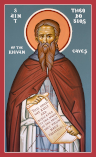 From his earliest youth, he fled from laughter and merriment and gave himself to pondering on
God and prayer. Because of this, he was often beaten by his mother, and especially when she saw
one day an iron belt around his naked body, from which his shirt was stained with blood. Reading
one day in the Gospel the words of the Lord: ‘He who loves father or mother more than Me,
is not worthy of Me,’ he left his parents’ home and fled to Kiev, to the cave of our
holy father Anthony. Anthony received him and quickly made him a monk. When his mother found him,
and called him to return home, he spoke with her and she then became a nun in a women’s
monastery. By his asceticism, his meekness and his goodness, Theodosius quickly outstripped all
the other monks and became very dear to Anthony, who made him abbot of the monastery. In his
time, the number of brethren in the monastery grew very rapidly, churches and cells were built,
and the Rule of the Studion was introduced in its fullness. God endowed Theodosius with great
grace in response to his virginal purity, labors in prayer and love for his neighbor, and so this
man of God had great power over unclean spirits and healed sicknesses and had insight into the
destinies of men. With St. Anthony, St. Theodosius is regarded as the restorer and organizer of
Russian monasticism. He entered peacefully into rest in 1074, and his healing relics rest beside
those of St. Anthony.
FOR CONSIDERATION
Abba John Kolovos asked his monks: ‘Who or what sold Joseph?’ One of them answered: ‘His brethren.’ To this the elder said: ‘Not his brothers, but his humility.’ Joseph could have revealed that he was their brother, and thus oppose the sale. But he kept silent about that. By humility, then, was he sold, and this same humility later made him ruler of Egypt. We guard ourselves too carefully from the outward difficulties encountered in giving ourselves over to the will of God, and so we lose the good fruits that are reaped in difficult circumstances endured with humility. Abba Poemen spoke wisely thus: ‘We have set aside the light yoke; that is, self-instruction, and loaded ourselves with the heavy one; that is, self-righteousness.’ Christians accept every difficulty as payment for past or present sins, seeking the will of God with faith in all things, and looking to the end with hope.
Daily Scripture Readings taken from The Orthodox New Testament, translated and published by Holy Apostles Convent, Buena Vista, Colorado, copyright © 2000, used with permission, all rights reserved.
Daily Prologue Readings taken from The Prologue of Ochrid, by Bishop Nikolai Velimirovic, translated by Mother Maria, published by Lazarica Press, Birmingham, England, copyright © 1985, all rights reserved. Edited by Dormition Skete.