

Daily Devotional
Sunday, May 14, 2034 (NS), May 1, 2034 (OS)
No Fasting.
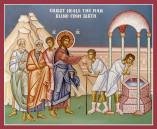
| Sixth Sunday of Pascha, or the Sunday of the Blind Man Mode Plagal One — Eighth Eothinon |
1. The commemoration of the holy Prophet Jeremias, and the venerable Monk- martyrs of Mt. Athos, Efthymios, Ignatios, and Akakios.
Scripture Readings
Paschalion — Movable Calendar
Sixth Sunday of Pascha, or the Sunday of the Blind Man
Mode Plagal One — Eighth Eothinon
Epistle
The Reading is from the Acts of the Apostles [§ 38]. In those days:
16 16It came to pass, as we went to prayer, that a certain young girl, possessing a spirit of Python, met us, who was producing much business for her masters by divining. 17She followed after Paul and us, and cried out, saying, “These men are slaves of God, the Most High, who proclaim to us the way of salvation.” 18And she kept doing this for many days. But Paul was worn out, and turned around to the spirit, and said, “I command thee in the name of Jesus Christ to come out from her.” And he came out the same hour. 19And after her masters saw that the hope of their business was gone, they laid hold of Paul and Silas, and dragged them into the marketplace before the rulers. 20And they brought them to the magistrates, and said, “These men, being Jews, exceedingly trouble our city, 21“and declare customs, which are not allowed for us to receive, nor to do, being Romans.” 22And the crowd rose together against them; and the magistrates tore off their garments, and kept on commanding to beat them with rods. 23And after they laid on them many stripes, they cast them into prison, ordering the jailer to guard them securely, 24who, having received such an order, cast them into the inner prison and secured their feet in the stocks. 25And at midnight Paul and Silas were praying and singing hymns to God; and the prisoners were listening to them. 26And suddenly there occurred a great earthquake, so that the foundations of the prison were shaken; and immediately all the doors were opened and the bonds of all were loosed. 27The jailer, having been awakened out of sleep and seeing the doors of the prison opened, drew a sword, and was about to kill himself, believing the prisoners to have escaped. 28But Paul cried out with a loud voice, saying, “By no means begin to do any evil to thyself; for we are all here.” 29And after he asked for lights, he leaped in and became tremulous, falling down before Paul and Silas. 30And having brought them forth outside, he said, “Sirs, what is necessary for me to do in order that I might be saved?” 31And they said, “Believe on the Lord Jesus Christ, and thou shalt be saved, thou and thy house.” 32And they spoke to him the word of the Lord, and to all those in his house. 33And having taken them in that hour of the night, he washed their wounds. And he was baptized, he and all his, immediately. 34And having brought them into his house, he set a table before them, and rejoiced, having believed in God, with all his house.
Gospel
The Reading is from the Holy Gospel according to Saint John [§ 34]. At that time:
9 1As Jesus passed by, He saw a man who was blind from birth. 2And His disciples asked Him, saying, “Rabbi, who sinned, this one or his parents, that he should be born blind?” 3Jesus answered, “Neither this one sinned nor his parents, but in order that the works of God should be made manifest in him. 4“It is needful for Me to be working the works of the One Who sent Me while it is day; night cometh when no one is able to be working. 5“Whenever I may be in the world, I am the light of the world.” 6Having said these things, He spat on the ground, and made clay out of the spittle, and anointed the eyes of the blind one with the clay, 7and said to him, “Go, wash in the pool of Siloam” (which is interpreted, Sent forth). He went therefore and washed, and came seeing.
8Then the neighbors and those who saw him that was formerly blind were saying, “This is the one who sat and begged, is it not?” 9Some were saying, “This is he”; but others, “He is like him.” But that one kept on saying, “I am he.” 10Then they began to say to him, “How were thine eyes opened?” 11That one answered and said, “A Man Who is called Jesus made clay and anointed mine eyes, and said to me, ‘Go to the pool of Siloam, and wash.’ And I went and washed, and received sight.” 12Then they said to him, “Where is that Man?” He said, “I know not.”
13They brought him who was once blind to the Pharisees. 14And it was a sabbath when Jesus made the clay and opened his eyes. 15Then again the Pharisees also began asking him how he received sight. And he said to them, “He put clay upon mine eyes, and I washed, and I see.” 16Therefore some of the Pharisees were saying, “This Man is not from God, because He keepeth not the sabbath.” Others were saying, “How is a man, a sinner, able to do such signs?” And there was a division among them. 17They say to the blind one again, “What sayest thou concerning Him, in that He opened thine eyes?” And he said, “He is a prophet.” 18Then the Jews did not believe concerning him, that he was blind and received sight, until which time they called the parents of him who received sight. 19And they asked them, saying, “Is this your son, whom ye say that he was born blind? How then doth he now see?” 20His parents answered them and said, “We know that this is our son, and that he was born blind; 21“but how he now seeth, we know not, or who opened his eyes, we know not; he is of age; ask him. He shall speak for himself.” 22The parents said these things because they were fearing the Jews; for already the Jews had agreed among themselves that if anyone should confess Him to be the Christ, he would be expelled from the synagogue. 23For this reason his parents said, “He is of age; ask him.” 24Then a second time they called the man who was blind, and said to him, “Give glory to God; we know that this Man is a sinner.” 25Then that one answered and said, “If He is a sinner, I know not; one thing I know, that though I was blind, now I see.” 26But they said to him again, “What did He do to thee? How did He open thine eyes?” 27He answered them, “I told you already, and ye did not hear; why again do ye wish to hear it? Ye do not also wish to become His disciples, do ye?” 28Then they reviled him, and said, “Thou art a disciple of that One; but we are disciples of Moses. 29“We know that God hath spoken to Moses; but this One, we do not know from what place He is.” 30The man answered and said to them, “Why in this is a marvellous thing, that ye do not know from what place He is, and yet He opened mine eyes. 31“Now we know that God heareth not sinners, but if anyone be serving God and doing His will, He heareth this one. 32“From of old it was not heard that anyone opened the eyes of one who hath been born blind. 33“If this One were not from God, He could do nothing.” 34They answered and said to him, “In sins thou wast born, all of thee, and dost thou teach us?” And they cast him out. 35Jesus heard that they cast him out; and having found him, He said to him, “Believest thou in the Son of God?” 36That one answered and said, “And Who is He, Sir, that I might believe in Him?” 37And Jesus said to him, “Thou hast both seen Him and the One Who talketh with thee is that One.” 38And he said, “I believe, O Lord.” And he made obeisance to Him.
Menaion — Fixed Calendar
1. The commemoration of the holy Prophet Jeremias, and the venerable Monk- martyrs of Mt. Athos, Efthymios, Ignatios, and Akakios.
Epistle
For the Prophet:
The Reading is from the First Epistle of Saint Paul to the Thessalonians [§ 266].
For Gk. usage, see 1 Thess. 2:14-20; for Sl. usage, see 1 Thess. 2:14-19.
2 14Brethren, ye became imitators of the churches of God which are in Judæa in Christ Jesus. For ye also suffered the same things by your own countrymen, even as they have by the Jews, 15who both killed the Lord Jesus and their own prophets, and persecuted us; and they please not God, and are contrary to all men, 16forbidding us to speak to the nations that they might be saved, to the end that they fill up their sins always. But the wrath came upon them to the uttermost.
17But we, brethren, having been made orphans from you for an hour’s time—in person, not in heart—endeavored more abundantly to see your face with great desire. 18Wherefore we wished to come to you, indeed I Paul, both once and twice, and yet Satan hindered us. 19For what is our hope, or joy, or crown of boasting? Are not also ye before our Lord Jesus Christ at His coming? 20For ye are our glory and joy.
for Sl. usage, see [1 Cor. 14:20-25].
For the venerable Martyrs:
The Reading is from the Epistle of Saint Paul to the Romans [§ 99]. Brethren:
8 28We know that to those who love God all things work together for good, to those who are called according to purpose. 29For whom He foreknew, He also foreordained to be conformable to the image of His Son, in order for Him to be the firstborn among many brethren. 30But whom He foreordained, these also He called; and whom He called, these also He justified; and whom He justified, these also He glorified. 31What then shall we say to these things? If God is for us, who can be against us? 32He Who indeed spared not His own Son, but delivered Him up for us all, how shall He not with Him also graciously give us all things? 33Who shall bring an accusation against the elect of God? God is the One Who justifieth. 34Who is the one who condemneth? Christ is the One Who died, but much more is He the One also Who was raised, Who also is at the right of God, Who also intercedeth for us. 35Who shall separate us from the love of Christ? Shall affliction, or distress, or persecution, or famine, or nakedness, or danger, or sword? 36Even as it hath been written: “For on account of Thee, we are being put to death the whole day; we were counted as sheep of slaughter [Ps. 43(44):23(22)].” 37But in all these things we more than conquer through the One Who loved us. 38For I have been persuaded that neither death, nor life, nor angels, nor principalities, nor powers, nor things present, nor things coming, 39nor height, nor depth, nor any other created thing, shall be able to separate us from the love of God, which is in Christ Jesus our Lord.
Gospel
For the Prophet:
The Reading is from the Holy Gospel according to Saint Luke [§ 14]. At that time:
4 22 The crowds were wondering at the words of grace which were proceeding out of Jesus’ mouth, and were saying, “This is the Son of Joseph, is it not?” 23And He said to them, “No doubt, ye will say this parable to Me, ‘Physician, heal thyself; as much as we heard was done in Capernaum, do also here in Thy country.’” 24And He said, “Verily I say to you that not one prophet is accepted in his own country. 25“But in truth I say to you, many widows were in Israel in the days of Elias, when the heaven was shut up for three years and six months, when a great famine arose over all the land; 26“and to not even one of them was Elias sent, except to Sarepta of Sidon, to a woman who was a widow. 27“And many lepers were in Israel in the time of Elisaios the prophet, and not one of them was cleansed, except Neman the Syrian.” 28And all in the synagogue were filled with anger when they heard these things. 29And they rose up and cast Him outside of the city; and they led Him up to the brow of the hill on which their city had been built, in order to throw Him down headlong. 30But He, having passed through the midst of them, kept going on His way.
For the venerable Martyrs:
The Reading is from the Holy Gospel according to Saint Matthew [§§ 38, mid 79]. The Lord said to his disciples:
10 32“Everyone who shall confess in Me before men, I also will confess in him before My Father Who is in the heavens. 33“But whosoever shall deny Me before men, him will I also deny before My Father Who is in the heavens.... 37“The one who loveth father or mother more than Me is not worthy of Me; and the one who loveth son or daughter more than Me is not worthy of Me. 38“And whosoever taketh not his cross and followeth after Me is not worthy of Me.”...
19 27Peter answered and said to Him, “Behold, we left all things and followed Thee; what then shall be for us?” 28And Jesus said to them, “Verily I say to you, that ye who followed Me, in the regeneration, whenever the Son of Man shall have taken His seat upon the throne of His glory, ye also shall sit upon twelve thrones, judging the twelve tribes of Israel. 29“And everyone who leaveth houses, or brothers, or sisters, or father, or mother, or wife, or children, or lands, on account of My name, shall receive a hundredfold, and shall inherit life everlasting. 30“But many who are first shall be last, and the last first.”
Lives of the Saints (Prologue)
May 14th – Civil Calendar
May 1st – Church Calendar
1. The Holy Prophet Jeremias (Jeremiah).
 Born 650 years before Christ in the village of Anathoth, not far from
Jerusalem, he began to prophesy at an early age, during the reign of King Josiah (Jer. 1:1-19).
He preached repentance to the king and nobles and the false prophets and priests, and in the time
of that King Josiah, barely escaped death at the hands of the enraged nobles. He prophesied to
King Jehoiakim that his burial would be like that of an ass; that is, he would be cast dead out
of Jerusalem and his body would be for a long time dragged around the ground without burial
(22:18). For this, Jeremias was thrown into prison. Being unable to write there, he sent for
Baruch, who stood outside the window of the prison while Jeremias dictated to him. When the king
read this prophecy, he took the paper in fury and threw it into the fire. By God’s providence,
Jeremias was saved from prison, and the words of the prophecy were fulfilled upon Jehoiakim. He
prophesied to King Jeconiah that he would be carried off to Babylon with his whole family and
that he would die there, all of which quickly came to pass (24:1; 27:20). Under King Zedekiah, he
put a yoke on his neck and walked through Jerusalem prophesying the fall of the city and slavery
under the yoke of Babylon (27:2). He wrote to the slaves in Babylon, telling them that they would
not return to Jerusalem but would remain for seventy years in Babylon, which came to pass
(25:11). In the valley of Topnet, near Jerusalem, where the Jews had brought children to the
idols for sacrifice, Jeremias took a whole pot in his hands and smashed it in front of the
people, prophesying the imminent crushing of the Jewish Kingdom (19:10-11). The Babylonians soon
overran Jerusalem, killed King Zedekiah, burned the city down and utterly destroyed it. They
slaughtered an enormous number of Jews in the valley of Topnet, in the place where children had
died as sacrifices to idols and where the prophet had broken the pot. Jeremias, with the Levites,
took the Ark out of the Temple and bore it off to the mountain of Nebo, where Moses had died, and
hid it in a cave. He hid the fire from the altar in a deep well. He was forced by some Jews to go
with them to Egypt, where he lived for four years and was then stoned to death by his countrymen.
He prophesied to the Egyptians the destruction of their idols and the coming there of a Virgin
with a Child. There is a tradition that Alexander the Great himself visited the grave of the
Prophet Jeremias,* and ordered that his body be moved and buried in Alexandria.
* Author’s note: The Egyptians almost deified St. Jeremias, and they therefore buried him as a king. He was regarded as a wonder-worker after his death. The dust from his tomb was taken as a medicine against snake bites, and today many Christians invoke his help against them.
2. The Right-believing Queen Tamara of Georgia.
She was born between the years 1156 and 1165, a descendant of the ancient Bagratid Dynasty. In her youth, Tamara became co-regent with her father. She became sole ruler of Georgia upon his death in 1184. Her reign came to be known as the Golden Age of Georgian history. Queen Tamara ruled with much wisdom and godly piety. She was a favorite among her people. In imitation of the saintly empress of old, Helen, Tamara built countless churches and monasteries throughout her kingdom and was a benefactress to the holy land, Mount Athos, and the sacred places in Greece and Cyprus. Saint Tamara was conspicuous for her continuous flow of alms among the needy. She sponsored both education and learning. Upon her coronation she convoked a holy synod, urging the holy fathers to establish righteousness and redress abuses. The young sovereign addressed the prelates with many wise words, speaking in this manner, “Our holy Faith will be exalted by you as spiritual fathers and ones with authority given to you from on high, and by me as this fair country’s ruler and vigilant guardian.” In 1204, the Georgian people were threatened by the inroads of Muslims. The queen went herself, clad in armor at the head of her Georgian armies. With sword in hand, she gained unprecedented military triumphs over the neighboring Muslims. By means of her many military and political triumphs, she expanded Georgian power into Armenia and Persia, for the sake of Orthodoxy and the curtailment of Islam. Queen Tamara also founded the empire of Trebizond. The enemies of Georgia, entire mountain tribes, on account of the reverence they had for Tamara the queen, renounced Islam and were baptized. She also defeated coalitions of Muslim rulers. In other instances, the Archangel Michael appeared to her prisoners of war, making it known that his heavenly solicitude was directed toward the queen, so that he both protected her in battle and caused her campaigns to succeed. Although fearless in war and governing, her people extolled her gentleness, love of peace, wisdom, piety, and beauty. Although St. Tamara acquired much glory and admiration in her lifetime, still she did not exalt herself in her mind. She spent the final years of her life in the Bardzia Cave Monastery. She had her own cell which was connected to the church by a window, through which she could offer up prayer to God during the divine offices. She reposed in peace between 1207 and 1213, and soared into the heavens where she is numbered among the saints. St. Tamara is venerated as the healer of infirmities. She is also commemorated on the Sunday of the Myrrh-bearing Women. The queen is recorded to have uttered these final words: “O Christ, my God, as Thou hadst entrusted me with the stewardship of this kingdom dedicated to Thee, so I commend to Thee the people who have been redeemed by Thy precious blood. To Thee, O my Christ, do I commit my spirit.” Tamara the all-great is the never-fading glory of the Iberians and the exquisite ornament of the Orthodox Church, for she tended well the portion of the Theotokos and cultivated well the vine of the enlightener Nina, by confirming her people in Orthodoxy and with right doctrine and practice.
3. Our Holy Father, the New-Martyr Akakios the Slipper-Maker.
He was from the village of Neochorion, near Thessalonica. Being much ill-treated by his master in Serres, he became a Turk. After that, as a penitent and a monk, he lived at Hilandar. His poor and devout mother counselled him: ‘As you voluntarily denied the Lord, so you must now voluntarily and courageously receive martyrdom for our sweet Jesus’. The son obeyed his mother, and with the blessing of the fathers of the Holy Mountain, went off to Constantinople, where he was beheaded by the Turks on May 1st, 1815. His head is preserved in the monastery of St. Panteleimon.
4. Our Holy Father Paphnutius of Borovsk.
The son of a Tartar noble who had earlier accepted the Christian Faith, he became a monk at the age of twenty and remained in his monastery to the age of ninety-four, when he entered into rest in the Lord. He was a virgin and an ascetic, and because of this, a great wonder-worker and clairvoyant. He died in 1478.
FOR CONSIDERATION
Our holy father Paphnutius of Borovsk spoke to his disciples of how a man’s soul and hidden works can be known by external sight. This seemed improbable to his disciples, until this man of God demonstrated it in practice on several occasions. Looking with insight into the destiny of others, he also saw his own. For a week, while still in good health, he prophesied that, on the next Thursday, he would be parted from this world. And when that Thursday dawned, he cried out with joy: ‘This is the day of the Lord! Rejoice, O ye people! Lo, the expected day has dawned!’ And thus the man waited for death who, through his whole life, had thought on the parting from this world and the meeting with God.
Daily Scripture Readings taken from The Orthodox New Testament, translated and published by Holy Apostles Convent, Buena Vista, Colorado, copyright © 2000, used with permission, all rights reserved.
Daily Prologue Readings taken from The Prologue of Ochrid, by Bishop Nikolai Velimirovic, translated by Mother Maria, published by Lazarica Press, Birmingham, England, copyright © 1985, all rights reserved. Edited by Dormition Skete.