

Daily Devotional
Sunday, May 7, 2034 (NS), April 24, 2034 (OS)
No Fasting.
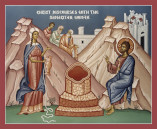
| Fifth Sunday of Pascha, or Sunday of the Samaritan Woman Mode Four — Seventh Eothinon |
The commemoration of our venerable Mother Elisabeth the Wonder-worker of Constantinople, and the Martyr Savvas the General of Rome and 70 soldiers with him.
Scripture Readings
Paschalion — Movable Calendar
Fifth Sunday of Pascha, or Sunday of the Samaritan Woman
Mode Four — Seventh Eothinon
Epistle
The Reading is from the Acts of the Apostles [§ 28]. In those days:
For Gk usage, see Acts 11:19-30; for Sl. usage. see Acts 11:19-26, 29, 30.
11 19The apostles, who were scattered because of the affliction that arose about Stephen, went abroad as far as Phœnicia and Cyprus and Antioch, speaking the word to no one except to Jews only. 20But some of them were men of Cyprus and Cyrene, who, after they came to Antioch, began speaking to the Hellenists, preaching as good tidings the Lord Jesus. 21And the hand of the Lord was with them, and a great number believed and turned to the Lord. 22Then the report concerning them was heard in the ears of the Church which was in Jerusalem. And they sent forth Barnabas to go through as far as Antioch, 23who, after he came and saw the grace of God, was glad and was exhorting all to keep on remaining near to the Lord with purpose of heart. 24For he was a good man, and full of the Holy Spirit and of faith; and a considerable crowd was added to the Lord. 25And Barnabas went forth to Tarsus to search for Saul. 26And having found him, he brought him to Antioch. And it came to pass that they were gathered together with the Church for a whole year, and taught a considerable crowd. And the disciples were called Christians first in Antioch.
27And in these days prophets came down from Jerusalem to Antioch. 28And one of them, by name Agavos, rose up, and signified by the Spirit that there was about to be a great famine over all the inhabited world, which also came to pass in the time of Claudius Cæsar. 29And according as any one of the disciples was prospered, each of them determined to send relief toward ministering to the brethren who dwelt in Judæa, 30which also they did, sending it off to the presbyters by the hand of Barnabas and Saul.
Gospel
The Reading is from the Holy Gospel according to Saint John [§ 12]. At that time:
4 5Jesus came to a city of Samaria called Sychar, near the place which Jacob gave to his son Joseph. 6And Jacob’s well was there. Jesus then, having grown weary from the journey, was sitting thus on the well. It was about the sixth hour. 7There cometh a woman of Samaria to draw water. Jesus saith to her, “Give Me to drink.” 8For His disciples had gone away into the city in order that they might buy provisions. 9Then the Samaritan woman saith to Him, “How is it that Thou, being a Jew, askest to drink from me, who am a Samaritan woman? For the Jews have no dealings with Samaritans.” 10Jesus answered and said to her, “If thou knewest the gift of God, and Who is the One Who saith to thee, ‘Give Me to drink,’ thou wouldest have asked Him, and He would have given to thee living water.” 11The woman saith to Him, “Lord, Thou hast no bucket for drawing water, and the well is deep. From what place then hast Thou the water, the living one? 12“Thou art not greater than our father Jacob, who gave us the well, and drank from it himself, and his sons, and his animals, art Thou?” 13Jesus answered and said to her, “Everyone who drinketh of this water shall thirst again; 14“but whosoever drinketh of the water which I shall give him in no wise shall ever thirst. But the water which I shall give him shall become in him a fountain of water springing into eternal life.” 15The woman saith to Him, “Lord, give me this water, that I may not be thirsting, nor keep on coming here to draw.” 16Jesus said to her, “Go, call thy husband, and come here.” 17The woman answered and said, “I have no husband.” Jesus said to her, “Well didst thou say, ‘I have no husband,’ 18“for thou hast had five husbands, and now he whom thou hast is not thy husband; this truly thou hast spoken.” 19The woman saith to Him, “Lord, I perceive that Thou art a prophet. 20“Our fathers do reverence in this mountain, and ye say that in Jerusalem is the place where it is needful to do reverence.” 21Jesus saith to her, “Woman, believe Me, that there is coming an hour when neither in this mountain, nor in Jerusalem, shall ye do reverence to the Father. 22“Ye do reverence what ye know not; we do reverence what we know, for salvation is of the Jews. 23“But there is coming an hour, and now is, when the true worshippers shall do reverence to the Father in spirit and truth; for also the Father seeketh such as those who revere Him. 24“God is Spirit, and it is needful for those who revere Him to do reverence in spirit and truth.” 25The woman said to Him, “I know that Messiah is coming, the One Who is called Christ. Whenever that One should come, He will announce to us all things.” 26Jesus saith to her, “I am, the One Who speaketh to thee.” 27And upon this came His disciples, and they wondered that He was speaking with a woman; nevertheless no one said, “What seekest Thou?” or “Why speakest Thou with her?” 28The woman then left her waterpot, and went away into the city, and saith to the people, 29“Come, see a Man Who told me all things whatsoever I did. This One is not the Christ, is He?” 30Then they went forth out of the city and were going toward Him.
31But in the meantime the disciples were entreating Him, saying, “Rabbi, eat.” 32But He said to them, “I have food to eat which ye know not.” 33Therefore the disciples were saying to one another, “No one brought Him anything to eat, did he?” 34Jesus saith to them, “My food is that I be doing the will of Him Who sent Me, and that I should finish His work. 35“Do ye not say, ‘It is yet a space of four months, and the harvest cometh’? Behold, I say to you, lift up your eyes and see the fields, for they are white already to harvest. 36“And the one who reapeth receiveth a reward, and gathereth fruit to life eternal, that both the one who soweth and the one who reapeth may rejoice together. 37“For in this the saying is true, ‘There is one who soweth and another who reapeth.’ 38“I sent you forth to reap on what ye have not labored; others have labored, and ye have entered into their labor.” 39And many of the Samaritans of that city believed in Him, because of the utterance of the woman testifying, “He told me all things whatsoever I did.” 40Therefore, when the Samaritans came to Him, they were asking Him to stay with them; and He stayed there two days. 41And many more believed because of His word. 42And to the woman they were saying, “We no longer believe because of thy talk; for we ourselves have heard, and we know that this One is truly the Savior of the world, the Christ.”
Menaion — Fixed Calendar
The commemoration of our venerable Mother Elisabeth the Wonder-worker of Constantinople, and the Martyr Savvas the General of Rome and 70 soldiers with him.
No readings given.
Lives of the Saints (Prologue)
May 7th – Civil Calendar
April 24th – Church Calendar
1. The Holy Martyr Savvas Stratelates.
This famous Savvas lived in Rome in the time of the Emperor Aurelian, and held a general’s rank. He was of a noble Gothic family. He often visited Christians in prison, helping them from his abundance. Through his great purity and fasting, God gave him power over unclean spirits. When he was charged with being a Christian, he stood courageously before the emperor, cast his officer’s belt before him and publicly confessed Christ the Lord. He was tortured in various ways: flogged, flailed with iron rods, burned with torches. But he did not succumb to these deadly tortures, and was seen to be alive and well. His comrades, the soldiers, seeing clearly that God was helping Savvas, accepted the Christian Faith, and seventy of them were immediately beheaded at the emperor’s command. Christ the Lord Himself appeared to Savvas in the prison in great light, and strengthened His martyr. Then Savvas was condemned to death by drowning. He was thrown into a deep river, where he gave his soul to God in the year 272. And his soul went to the Lord to Whom he had remained faithful under many tortures.
2. Our Holy Mother Elisabeth
She embraced monasticism in early youth in the monastery of Ss. Kosmas and Damian in Constantinople, and took on herself a heavy asceticism for the sake of Christ the Lord and of her soul. She regarded herself as the bride of Christ, and this world as illusory. From her great love for God flowed a great compassion for people, especially for the sick and suffering. By the gift she had received from God, she healed many diseases and much distress among the people. At her nightly prayers she was seen all illuminated with heavenly light. And after her death, her relics had the power of healing, and many of the sick and suffering have come to her grave through the ages. She entered peacefully into rest and went to the eternal joy of her Lord in the year 540.
3. The Holy Martyrs Evsevios, Neon, Leontios and Longinos.
These four were army comrades of St. George. Seeing the courageous endurance and marvels of the saint, they became Christians and were consequently beheaded.
4. The Holy Martyrs Pasikratees and Valention.
When the judge urged Pasikratees (Pasicrates), and also the martyr’s brother, Papianos (who had fallen away from Christ through fear of torture) to offer sacrifice to idols, Pasikratees put his hand into the fire and cried: ‘The body is dead and burned by fire, but the soul is immortal and does not feel visible torture.’ His mother upheld him and greatly encouraged him to endure to the end. He was beheaded along with Valention (Valentine), and they both went to the kingdom of Christ in about 302.
5. Our Holy Father Thomas the Fool for Christ.
Whenever, in his monastic work, he had to go into the city of Antioch, Thomas feigned madness for the sake of Christ. A certain Anastasios, refusing to give him the requested alms for the monastery, gave him a blow instead. Then Thomas prophesied: ‘From now on, I shall receive nothing from Anastasios, nor will Anastasios be able to give anything.’ One day later, Anastasios died; and Thomas also, about to return to the monastery, gave up the spirit. And so the prophecy of this holy man was fulfilled. St. Thomas departed this life in Laphnis near Antioch, in the time of Patriarch Domnos (546-560).
6. The Holy New-Martyrs Luke and Nicholas
The young man Luke (or Doukas), a tailor by profession, suffered for Christ in 1546, and Nicholas in 1776.
FOR CONSIDERATION
Exhorting Christians to come to church for prayer, St. John Chrysostom says: ‘If a messenger brings an imperial or princely document to a subject citizen, the citizen does not examine the life of the bearer, whether he is rich or poor, righteous or sinful, but listens carefully to what he reads. If anyone has not heard him, he asks someone who has. So, if you have such enormous respect for an earthly ruler, how necessary it is to listen to us priests, here where the Creator of the heavenly powers speaks through us sinners.’ And, indeed, what are the holy Scriptures but documents of the King of heaven? How can it not interest us every day and every hour, that unique and saving document, when the least decree of the lowest authority in the state interests us? St. Anthony says: ‘Let all that you do be justified in holy Scripture.’ But how can you have justification from holy Scripture if you do not know the Scriptures?
Daily Scripture Readings taken from The Orthodox New Testament, translated and published by Holy Apostles Convent, Buena Vista, Colorado, copyright © 2000, used with permission, all rights reserved.
Daily Prologue Readings taken from The Prologue of Ochrid, by Bishop Nikolai Velimirovic, translated by Mother Maria, published by Lazarica Press, Birmingham, England, copyright © 1985, all rights reserved. Edited by Dormition Skete.