

Daily Devotional
Wednesday, May 3, 2034 (NS), April 20, 2034 (OS)
Fast Day, but Wine and Olive Oil Allowed.
The Wednesday of the Mid-Pentecost
The commemoration of our venerable Father Theodore Trichinas ("the Hair-shirt Wearer"), hermit near Constantinople, and our venerable Father Anastasios of Sinai (commemorated on Gk. calendar on the 21st of April).
Scripture Readings
Paschalion — Movable Calendar
The Wednesday of the Mid-Pentecost
Epistle
The Reading is from the Acts of the Apostles [§ 34]. In those days:
14 6The apostles fled for refuge to the cities of Lycaonia, Lystra, and Derbe, and the country round about; 7and there they were preaching the Gospel.
8And a certain man in Lystra, disabled in his feet, who was lame from his mother’s womb and who never had walked, was sitting. 9This same one heard Paul speaking, who, having looked intently on him and perceiving that he had faith to be made well, 10said with a loud voice, “Stand upright on thy feet.” And he leaped and was walking about. 11And after the crowds saw what Paul did, they lifted up their voice in Lycaonian, saying, “The gods, having become like men, came down to us.” 12And they indeed began calling Barnabas Zeus, and Paul Hermes, since he was the leader of the discourse. 13And the priest of Zeus, whose temple was before their city, brought oxen and garlands to the gateways, and was intending to sacrifice with the crowds. 14But the apostles, Barnabas and Paul, after they heard this, tore their garments and rushed into the crowd, crying out, 15and saying, “Men, why do ye these things? We also are men of like feelings with you, preaching the Gospel to you to turn you from these vanities to the living God, Who made the heaven, and the earth, and the sea, and all the things in them, 16“Who in the generations which have gone by suffered all the nations to walk in their own ways. 17“And yet indeed, He left not Himself without witness, doing good, giving rain from heaven to us and fruit-bearing seasons, filling our hearts with food and good cheer.” 18And saying these things, they scarcely stopped the crowds from sacrificing to them.
Gospel
The Reading is from the Holy Gospel according to Saint John [§ 26].
7 14It now already being the middle of the feast, Jesus went up into the temple and began to teach. 15And the Jews were wondering, saying, “How knoweth this One letters, since He hath not learned?” 16Jesus answered them and said, “My teaching is not Mine, but of the One Who sent Me. 17“If anyone be willing to do His will, he shall know concerning the teaching, whether it is from God or whether I speak from Myself. 18“The one who speaketh from himself seeketh his own glory; but the One Who seeketh the glory of the One Who sent Him, this One is true, and unrighteousness is not in Him. 19“Moses hath given you the law, hath he not? And yet not one of you doeth the law. Why do you seek to kill Me?” 20The crowd answered and said, “Thou hast a demon; who seeketh to kill Thee?” 21Jesus answered and said to them, “I did one work, and ye all wonder on this account. 22“Moses hath given you circumcision—not that it is of Moses, but of the fathers—and on a sabbath ye circumcise a man. 23“If a man receive circumcision on a sabbath, in order that the law of Moses should not be broken, are ye bilious because I made a whole man sound on a sabbath! 24“Cease judging according to appearance, but judge the righteous judgment.” 25Then some of those from Jerusalem were saying, “This is the One Whom they seek to kill, is it not? 26“But behold, He speaketh boldly, and they say nothing to Him. Can it be that the rulers indeed came to know that this is truly the Christ? 27“But we know from what place this One is; but the Christ, whenever He may be coming, no one knoweth where He is from.” 28Then Jesus cried out in the temple, teaching and saying, “Ye both know Me, and ye know from what place I am; and I have not come of Myself, but the One Who sent Me is true, Whom ye know not. 29“But I know Him; for I am from Him, and that One sent Me forth.” 30Then they began seeking to lay hold of Him; but no one laid his hand upon Him, because His hour had not yet come.
Menaion — Fixed Calendar
The commemoration of our venerable Father Theodore Trichinas ("the Hair-shirt Wearer"), hermit near Constantinople, and our venerable Father Anastasios of Sinai (commemorated on Gk. calendar on the 21st of April).
No readings given.
Lives of the Saints (Prologue)
May 3rd – Civil Calendar
April 20th – Church Calendar
1. Our Holy Father Theodore Trichinas.
He was a citizen of Constantinople, and the son of wealthy parents. He left parents, home and riches while still a young man and settled in a remote monastery in Thrace, where he undertook the most rigorous ascetic life. He slept on a stone so that he might have less sleep; he was always bareheaded and dressed in a hair-shirt, from which he was called ‘Trichinas’ or ‘hairy’. Because of his great and self-inflicted sufferings for the sake of his soul’s salvation, God granted him the gift of working miracles, both in his lifetime and after his death, and he died peacefully in about 400. Healing myrrh flowed from his relics.
2. Our Holy Father Anastasios of Mount Sinai.
He was abbot of Mount Sinai. He was for a long time a monk under the famous abbot, St. John of the Ladder, whom he succeeded on the latter’s death. He was also a great ascetic, and an eloquent narrator of the lives of the saints and the author of other instructive works. He fought an intensive battle against the heresy of the Akephalites, which was condemned by the Fourth Ecumenical Council at Chalcedon. He died in great old age in 685, and went to the Lord Whom he had served so faithfully.
3. Blessed Anastasios the Sinaite, Patriarch of Antioch.
He was chosen as Patriarch of Antioch in the reign of the Emperor Justinian while still a monk on Mount Sinai. His virtues, purity of life, great spiritual learning and staunch faith won him the patriarchal throne. But Justinian, according to one historical source, for a short time fell into the heresy of Aphthartodocetism. Eftychios, Patriarch of Constantinople, and Blessed Anastasios reacted sharply against this. The emperor exiled Eftychios and wanted to exile Anastasios also, but could find nothing in his life capable of criticism. When Justinian was dying, he repented and returned Eftychios to the patriarchal throne, but Justin, his successor, succeeded in exiling Anastasios on the basis of certain slanders. Anastasios spent twenty-three years in exile and was then returned to the throne of Antioch during the reign of the Emperor Maurice. He governed the Church of God for six further years and finished his earthly course in 599.
4. Blessed Gregory, Patriarch of Antioch.
An Armenian by birth, he was abbot first of the Pharanite monastery and then on Mount Sinai, and when Blessed Anastasios was driven from the patriarchal throne, he was, against his will, installed as Patriarch of Antioch. John Moschus writes about him in his ‘Meadow,’ praising him highly. Gregory was particularly distinguished by an outstanding compassion, most especially towards sinners. He entered into rest in the Lord in 593
5. The Holy Apostle Zaccheus.
He was at first a publican and a sinner, but when the Lord saw him in the tree in Jericho (Lk. 19), He immediately brought Zaccheus to repentance. Zaccheus later followed the Apostle Peter, who made him Bishop of Caesarea in Palestine, where he served the Gospel in faithfulness and died peacefully.
6. Our Holy Father Athanasius of Meteora.
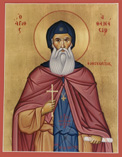 Born in 1310, he lived in asceticism on the Holy Mountain.
He founded a famous monastery in the Meteora in Thessaly. He had great gifts of discernment
and wonder-working. |
Author’s note: Philaret also mentions Gabriel the Child-martyr in his ‘Lives of the Saints’. He was born in the village of Zvjerka, near the town of Zabludov and was only six years old when, in 1648, on the day when his parents were not at home, he was lured to a lonely place by a Jew named Schutko and crucified there. His body was found incorrupt thirty years later.
FOR CONSIDERATION
St. Anastasios of Mount Sinai teaches: ‘God gives to each Christian an angel to care for him through his whole life, unless he drives him away by his evil doings. But, as smoke drives away bees and an evil stench doves, so the guardian of our life, our angel, is driven away from us by our sins: drunkenness, debauchery, anger and the rest. An angel guides every faithful man in every good work, while the demons exert all their strength to disturb the faithful and deprive them of the heavenly kingdom.’ That angels are close to men and take care of them is testified to in the whole of holy Scripture and especially in the New Testament. Besides this, there are in the Orthodox Church innumerable testimonies of holy men and women who witnessed to that which Anastasios emphasises: that a gracious and powerful messenger of God, a soldier of the King of heaven, an angel of light, accompanies each one of us through this life. Who, other than the insane, would drive away such a good friend from himself? Indeed, only the insane and other ignoramuses drive away their greatest friends, their guardian angels.
Daily Scripture Readings taken from The Orthodox New Testament, translated and published by Holy Apostles Convent, Buena Vista, Colorado, copyright © 2000, used with permission, all rights reserved.
Daily Prologue Readings taken from The Prologue of Ochrid, by Bishop Nikolai Velimirovic, translated by Mother Maria, published by Lazarica Press, Birmingham, England, copyright © 1985, all rights reserved. Edited by Dormition Skete.