

Daily Devotional
Sunday, April 30, 2034 (NS), April 17, 2034 (OS)
No Fasting.
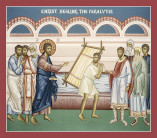
| The Fourth Sunday of Pascha, or the Sunday of the Paralytic Mode Three — Fifth Eothinon |
The commemoration of our holy father among the saints, Symeon, Bishop of Persia, and those with him, Avdella the presbyter, Gothazat, Fousik, and 1,150 others, and our holy father among the saints, Akakios, Bishop of Melitene.
Scripture Readings
Paschalion — Movable Calendar
The Fourth Sunday of Pascha, or the Sunday of the Paralytic
Mode Three — Fifth Eothinon
Epistle
The Reading is from the Acts of the Apostles [§ 23]. In those days:
9 32It came to pass, as Peter passed through all quarters, he went down also to the saints that dwelt at Lydda. 33And there he found a certain man, by name Æneas, who kept his bed for eight years, and was paralyzed. 34And Peter said to him, “Æneas, Jesus the Christ healeth thee; rise up and make up thy bed for thyself.” And straightway he rose up. 35And all those inhabiting Lydda and the Sharon Plain, who saw him, turned to the Lord. 36Now there was in Joppa a certain disciple, by name Tabitha, which, being interpreted, is called Dorcas. She was full of good works and of alms which she used to do. 37And it came to pass in those days she fell sick and died. And after they washed her, they laid her in an upper room. 38And since Lydda was near to Joppa, and the disciples heard that Peter was in it, they sent forth two men to him, beseeching him not to delay to come over to them. 39And Peter, having risen up, went with them, whom after he came, they brought him into the upper room. And all the widows stood by him weeping, and showing howsoever many tunics and garments Dorcas used to make while she was with them. 40But Peter put them all forth, and kneeled down, and prayed. And turning to the body, he said, “Tabitha, rise up.” And she opened her eyes; and after she saw Peter she sat up. 41And he gave her his hand and raised her up; and after he called the saints and the widows, he presented her alive. 42And it became known throughout all of Joppa; and many believed on the Lord.
Gospel
The Reading is from the Holy Gospel according to Saint John [§ 14]. At that time:
5 1Jesus went up to Jerusalem. 2Now there is in Jerusalem by the gate a sheep pool, which is surnamed in Hebrew, Bethesda, having five porches. 3In these was lying a great multitude of the infirm, blind, lame, withered, awaiting the moving of the water. 4For an angel used to come down from time to time into the pool and trouble the water; then after the troubling of the water, the one who first entered became well of whatsoever disease he was held by. 5And a certain man was there, who had been thirty and eight years in his infirmity. 6Jesus saw this one lying there, and knew that he had already been much time in that condition, and He said to him, “Dost thou wish to become well?” 7The sick man answered Him, “Sir, I have no man in order that whenever the water is troubled he may put me into the pool; but while I am coming, another goeth down before me.” 8Jesus saith to him, “Rise, take up thy bed and be walking.” 9And straightway the man became well, and took up his bed, and went on walking. And on that day it was a sabbath. 10The Jews therefore were saying to him who had been healed, “It is a sabbath; it is not lawful for thee to take up the bed.” 11He answered them, “The One Who made me well, the same said to me, ‘Take up thy bed and be walking.’” 12Then they asked him, “Who is the Man Who said to thee, ‘Take up thy bed and be walking?’” 13But the one who was healed knew not Who it was, for Jesus turned aside, because a crowd was in the place. 14After these things Jesus findeth him in the temple, and said to him, “Behold, thou hast become well; no longer go on sinning, lest a worse thing should befall thee.” 15The man went away, and told the Jews that Jesus was the One Who made him well.
Menaion — Fixed Calendar
The commemoration of our holy father among the saints, Symeon, Bishop of Persia, and those with him, Avdella the presbyter, Gothazat, Fousik, and 1,150 others, and our holy father among the saints, Akakios, Bishop of Melitene.
No readings given.
Lives of the Saints (Prologue)
April 30th – Civil Calendar
April 17th – Church Calendar
1. The Hieromartyr Simeon, Bishop in Persia.
In the time of the wicked King Sapor, Simeon was tortured for Christ together with two of his priests, Audel and Ananias. The king’s eunuch, Ustazan, who had first denied Christ but then, moved by the reprimand of St. Simeon, again confessed the true Faith before the king, was executed before they were. A thousand other Christians were also led to execution with St. Simeon, who purposely stood a little back so that he should be the last to die, and so be able to encourage the other Christians right to the end and keep them from wavering through fear of death. When the priest Ananias laid his head on the block, he was trembling all over. But the king’s clerk, Fusik, who was himself secretly a Christian, began to encourage him, saying: ‘Don’t be frightened, elder. Shut your eyes and be a man, and you’ll see the divine light.’ As soon as he had said this, it was seen that he was a Christian and he was denounced to the king. The king wore him down with harsh tortures, and also his daughter, the maiden Askitria. St. Simeon was eventually beheaded, after having seen his flock into the other world. The following year, on Great Friday, the king’s beloved eunuch, Azat, was slain for Christ, along with another thousand of the faithful. Then the king grieved for his eunuch and gave up killing any more Christians. They all suffered with honor for Christ their King and Lord in about 341.
2. St. Acacius, Bishop of Melitene.
He lived in asceticism in his birthplace, the city of Melitene in Armenia. Blessed Otreius, the bishop of that city, who took part in the Second Ecumenical Council in 381, ordained him to the priesthood. After Otreius’ death, Acacius was chosen as bishop. He participated in the Third Ecumenical Council in 431, which condemned the Nestorian blasphemy concerning the Mother of God. There he, together with St. Kyril of Alexandria, showed great zeal for the purity of the Orthodox Faith. St. Acacius was endowed with great grace by God, and worked many miracles. After long and zealous service of God, he died peacefully in 435.
3. St. Agapetus, Pope of Rome.
He was sent by Theodotus, King of the Goths, to the Emperor Justinian in Constantinople, to dissuade the latter from his campaign against the Goths. On the way, he healed a dumb and blind man. In Constantinople, he helped to uphold Orthodoxy, and died in 536.
4. Our Holy Father Zossima.
One of the founders of the ascetic community on the island of Solovetz (Solovki) in the White Sea. Many great saints were glorified in this community. His predecessor St. Sabbatius entered into rest in 1435, and St. Zossima in 1478.
FOR CONSIDERATION
After the Council of Chalcedon the Emperor Anastasios, a heretic, sent Elias, the Orthodox Patriarch of Jerusalem, and Flavian of Antioch to prison. One day these two saints foresaw the death of the heretic emperor, and simultaneously sent each other word of this, saying: ‘Anastasios has at this moment died; let us set out that we may be judged by God together with him!’ The emperor died, and both patriarchs died two days later. What zeal for the true Faith! And what a humble attitude to God’s judgement! These saints saw no other reason for their earthly life than the truth of God. Neither did they say ‘We have judged,’ but ‘Let God judge!’ Our sojourn on earth is not just for the sake of our being here, but for our personal decision for good or evil, for truth or falsehood. Blessed are we if we can lay all before the will of God and the judgement of God. But in all things a strong faith is vital. These Orthodox hierarchs had strong faith.
So had St. Acacius. Once, in a time of great drought, when the people were in despair, Acacius held a procession with the people all round the town. And he arranged for the Liturgy to be celebrated outside the town, outside the Church of St. Eustace. Consecrating the holy Gifts, Acacius did not pour water into the wine, but prayed to God that He, the Almighty, would send water into the chalice from a cloud. God hearkened to the prayer of His faithful servant and sent abundant rain onto the thirsty fields, as well as into the chalice.
Daily Scripture Readings taken from The Orthodox New Testament, translated and published by Holy Apostles Convent, Buena Vista, Colorado, copyright © 2000, used with permission, all rights reserved.
Daily Prologue Readings taken from The Prologue of Ochrid, by Bishop Nikolai Velimirovic, translated by Mother Maria, published by Lazarica Press, Birmingham, England, copyright © 1985, all rights reserved. Edited by Dormition Skete.