

Daily Devotional
Saturday, March 25, 2034 (NS), March 12, 2034 (OS)
Fast Day, but Shellfish, Wine and Olive Oil Allowed.
Holy & Great Fast
The Saturday of the Fifth Week of the Great Fast and of the Akathist
The commemoration of our holy Father Theophanes the Confessor of Sigriane, and our father among the saints, Gregory the Dialogist, Pope of Rome, and our venerable Father Symeon the New Theologian.
Scripture Readings
Paschalion — Movable Calendar
The Saturday of the Fifth Week of the Great Fast and of the Akathist
Epistle
The Reading is from the Epistle of Saint Paul to the Hebrews [§ 322]. Brethren:
9 24The Christ entered not into the holies made by hand, antitypes of the true things, but into the heaven itself, now to be manifested before the face of God on our behalf; 25not in order that He may offer Himself many times, even as the high priest entereth into the holies year by year with blood belonging to another; 26for otherwise it would be necessary for Him many times to have suffered from the foundation of the world; but now, once for all, at the consummation of the ages, He hath been manifested for the setting at nought of sin by the sacrifice of Himself. 27And inasmuch as it is laid up for men to die once, but after this, judgment, 28thus the Christ Who was offered once for all to bear up the sins of many, shall appear the second time without sin to those who await Him unto salvation.
Another Reading for Saturday of the Fifth Week of the Great Fast for the Theotokos
The Reading is from the Epistle of Saint Paul to the Hebrews [§ 320]. Brethren:
9 1The first tabernacle also used to have both ordinances of worship and the sanctuary of this world. 2For a tabernacle was furnished: the first in which were both the lampstand and the table, and the laying forth of the loaves, which is called Holy; 3and after the second veil, a tabernacle which is called Holy of Holies, 4which hath a golden censer, and the ark of the covenant which hath been covered all around from every side with gold, in which was the golden jar having the manna, and the rod of Aaron that budded, and the tablets of the covenant; 5and above it were the cherubim of glory overshadowing the mercy seat, concerning which now is not the time to speak severally. 6Now after these things were thus furnished, the priests, on the one hand, enter into the first tabernacle, performing worship services; 7on the other hand, into the second, the high priest entereth alone once for all every year, not without blood, which he offereth on behalf of himself and the faults of ignorance of the people.
Gospel
The Reading is from the Holy Gospel according to Saint Mark [§ 35]. At that time:
8 27Jesus went out, and His disciples, into the villages of Cæsarea Philippi; and on the way He was asking His disciples, saying to them, “Whom do men say that I am?” 28And they answered, “John the Baptist, but others say Elias; and others, one of the prophets.” 29And He saith to them, “But ye, whom do ye say that I am?” And Peter answereth and saith to Him, “Thou art the Christ.” 30And He strictly warned them that they should tell no one about Him. 31And He began to teach them that it is necessary for the Son of Man to suffer many things, and to be rejected by the elders and chief priests and scribes, and to be killed, and after three days to rise.
Another Reading for the Theotokos
The Reading is from the Holy Gospel according to Saint Luke [§ 54]. At that time:
10 38Jesus entered into a certain village. And a certain woman, by name Martha, received Him into her house. 39And she had a sister called Mary, who also sat down beside the feet of Jesus, and was listening to His word. 40But Martha was distracted about much serving, and she came up to Him and said, “Lord, is it no concern to Thee that my sister left me to serve alone? Speak to her therefore that she should help me.” 41And Jesus answered and said to her, “Martha, Martha, thou art anxious and troubled about many things. 42“But there is need of one thing, and Mary chose the good part, which shall not be taken away from her.”...
11 27And it came to pass, as He was speaking these things, a certain woman out of the crowd lifted up her voice and said to Him, “Blessed is the womb that bore Thee, and the breasts which Thou didst suck.” 28But He said, “Yea rather, blessed are they who hear the word of God and keep it.”
Menaion — Fixed Calendar
The commemoration of our holy Father Theophanes the Confessor of Sigriane, and our father among the saints, Gregory the Dialogist, Pope of Rome, and our venerable Father Symeon the New Theologian.
Epistle
For the Hierarch:
The Reading is from the Epistle of Saint Paul to the Hebrews [§ 318]. Brethren:
7 26Such a High Priest was fitting for us: holy, guileless, undefiled, Who hath been separated from the sinners and hath become higher than the heavens, 27Who hath no need daily, even as the high priests, to offer up sacrifices, first for his own sins, then for those of the people; for this He did once for all after He offered up Himself. 28For the law appointeth men high priests who have weakness; but the word of the oath, which is after the law, appointeth the Son, Who hath been perfected forever.
8 1Now in reference to the things being spoken of, the chief point is: We have such a High Priest, Who sat down on the right of the throne of the majesty in the heavens, 2a Liturgist of the holies and of the tabernacle, the true one, which the Lord pitched, and not man.
Gospel
For the Hierarch:
The Reading is from the Holy Gospel according to Saint Luke [§ 24]. At that time:
6 17Jesus stood upon a level place. And there was a crowd of
His disciples, and a great multitude of the people from all of Judæa and Jerusalem and the
seacoast of Tyre and Sidon, who came to hear Him, and to be healed of their diseases—
18even those who were troubled by unclean spirits; and they were cured.
19And all the crowd was seeking to touch Him, for power was coming forth from Him and
healing all. 20And He lifted up His eyes to His disciples, and began to say:
“Blessed are the poor, for yours is the kingdom of God.
21“Blessed are ye who hunger now, for ye shall be
filled.
Blessed are ye who weep now, for ye shall laugh.
22“Blessed are ye whenever men hate you, and whenever they
separate you, and reproach you, and cast out your name as evil, on account of the Son of
Man.
23“Rejoice in that day and leap for joy, for behold, your
reward is great in the heavens.”
Lives of the Saints (Prologue)
March 25th – Civil Calendar
March 12th – Church Calendar
1. Our Holy Father Theophanes the Confessor.
Named ‘the Sygrian’ from his birthplace, Sygriane, he was a kinsman of the Emperor Leo the Isaurian (717-741) and his son Kopronymos (741-775). He had enormous wealth and lived in great splendor. But all this lost its value for Theophanes when he enthroned Christ the Lord in his soul. Then he was hindered by a marriage which he was obliged to make. He succeeded, though, in persuading his bride that they should live as brother and sister in chastity, and as soon as his parents died, his wife went to one monastery and he to another. His monastery was in the Syrian mountains in the Kyzikos region. The splendid and wealthy Theophanes lived for some time in the monastery as the poorest wretch, and all marvelled at the great change in him. Then, because he had become so known for his firm faith, abstinence and wisdom, he was invited to the Seventh Ecumenical Council at Nicaea in 787, at which the veneration of icons was upheld. Because of his great purity and chastity, God gave him the gift of wonder-working and he was able to heal all manner of illness, especially mania and madness. He prayed to God for all the sick and distressed and helped them by his prayers. Only when he himself fell ill and was sick for a long time did he refuse to pray for his own healing but endured it with thanksgiving. When another iconoclast period arose under the wicked Emperor Leo the Armenian, Theophanes was taken to Constantinople and thrown into prison, where he spent two years in discomfort, pain and humiliation. The emperor then sent him into exile on the island of Samothrace, an exile which he had foreseen in his spirit and foretold to the prison warders. When he arrived on Samothrace, he lived for only twenty-three days, then went to his Lord and Creator to receive the deserved wreath of glory.
2. Our Holy Father Simeon the New Theologian.
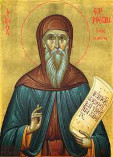 This
great and godly father of the Church was born in Galatia in Paphlagonia and educated in
Constantinople, where he entered the imperial service. He left all for Christ and took
himself off to a monastery, living in asceticism under the guidance of an elder, Simeon. He
then became abbot of the monastery of St. Mamas, and finally a hermit. He was the greatest
theologian since St. Gregory the Theologian. His writings, illumined with the grace he
carried in his heart, are a true theological revelation. He entered into rest in 1022,
leaving wonder-working relics. |
3. St. Gregory the Dialogist, Pope of Rome.
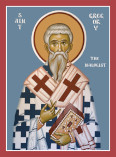 Son of the senator Gordianus, he himself became a senator and
governor of the city of Rome, but as soon as his father died, he gave himself to the spiritual
life. Out of his great wealth, he built six monasteries in Sicily and a seventh in Rome itself,
being tonsured in this last, which he dedicated to the Apostle Andrew. His mother, Sylvia, also
received the monastic schema in a women’s monastery. After the death of Pope Pelagius,
Gregory was chosen as pope. He fled from this honor and power and hid himself in the mountains
and ravines, but God showed people where to find him by making a fiery column, reaching from
earth to heaven, appear at the place where Gregory was hiding. He had a rare compassion, using
all his income for the housing of the poor and on hospitality. He frequently brought the poor in
and fed them from his own table. He occupied himself with the writing of instructive books.
‘The Dialogist,’ or ‘the one who converses’ was the name he was known by,
having written a book entitled ‘The Dialogues’ in which he brought to light the
virtues and miracles of the Italian saints. He also compiled the service of the Presanctified
Gifts that is used during the Great Fast. His archdeacon, Peter, often saw a dove hovering over
his head when he was writing. He went to the Lord in 604.
FOR CONSIDERATION
No one, not the Lord God Himself, takes pleasure in instructing the proud. No one cares for giving instruction to him who asserts that he knows everything. ‘Secrets will be revealed to the meek,’ says the wise Sirach (3:19). And David says that God ‘keeps the meek in truth and teaches the meek His ways’ (Ps. 24:9). The proud man wants to teach everyone and not be taught by anyone himself; but the meek man wants to teach no one but desires constantly to be instructed by someone, no matter whom. An empty ear of grain lifts its head high up over all the field, but a full ear has a drooping head!
O proud man, if only your guardian angel would some time pull back the curtain from your eyes and disclose to you the endless vista of all that you do not know! You would kneel before every man before whom you have vaunted your pride and whom you have despised, and would cry with tears: ‘Forgive me, forgive me! I know nothing!’ To the humble and devout it is often given to know the hour of their death, but death comes unexpectedly to the proud. St. Gregory the Dialogist tells of a humble bishop, Carpus, who celebrated the Liturgy every day, to whom One from the other world appeared and said: ‘Go on doing what you are doing, and serve Me while your legs will stand and your hands function. And on the day of the dormition of the Mother of God, come to Me, and I will give you your reward in My heavenly kingdom, together with all those who have prayed at these services.’ After a year, on the Feast of the Dormition, Bishop Carpus celebrated the divine Liturgy, bade farewell to his clergy and gave his spirit to God. And his face shone with the light of the sun.
Daily Scripture Readings taken from The Orthodox New Testament, translated and published by Holy Apostles Convent, Buena Vista, Colorado, copyright © 2000, used with permission, all rights reserved.
Daily Prologue Readings taken from The Prologue of Ochrid, by Bishop Nikolai Velimirovic, translated by Mother Maria, published by Lazarica Press, Birmingham, England, copyright © 1985, all rights reserved. Edited by Dormition Skete.