

Daily Devotional
Saturday, March 18, 2034 (NS), March 5, 2034 (OS)
Fast Day, but Shellfish, Wine and Olive Oil Allowed.
Holy & Great Fast
The Saturday of the Fourth Week of the Great Fast
The commemoration of the holy Martyr Conon of Isauria.
Scripture Readings
Paschalion — Movable Calendar
The Saturday of the Fourth Week of the Great Fast
Epistle
The Reading is from the Epistle of Saint Paul to the Hebrews [§ 313]. Beloved:
6 9We have been persuaded of the better things concerning you, even those things which hold on to salvation, though we speak thus. 10For God is not unjust, to be forgetful of your work and the labor of love which ye yourselves showed toward His name, in that ye have ministered to the saints and do minister. 11And we desire each of you to show the same earnestness to the full assurance of the hope until the end, 12in order that ye might not become sluggish, but imitators of those who through faith and long-suffering inherit the promises.
Another Reading for Saturday of the Fourth Week of the Great Fast in Commemoration of the Departed
The Reading is from the First Epistle of Saint Paul to the Corinthians [§ 163]. Brethren:
15 47The first man is of earth, earthy; the second Man is the Lord from heaven. 48As is the earthy, such are they also who are earthy; and as is the heavenly, such are they also who are heavenly. 49And even as we bore the image of the earthy, let us also bear the image of the heavenly. 50Now this I say, brethren, that flesh and blood is not able to inherit the kingdom of God; neither doth corruption inherit incorruption. 51Behold, I tell you a mystery: On the one hand we shall not all fall asleep, but on the other hand we shall all be changed— 52in a moment, in a wink of an eye, at the last trumpet. For a trumpet shall sound, and the dead shall be raised incorruptible, and we shall be changed. 53For it is needful for this corruptible to put on itself incorruption and this mortal to put on itself immortality. 54But whenever this corruption should put on itself incorruption, and this mortal should put on itself immortality, then the word which hath been written shall come to pass: “Death is swallowed up in victory [cf. Is. 25:8]. 55“O death, where is thy sting? O Hades, where is thy victory [cf. Hos. 13:14]?” 56Now the sting of death is sin, and the power of sin is the law. 57But thanks be to God Who giveth us the victory through our Lord Jesus Christ.
Gospel
The Reading is from the Holy Gospel according to Saint Mark [§ 31]. At that time:
7 31Jesus, having departed from the borders of Tyre and Sidon, came to the Sea of Galilee, in the midst of the borders of Decapolis. 32And they bring to Him a deaf man having an impediment in his speech; and they beseech Him that He might lay His hand on him. 33And He took him away, aside from the crowd, and put His fingers into his ears, and He spit and touched his tongue. 34And having looked up to the heaven, He sighed, and saith to him, “Ephphatha,” that is, “Be thou opened.” 35And straightway his ears were opened, and the band of his tongue was loosed, and he began to speak rightly. 36And He Himself gave them express orders that they should tell no one; but as much as He was giving them express orders, much more abundantly were they proclaiming it. 37And beyond all measure they were astonished, saying, “He hath done all things well. He maketh both the deaf to hear and the dumb to speak.”
Commemoration of the Departed
The Reading is from the Holy Gospel according to Saint John [§ 16]. The Lord said to the Jews who had come to Him:
5 24“Verily, verily, I say to you, that the one who heareth My word and believeth the One Who sent Me hath everlasting life, and cometh not into judgment, but hath passed over out of death into life. 25“Verily, verily, I say to you, that an hour cometh, and now is, when the dead shall hear the voice of the Son of God, and they who hear shall live. 26“For even as the Father hath life in Himself, so He also gave to the Son to have life in Himself, 27“and He also gave to Him authority to execute judgment. That He is Son of Man, 28“cease marvelling at this; for an hour is coming in which all those in the graves shall hear His voice, 29“and shall go forth—they who did good things to a resurrection of life, but they who practised bad things to a resurrection of condemnation. 30“I am not able to do anything of Myself. Even as I hear, I judge; and My judgment is just, because I seek not Mine own will, but the will of the One Who sent Me, the Father.”
Menaion — Fixed Calendar
The commemoration of the holy Martyr Conon of Isauria.
No readings given.
Lives of the Saints (Prologue)
March 18th – Civil Calendar
March 5th – Church Calendar
1. The Holy Martyr Conon of Isauria.
Conon was instructed in the Christian Faith and baptized in the name of the Holy Trinity by the Archangel Michael himself, and he was accompanied by this archangel of God right up to his death. He was so enlightened and fortified by grace of the Holy Spirit that his heart was kept from all things earthly and clave to the spiritual and heavenly. When his parents forced him to marry, he, on the first evening, took a candle and put it under a vessel, then asked his bride: ‘Which is better, light or darkness?’ She answered: ‘Light,’ and he then began to speak to her of the Christian Faith, and of the spiritual life as better and finer than the physical. He succeeded in bringing first her and then his parents to the Christian Faith, and he and his wife lived as brother and sister. His wife and parents soon died, and he withdrew himself entirely from the world and gave himself to prayer, fasting and pondering on God. He performed great wonders, which brought many to Christianity. Among other wonders, evil spirits were forced to serve him. During a persecution he was arrested and tortured, and stabbed all over with knives. The sick anointed themselves with his blood and were healed. He lived for two further years in his own town, and went to the Lord. This wonderful saint lived and suffered in the second century.
2. The Holy Martyr Conon the Gardener.
From Nazareth, he was mild and virtuous, and pleasing to God in all things. During the persecution under Decius he was tortured for Christ, but he remained firm in the Faith and sharply denounced the judges for their folly. With nails through his legs, this good and virtuous saint was bound behind the prince’s chariot and was dragged on and on, until he was utterly spent. Then he made his last prayer to God and gave his soul into His keeping, in 251.
3. Our Holy Father Hesychios the Faster.
He was born near Bursa in the eighth century, but withdrew to a mountain called the hill of Maion, a place with an evil reputation for diabolical apparitions. He built himself a hut there, and a church dedicated to St. Andrew, and also made himself a garden which he cultivated in order to live by his own toil. Miracles were worked through his prayers. He foretold that there would be a women’s monastery in that place after his death. A month before he died, he foretold the day and hour of his death, and at midnight on the day foretold, people saw his hut illumined with an unusual light, and when they came to it, they found him dead. He was buried in the church of St. Andrew, but later Theophylact, the bishop of Amaseia, took him to the town of Amaseia. He departed this life peacefully and went to the kingdom of his God in 790. (In the Greek Synaxarion, he is commemorated on March 6th.)
4. Our Holy Father Mark the Ascetic.
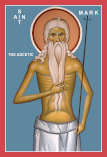 An ascetic and
wonder-worker, he was made a monk at the age of forty by his teacher, St. John Chrysostom.
Mark spent sixty more years in the Nitrian desert in fasting, prayer and the writing of
instructive books. He knew the whole of the holy Scriptures by heart. He was very merciful,
and wept for the distress of any one of God’s creatures. He was once weeping for the
blind whelp of a hyena when the whelp received its sight. In gratitude, the mother hyena
brought him a sheepskin, and the saint forbade the hyena in the future to slaughter the
sheep of poor people. He received communion at the hands of an angel. His homilies on the
spiritual law, on repentance, on sobriety and so forth fall into the first rank of
ecclesiastical literature; the great Patriarch Photius himself held them in high esteem. |
FOR CONSIDERATION
Why do some people, well-educated, baptized as Christians, fall away from Christianity into philosophy and learned theories, alleging them to be something truer than Christianity? For two main reasons: either from an utterly superficial knowledge of Christianity, or from sin. A superficial knowledge of Christ rejects Him, and sin flees from Christ like a felon from judgement. Superficial and guilty Christians have often become as bitter enemies of Christianity as are pagans. To the superficial and the guilty it is more comfortable to bathe in the shallow pool of human thought than in the dangerous depths of Christ. Those who sincerely set themselves to follow Christ are constantly invited by Christ to a greater and greater depth, as He once said to the Apostle Peter: ‘Launch out into the deep.’ St. Mark the Ascetic writes that one understands the law of God insofar as one fulfills His commandments. ‘Ignorance urges a man to speak against that which is helpful, and insolence breeds vice.’
Daily Scripture Readings taken from The Orthodox New Testament, translated and published by Holy Apostles Convent, Buena Vista, Colorado, copyright © 2000, used with permission, all rights reserved.
Daily Prologue Readings taken from The Prologue of Ochrid, by Bishop Nikolai Velimirovic, translated by Mother Maria, published by Lazarica Press, Birmingham, England, copyright © 1985, all rights reserved. Edited by Dormition Skete.