

Daily Devotional
Sunday, March 12, 2034 (NS), February 27, 2034 (OS)
Fast Day, but Shellfish, Wine and Olive Oil Allowed.
Holy & Great Fast
| The Sunday of the Third Week of the Great Fast or Sunday of the Veneration of the Cross. Mode Plagal Two — Sixth Eothinon |
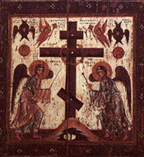
The commemoration of our venerable Father Procopios, Confessor of Decapolis.
Scripture Readings
Paschalion — Movable Calendar
The Sunday of the Third Week of the Great Fast or Sunday of the Veneration of the Cross.
Mode Plagal Two — Sixth Eothinon
Epistle
The Reading is from the Epistle of Saint Paul to the Hebrews [§ 311]. Brethren:
4 14Having then a great High Priest Who hath passed through the heavens, Jesus the Son of God, let us be holding fast our confession. 15For we do not have a High Priest Who is not able to sympathize with our weaknesses, but One Who hath been tempted in all respects according to our likeness, without sin. 16Let us therefore be coming with boldness to the throne of grace, that we might receive mercy and find grace for help in due season.
5 1For every high priest being taken from among men is being appointed on behalf of men in things pertaining to God, that he may offer both gifts and sacrifices for sins, 2who is able to feel in due measure with those who are ignorant and led astray, since he himself also is compassed about with weakness. 3And by reason of this he ought, even for the people, so also for himself, to offer for sins. 4And no one taketh the honor to himself, but he who is called by God, even as also Aaron. 5Thus also the Christ glorified not Himself to become a high priest, but the One Who said to Him, “Thou art My Son, today I have begotten Thee [Ps. 2:7].” 6Even as He saith also in another place, “Thou art a priest forever according to the order of Melchisedek [Ps. 109(110):4].”
Gospel
The Reading is from the Holy Gospel according to Saint Mark [§ 37]. The Lord said:
8 34“Whosoever is willing to follow after Me, let him deny himself, and take up his cross, and keep on following Me. 35“For whosoever will save his life shall lose it; but whosoever will lose his life on account of Me and of the Gospel, this same one shall save it. 36“For what shall it profit a man, if he should gain the whole world, and lose his soul? 37“Or what shall a man give as an exchange for his soul? 38“For whosoever is ashamed of Me and My words in this generation, the adulterous and sinful one, also the Son of Man shall be ashamed of him, whenever He should come in the glory of His Father with the holy angels.”
9 1And He was saying to them, “Verily I say to you, that there are some of those standing here who in no wise shall taste of death, until they see the kingdom of God having come in power.”
Menaion — Fixed Calendar
The commemoration of our venerable Father Procopios, Confessor of Decapolis.
No readings given.
Synaxarion Readings
Synaxarion for the Third Sunday of Great Lent
Adoration of the Precious and Life-giving Cross
“Let all the earth venerate the Cross, through which it has learned to worship Thee, the Logos.”
On this third Sunday of the Great Fast we celebrate the veneration of the precious and life-giving Cross. Since during the forty days of the Fast we are also in a way crucified, mortified to the passions, contrite, abased, and sorrowful, the precious and life-giving Cross is offered to us as refreshment and confirmation, calling to mind the Passion of our Lord Jesus Christ and comforting us. If our God was crucified for our sake, how great should be our effort for His sake, since our afflictions have been assuaged through the Lord’s tribulations, and by the commemoration and the hope of the Cross of glory. For as our Savior in ascending the Cross was glorified through dishonor and grief, so should we also endure our sorrows, in order to be glorified with Him. Also, as those who have traveled a long hard road, weighed down by the labors of their journey, in finding a shady tree, take their ease for a moment and then continue their journey rejuvenated, so now in this time of the Fast, this sorrowful and laborious journey, the holy fathers have planted the life-giving Cross for our relief and refreshment, to encourage and make easier the labors that lie ahead. Or as when there is a royal procession, the king’s scepter and banners precede him, and then he himself appears, radiant and joyous in his victory, causing his subjects to rejoice with him. So then our Lord Jesus Christ, desiring to show His sure victory over death and His glory on the day of the Resurrection, sends His scepter before Himself, the sign of His kingship, the life-giving Cross, to gladden and refresh us, as it greatly fortifies and enables us to be prepared to receive the King with all possible strength and to praise Him in His radiant victory.
This week lies at the middle of the holy Forty Day Fast. The Fast is like a bitter source because of our contrition and the sadness and sorrow for sin that it brings. And as Moses plunged the branch in the bitter waters of Marah, making them sweet, so God, Who has led us through the spiritual Red Sea away from Pharaoh, through the life-giving wood of the precious and life-giving Cross, sweetens the bitterness of the Forty Day Fast and comforts us as those who were in the wilderness, until the time when by His Resurrection He will lead us to the spiritual Jerusalem. And since the Cross is called, and indeed is, the Tree of Life, it is fitting that the holy fathers have planted the Tree of the Cross in the middle of the Great Fast to commemorate both Adam’s tasting of its sweet fruit and of its being taken from us in favor of the Tree of the Cross, tasting of which we shall in no way die but will have even greater life.
Through the power of Thy Cross, O Christ our God, preserve us also from the temptations of the evil one. And make us worthy to venerate Thy divine Passion and life-bearing Resurrection, having radiantly traversed the great length of the Fast, and have mercy on us, as Thou art good and lovest mankind. Amen.
Translated from Triodion, siest ‘Tripesnets: Triod’ Postnaya, Moscow, 1904, by Robert Parent.
Lives of the Saints (Prologue)
March 12th – Civil Calendar: Non-Leap Year
March 11th – Civil Calendar: Leap Year
February 27th – Church Calendar
1. Our Holy Father Prokopios of Decapolis.
This saint came from Decapolis by the Sea of Galilee. In youth, he gave himself to the monastic life and passed through all those prescribed labors that purify the heart and uplift the soul to God. When a persecution on the part of the wicked Emperor Leo the Isaurian broke out over icons, Prokopios stood up and defended icons, showing that their veneration is not idolatry, for Christians know that to prostrate themselves before icons is not to prostrate before dead matter, but before the living saints depicted on the icons. Prokopios was bestially tortured, imprisoned, beaten and flogged with iron flails. When the wicked emperor was murdered, being already a lost soul, the icons were returned to the churches and Prokopios returned to his monastery, where he spent his remaining days in peace. In old age, he entered into God’s kingdom, where he beheld with joy the living angels and saints whose images were on the honored icons on earth. He departed this life peacefully in the 9th century.
2. Our Holy Father Thalelaios (Thaleleus), a Syrian hermit.
He was at first in the monastery of St. Sava the Sanctified, but then settled in a pagan graveyard, famed for the appearing of evil spirits and bogies. To conquer his terror by faith in God, Thalelaios settled in that graveyard and lived there for many years, enduring much from the fallen spirits both day and night. By his great faith and love towards God, he was endowed by Him with the gift of working wonders, and did much good for the sick and suffering. He died in about 460.
3. Our Holy Father Titus of the Kiev Caves.
Titus was a priest and had a sincere love for a deacon, Evagrius, as brother for brother. But, though such was their love at first, it later became a mutual malice and hatred, sown by the devil. They hated each other so much that, when one of them used the censer in church, the other turned and went outside. Titus tried many times to make peace with his adversary, but in vain. Titus became ill, and all thought that he was dying. He begged that Evagrius be brought to him, that they might forgive each other. Evagrius was brought by force to Titus’ bedside, but he fled away, saying that he would not forgive Titus, either in this world or the next. As he said this, he fell to the ground and breathed his last. But Titus rose from his bed healed, and revealed how the demons had flown around him until he forgave Evagrius, and when he had done so, the demons had fled and attacked Evagrius, with angels of God surrounding himself. He died in 1190.
4. Our Holy Father Stephen.
He was first an official at the court of the Emperor Maurice, but then left his courtly service, and urged by the love of Christ, built an almshouse for the elderly in Constantinople. He died peacefully in 614.
5. The Holy Martyr Julian the Gout-Sufferer.
Because of his gout, he was unable either to stand or to walk. He was brought to trial in Alexandria on a stretcher for his faith in Christ and burned alive on a pyre, along with his pupil Chronyon, in the time of the Emperor Decius.
FOR CONSIDERATION
Whenever we are outside the grace of God, we are outside ourselves, and compared with our grace-endowed nature, we are in no better state than a madman compared with a healthy man. Only a grace-endowed man is a natural man; that is, a man of genuine nature, in whom the grace of God rules and reigns. St. Simeon the New Theologian says: ‘A lamp, even if it is filled with oil and has a wick, remains completely dark if it is not lit. So the soul, with regard to its adornment with all the virtues; if it has not the light and grace of the Holy Spirit, it is quenched and dark’ (Homily 59). As the great apostle says, ‘by the grace of God, I am what I am’ (I Cor. 15:10). To be without grace means to be estranged from God, and thus estranged from the reality of our own being. Our being, our personality, strengthens its reality and receives its fullness only in closeness to God. Thus sinners are those who are sick, lost in insubstantial shadows, without reality and without understanding.
Daily Scripture Readings taken from The Orthodox New Testament, translated and published by Holy Apostles Convent, Buena Vista, Colorado, copyright © 2000, used with permission, all rights reserved.
Daily Prologue Readings taken from The Prologue of Ochrid, by Bishop Nikolai Velimirovic, translated by Mother Maria, published by Lazarica Press, Birmingham, England, copyright © 1985, all rights reserved. Edited by Dormition Skete.