

Daily Devotional
Saturday, March 4, 2034 (NS), February 19, 2034 (OS)
Fast Day, but Shellfish, Wine and Olive Oil Allowed.
Holy & Great Fast
The Saturday of the Second Week of the Great Fast
The commemoration of the holy Apostles Archippos, Philemon, and Apfia, martyred at Colossae of Phrygia.
Scripture Readings
Paschalion — Movable Calendar
The Saturday of the Second Week of the Great Fast
Epistle
The Reading is from the Epistle of Saint Paul to the Hebrews [§ 309].
3 12Brethren, be taking heed, lest ever there shall be in any one of you an evil heart of unbelief in apostatizing from the living God; 13but be exhorting one another every day, as long as it is being called “Today,” lest any of you be hardened by the deceit of sin. 14For we have become partakers of Christ, if indeed we should hold fast the first principle of our subsistence firm even to the end, 15while it is being said, “Today, if ye will hear His voice, do not go on hardening your hearts as in the provocation [Ps. 94(95):8(7, 8)].” 16For who, having heard, did provoke? But was it not all those who came out of Egypt by Moses?
Another Reading for Saturday of the Second Week of the Great Fast in Commemoration of the Departed
The Reading is from the First Epistle of Saint Paul to the Thessalonians [§ 270].
4 13Brethren, we do not wish you to be ignorant concerning those who have fallen asleep, that ye may not be grieving, even as the rest who have no hope. 14For if we believe that Jesus died and is risen, so also those who fell asleep through Jesus will God bring with Him. 15For we say this to you by the word of the Lord, that we the living, the ones remaining over until the coming of the Lord, in no wise shall precede those who fell asleep. 16For the Lord Himself shall descend from heaven with a shout of command, with a voice of an archangel, and with a trumpet of God; and the dead in Christ shall rise first. 17Then we the living, the ones remaining over, shall be carried off together with them in clouds to a meeting of the Lord in the air, and so shall we always be with the Lord.
Gospel
The Reading is from the Holy Gospel according to Saint Mark [§ 6]. At that time:
1 35Jesus, having risen up very early at night, went out and departed into a desolate place, and was praying there. 36And Simon and those with him followed hard after Him. 37And having found Him, they say to Him, “All are seeking Thee.” 38And He saith to them, “Let us be going into the neighboring village-towns, in order that I might preach there also; for it was for this I have come forth.” 39And He was preaching in their synagogues in all Galilee, and casting out the demons.
40And a leper cometh to Him, beseeching Him, and kneeling down to Him and saying to Him, “If Thou art willing, Thou art able to cleanse me.” 41And Jesus, having been moved with compassion, stretched forth His hand and touched him, and saith to him, “I am willing; be thou cleansed.” 42And after He spoke, immediately the leprosy departed from him, and he was cleansed. 43And having sternly admonished him, forthwith He sent him away, 44also saying to him, “See that thou say nothing to anyone; but go thy way, show thyself to the priest, and offer for thy cleansing what Moses commanded, for a testimony to them.”
Commemoration of the Departed
The Reading is from the Holy Gospel according to Saint John [§ 16]. The Lord said to the Jews who had come to Him:
5 24“Verily, verily, I say to you, that the one who heareth My word and believeth the One Who sent Me hath everlasting life, and cometh not into judgment, but hath passed over out of death into life. 25“Verily, verily, I say to you, that an hour cometh, and now is, when the dead shall hear the voice of the Son of God, and they who hear shall live. 26“For even as the Father hath life in Himself, so He also gave to the Son to have life in Himself, 27“and He also gave to Him authority to execute judgment. That He is Son of Man, 28“cease marvelling at this; for an hour is coming in which all those in the graves shall hear His voice, 29“and shall go forth—they who did good things to a resurrection of life, but they who practised bad things to a resurrection of condemnation. 30“I am not able to do anything of Myself. Even as I hear, I judge; and My judgment is just, because I seek not Mine own will, but the will of the One Who sent Me, the Father.”
Menaion — Fixed Calendar
The commemoration of the holy Apostles Archippos, Philemon, and Apfia, martyred at Colossae of Phrygia.
No readings given.
Lives of the Saints (Prologue)
March 4th – Civil Calendar: Non-Leap Year
March 3rd – Civil Calendar: Leap Year
February 19th – Church Calendar
1. The Holy Apostles Archippus, Philemon and Apphia.
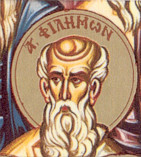 Archippus was one of the Seventy. The Apostle Paul mentions him in his
Epistles to the Colossians (4:17) and to Philemon (Philem. 2), calling him his fellow-soldier in
the battle. The Christians’ gathering-place for prayer in the town of Colossae was in the
house of Philemon. The Apostle Paul, writing to Philemon, calls this ‘the Church in thy
house’. This was in the time when the apostles were consecrating their disciples to the
episcopate—some to permanent sees and others as missionaries, travelling to various places.
Philemon was one of these latter. Apphia, Philemon’s wife, remained to serve the
house-church with fasting. At the time of a feast of the pagan goddess Artemis, all the faithful
in Colossae were, as was their custom, gathered at prayer in the house of Philemon. The pagans
came to hear of this gathering, rushed in on them and seized all the Christians. They flogged
Archippus, Philemon and Apphia as their leaders, then buried them up to the waist in the ground
and stoned them. Philemon and Apphia died of this, but they took Archippus out of the hole barely
alive and left him for the children to play with. They took knives and stabbed him all over, and
thus this fellow-soldier of Paul’s in the battle made a good end of his earthly road.
2. Our Holy Father Dositheos.
Dositheos was a disciple of the famous Abba Dorotheos, who lived with Saints Seridos, John and Barsanuphius the Great. He was kinsman to a general and traveled to Jerusalem to see the holy places. While he was looking at an icon of the Dreadful Judgement in some church, a woman in purple robes came up and explained many things to him. Finally, at parting, she told him that, if he sought salvation, he must fast and not eat meat, and pray frequently to God. This was the most holy Mother of God. The heart of the young Dositheos was set afire and he desired the monastic life. Dorotheos received him as his cell-servant and commanded him utterly to forsake his own will and obey his spiritual father. He left him for several days to eat as much as he wanted, then after a certain time cut his food down to a quarter, and after a while to a quarter of that, until he became accustomed to living on the smallest amount of food, always telling him: ‘Eating is a habit, and one eats what one is used to eating.’ He was saved and glorified by total obedience. He remains forever as an example of monastic obedience and devotion to one’s spiritual father. This young saint lived early in the 6th century.
FOR CONSIDERATION
St. Anthony teaches: ‘As a man comes forth naked from his mother’s womb, so the soul goes forth naked from the body. And one soul is pure and light, a second soiled by sin and a third blackened by many sins. If a body coming forth from an unhealthy womb cannot live, so also a soul; if it has not come to the knowledge of God through good conduct, it cannot be saved or be in communion with God. The organ of bodily vision is the eye; the organ of spiritual vision is the mind. As the body is blind without the eyes, so is the soul blind without a right mind and a right life.’
Daily Scripture Readings taken from The Orthodox New Testament, translated and published by Holy Apostles Convent, Buena Vista, Colorado, copyright © 2000, used with permission, all rights reserved.
Daily Prologue Readings taken from The Prologue of Ochrid, by Bishop Nikolai Velimirovic, translated by Mother Maria, published by Lazarica Press, Birmingham, England, copyright © 1985, all rights reserved. Edited by Dormition Skete.