

Daily Devotional
Saturday, February 25, 2034 (NS), February 12, 2034 (OS)
Fast Day, but Shellfish, Wine and Olive Oil Allowed.
Holy & Great Fast
The Saturday of the First Week of the Great Fast
The commemoration of our fathers among the saints, Meletios, Patriarch of Antioch the Great, and Alexis, Metropolitan and Wonder-worker of All Russia.
Scripture Readings
Paschalion — Movable Calendar
The Saturday of the First Week of the Great Fast
Epistle
The Reading is from the Epistle of Saint Paul to the Hebrews [§ 303]. Brethren:
1 1God, Who of old, in many parts and in many ways, spoke to the fathers through the prophets, 2did in these last of days speak to us through the Son, Whom He appointed heir of all things, by Whom also He made the ages, 3Who being the effulgence of the glory and impress of His hypostasis, and bearing all things by the word of His power, having made for Himself our purification through Himself, sat down on the right of the Majesty in high places, 4having become so much better than the angels, as He hath inherited a more excellent name than they. 5For to which of the angels said He at any time, “Thou art My Son, today I have begotten Thee [Ps. 2:7]”? And again, “I will be to Him for a Father, and He shall be to Me for a Son [2 Kgs.(2 Sam.) 7:14]”? 6And whenever He again should bring in the firstborn into the inhabited world, He saith, “And let all the angels of God do homage to Him [Deut. 32:43 LXX; cf. Ps. 96(97):8(7)].” 7And indeed with reference to the angels He saith, “The One Who maketh His angels spirits, and His ministers a flame of fire [Ps. 103(104):5(4)]”; 8but with reference to the Son, “Thy throne, O God, is forever and ever; a scepter of uprightness is the scepter of Thy kingdom [Ps. 44(45):5(6)]. 9“Thou didst love righteousness and didst hate lawlessness; on this account, God, Thy God, anointed Thee with the oil of gladness beyond Thy fellows [Ps. 44(45):6(7)].” 10And, “Thou, O Lord, in the beginning founded the earth, and the heavens are the works of Thy hands [Ps. 101(102):25]. 11“They shall perish, but Thou remainest; and they shall all become old as an outer garment [Ps. 101(102):26], 12“and as a covering Thou shalt roll them up, and they shall be changed. But Thou art the same, and Thy years shall not fail [Ps. 101(102):26, 27].”
Another Reading for Saturday of the First Week of the Great Fast in Commemoration of Saint Theodore
The Reading is from the Second Epistle of Saint Paul to Saint Timothy [§ 292]. Child Timothy:
2 1Be thou empowered in the grace that is in Christ Jesus; 2and the things which thou heardest from me in the midst of many witnesses, commit thou these things to faithful men who shall be competent also to teach others. 3Thou therefore suffer hardship as a good soldier of Jesus Christ. 4No one serving as a soldier is entangled with the affairs of life, in order that he might please the one who enlisted him. 5And if anyone also contend as an athlete in the games, he is not crowned unless he contend lawfully. 6The farmer who laboreth must be first to partake of the fruits. 7Be considering what I say; O may the Lord give thee understanding in all things! 8Be remembering Jesus Christ, of the seed of David, Who hath been raised from the dead, according to my Gospel, 9in which I suffer hardship even to bonds as a malefactor, but the word of God hath not been bound. 10On this account I endure all things for the sake of the elect, that they might also attain salvation that is in Christ Jesus with eternal glory.
Gospel
The Reading is from the Holy Gospel according to Saint Mark [§ 10]. At that time:
2 23During the sabbath days Jesus was going along through the sown fields; and His disciples began to make their way plucking the ears of grain. 24And the Pharisees were saying to Him, “Behold, why do they that which is not lawful on the sabbath days?” 25And He was saying to them, “Did ye not ever read what David did when he had need and hungered, he and those with him: 26“how he entered into the house of God in the time of Abiathar the high priest, and ate the loaves set forth before the presence of God, which it is not lawful to eat, except for the priests, and gave also to those who were with him?” 27And He was saying to them, “The sabbath was made for man, not man for the sabbath. 28“Therefore the Son of Man is Lord also of the sabbath.”
3 1And He entered again into the synagogue; and a man was there whose hand had been withered. 2And they were watching Him closely, whether He would cure him on the sabbath, in order that they might accuse Him. 3And He saith to the man who had the withered hand, “Arise and stand in the midst.” 4And He saith to them, “Is it lawful on the sabbath days to do good or to do evil, to save life or to kill?” But they were silent. 5And having looked round about on them with wrath, being grieved for the hardness of their heart, He saith to the man, “Stretch forth thy hand.” And he stretched it forth, and his hand was restored sound as the other.
Commemoration of Saint Theodore
The Reading is from the Holy Gospel according to Saint John [§ 52]. The Lord said to His disciples:
15 17“These things I command you, that ye be loving one another.
18“If the world hate you, ye know that it hath hated Me before it hath hated you. 19“If ye were of the world, the world would love its own; but because ye are not of the world—but I chose you for Myself out of the world—therefore the world hateth you. 20“Keep on remembering the word which I said to you, ‘A slave is not greater than his lord.’ If they persecuted Me, they will also persecute you; if they kept My word, they will keep yours also. 21“But all these things they will do to you for My name’s sake, because they know not the One Who sent Me. 22“If I had not come and spoken to them, they would not have sin, but now they have no pretext for their sin. 23“The one who hateth Me hateth My Father also. 24“If I did not do the works among them which no other one hath done, they would not have sin; but now they have both seen and hated both Me and My Father. 25“But this cometh to pass that the word might be fulfilled which hath been written in their law: ‘They hated Me without a cause [cf. Ps. 34(35):22, 68(69):5(4)].’ 26“But whenever the Paraclete should come, Whom I shall send to you from the Father, the Spirit of the truth Who proceedeth from the Father, that One shall bear witness concerning Me. 27“And ye also are bearing witness, because ye have been with Me from the beginning.
16 1“These things I have spoken to you, in order that ye should not be made to stumble. 2“They shall put you out of the synagogues; yea moreover, there cometh an hour that everyone who killeth you should think that he offereth God a service.”
Menaion — Fixed Calendar
The commemoration of our fathers among the saints, Meletios, Patriarch of Antioch the Great, and Alexis, Metropolitan and Wonder-worker of All Russia.
Epistle
The Reading is from the Epistle of Saint Paul to the Hebrews [§ 335]. Brethren:
13 17Be obedient to those who lead you, and keep on submitting, for they are watchful for your souls, as those about to render an account, that they may do this with joy, and not groaning; for this would be unprofitable for you. 18Keep on praying for us; for we trust that we have a good conscience, in all things wishing to conduct ourselves well. 19But I beseech you more abundantly to do this, that I might be restored more quickly to you.
20Now the God of peace Who brought up from the dead our Lord Jesus, the Shepherd of the sheep, the great One, in the blood of an everlasting covenant, 21may He render you perfect in every good work, in order to do His will, doing in you that which is well-pleasing before His face, through Jesus Christ, to Whom be glory to the ages of the ages. Amen.
Gospel
The Reading is from the Holy Gospel according to Saint Luke [§ 24]. At that time:
6 17Jesus stood upon a level place. And there was a crowd of
His disciples, and a great multitude of the people from all of Judæa and Jerusalem and the
seacoast of Tyre and Sidon, who came to hear Him, and to be healed of their diseases—
18even those who were troubled by unclean spirits; and they were cured.
19And all the crowd was seeking to touch Him, for power was coming forth from Him and
healing all. 20And He lifted up His eyes to His disciples, and began to say:
“Blessed are the poor, for yours is the kingdom of God.
21“Blessed are ye who hunger now, for ye shall be
filled.
Blessed are ye who weep now, for ye shall laugh.
22“Blessed are ye whenever men hate you, and whenever they
separate you, and reproach you, and cast out your name as evil, on account of the Son of
Man.
23“Rejoice in that day and leap for joy, for behold, your
reward is great in the heavens.”
Lives of the Saints (Prologue)
February 25th – Civil Calendar
February 12th – Church Calendar
1. St. Meletius, Archbishop of Antioch.
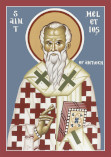 This great and holy man was an outstanding interpreter
and defender of Orthodoxy. The whole of his life was devoted to the fight against the Arian
heresy, which did not recognize the Son of God and blasphemed against the Holy Trinity.
Originally living in Armenia, he was appointed to shepherd the Church of Antioch. In that place,
the struggle between the Orthodox and the heretics was so bitter that the first time St. Meletius
preached to the people in church on the divine Trinity in unity, the deacon, a heretic, ran up to
the bishop and shut his mouth with his hand. Being unable to preach with words, Meletius preached
by signs. Thus, he raised his arms on high, opened three fingers to their fullest extent and
showed them to the people, then closed his hand and raised the one fist. He was three times
removed from his archiepiscopal throne by the heretics, and driven off into Armenia. He took part
in the Second Ecumenical Council in 381, where the Emperor Theodosios showed him especially great
honor. At that council, God showed a mystery through His archbishop. When Meletius was
propounding the doctrine of the Holy Trinity to the Arians, he first raised three fingers,
separated one by one, then brought them together; and at that moment lightning flashed from his
hand before the gaze of all present. At that council, Meletius established Gregory the Theologian
in the seat of Constantinople. While the council was still in session, St. Meletius finished his
earthly course in Constantinople. His relics were taken to Antioch.
2. St. Alexis (Alexei), Metropolitan of Moscow.
St. Alexis was a great hierarch of the Russian Church during a difficult period of Cossack warfare with the Russian people. Once in childhood he went bird hunting, and then went to sleep. In a dream he heard a voice that said, ‘Alexis, why rush around so fruitlessly? I will teach you to catch men!’ He became a monk at the age of twenty, and in time became Metropolitan of Moscow. He twice went among the Cossack Horde: once to sooth the wrath of Verdevir Khan against the Russian people, and the second time at the invitation of Amurat Khan, to cure his wife’s blindness. This woman had been blind for three years, but she was healed and her vision restored when Alexis prayed and anointed her with holy water. After a life of great endeavor and fruitfulness, Alexis entered into rest in 1378 at the age of 85, and went to the court of the Lord.
3. Our Holy Mother Mary (Marius).
Mary was a woman with great courage. After the death of her mother, her father desired to become a monk. Mary would not be separated from him, so they decided to go together to a men’s monastery—Mary with short hair and in man’s raiment as a youth. Her father died, and Mary became a monk and received the name Marius. There was an inn near the monastery, and the innkeeper’s daughter fell in love with the pious monk Marius. After pursuing him without success, she accused Marius of unlawful relations with her, because she had known some other man and borne him a son. Mary did not defend herself and was driven forth with scorn from the monastery. With the strange child in her care, she lived for three years in a grove belonging to the monastery, enduring hunger and hatred, and every sort of hardship and privation. As a result of all this, the innkeeper’s daughter became deranged. A little later, Mary died. Immediately after her death it was discovered that the ‘Monk Marius’ was a woman. As soon as the innkeeper’s daughter touched the relics of St. Mary, she was healed of her insanity and confessed her terrible sin. St. Mary entered into rest and went to eternal joy in 508.
4. St. Anthony, Patriarch of Constantinople.
A man of great compassion, he was at first an ascetic and then patriarch in the time of Emperor Leo the Wise (889-912). He professed his father a monk and built a monastery over the relics of St. Callia.
5. St. Callia.
Callia was generous to the poor from pure Christian compassion, both as a young girl and later as a married woman. Her husband was rich, but he was a hard man. Returning on one occasion from his work, he found that his wife had given away all his wealth to the poor. He thereupon killed her. But God glorified this compassionate soul, in that her relics healed many of the sick. Convinced by this of her sanctity, the holy Patriarch Anthony built a monastery over her relics.
FOR CONSIDERATION
St. John Chrysostom quotes the following example from the life of St. Meletius, demonstrating the true nobility of this great hierarch: Meletius was unjustly exiled from Antioch. When the governor got into the coach, seated the saint beside him and then began to drive hurriedly through the square, the citizens rushed from all sides with pebbles, which fell like hail on the governor’s head, the people being loath to part with their archbishop, and being ready to part with life rather than with this saint. But what did the blessed man do? Seeing the stones flying, he covered the governor’s head with his cloak. He thus shamed his enemy by his great meekness and gave his followers a lesson in the goodness we must show to those who insult us; how it is not enough just to do them no evil, but to use our strength to protect them from those dangers that threaten them. On Meletius’ outward appearance, St. Chrysostom writes further: ‘It was truly the greatest delight to see his holy face, and not only when he taught or spoke; when people only looked at him he brought virtue to the soul of the beholder.’
Daily Scripture Readings taken from The Orthodox New Testament, translated and published by Holy Apostles Convent, Buena Vista, Colorado, copyright © 2000, used with permission, all rights reserved.
Daily Prologue Readings taken from The Prologue of Ochrid, by Bishop Nikolai Velimirovic, translated by Mother Maria, published by Lazarica Press, Birmingham, England, copyright © 1985, all rights reserved. Edited by Dormition Skete.