

Daily Devotional
Thursday, February 9, 2034 (NS), January 27, 2034 (OS)
No Fasting.
Thursday of the Thirty-Fifth Week
The commemoration of the translation of the relics of our father among the saints, John Chrysostom, Archbishop of Constantinople.
Scripture Readings
Paschalion — Movable Calendar
Thursday of the Thirty-Fifth Week
Epistle
The Reading is from the First General Epistle of Saint John [§ 74]. Beloved:
4 20If anyone should say, “I love God,” and be hating his brother, he is a liar; for the one not loving his brother whom he hath seen, how is he able to love God Whom he hath not seen? 21And this commandment have we from Him, that the one loving God, be loving his brother also.
5 1Everyone who believeth that Jesus is the Christ hath been born of God; and everyone who loveth Him Who begat loveth also him who hath been begotten of Him. 2In this we know that we love the children of God, whenever we love God and keep His commandments. 3For this is the love of God, that we be keeping His commandments. And His commandments are not heavy. 4For everything that hath been born of God overcometh the world. And this is the victory, the victory having overcome the world—our faith. 5Who is the one overcoming the world, if not the one believing that Jesus is the Son of God? 6This is the One Who came by water and blood, Jesus Christ; not in the water only, but in the water and the blood. And the Spirit is the One Who beareth witness, because the Spirit is the truth. 7For there are three bearing witness in the heaven: the Father, the Logos, and the Holy Spirit; and these Three are One. 8And there are three bearing witness in the earth: the Spirit, and the water, and the blood; and the three are for the one. 9If we receive the witness of man, the witness of God is greater; for this is the testimony of God which He hath testified concerning His Son. 10The one believing in the Son of God hath the witness in himself; the one not believing God hath made Him a liar, because he hath not believed in the testimony which God hath testified concerning His Son. 11And this is the testimony, that God gave us eternal life, and this life is in His Son. 12The one having the Son hath the life; the one not having the Son of God hath not the life.
13I am writing these things to you who believe in the name of the Son of God, that ye may know that ye have eternal life, and in order that ye may believe in the name of the Son of God. 14And this is the boldness which we have toward Him, that if we be asking anything for ourselves according to His will, He heareth us. 15And if we know that He hear us, whatsoever we may be asking for ourselves, we know that we have the requests which we have asked from Him. 16If anyone should see his brother sinning a sin not unto death, he shall ask, and He shall give life to him, for those that sin not unto death. There is a sin unto death; not concerning that do I say one should make request. 17All unrighteousness is sin; and there is a sin not unto death. 18We know that everyone who hath been born of God sinneth not, but the one who was born of God keepeth himself, and the evil one doth not take hold of him. 19We know that we are of God, and the whole world lieth in the evil one. 20But we know that the Son of God is come, and hath given us an understanding, in order that we may know Him Who is true; and we are in the true One, in His Son Jesus Christ. This is the true God and Life Eternal.
21Little children, guard yourselves from the idols. Amen.
Gospel
The Reading is from the Holy Gospel according to Saint Mark [§ 66]. At that time:
15 1The chief priests held a consultation with the elders and scribes and the whole sanhedrin, and bound Jesus, and carried Him away, and delivered Him up to Pilate. 2And Pilate questioned Him, “Thou art the King of the Jews?” And He answered and said to him, “Thou sayest.” 3And the chief priests were accusing Him of many things, but He answered nothing. 4And Pilate was questioning Him again, saying, “Answerest Thou nothing? Behold how many things they bear witness against Thee.” 5But Jesus answered nothing any more, so that Pilate marvelled. 6Now at the feast he used to release to them one prisoner, whomsoever they were asking for themselves. 7And there was one called Barabbas, who had been bound with fellow insurrectionists who had committed murder in the sedition. 8And the crowd, having cried out, began to ask him to do even as he always used to do for them. 9But Pilate answered them, saying, “Do ye wish that I release to you the King of the Jews?” 10For he was perceiving that the chief priests had delivered Him up by reason of envy. 11But the chief priests stirred up the crowd, in order that he should rather release Barabbas to them. 12And Pilate answered and said again to them, “What do ye wish then that I should do to Him Whom ye call King of the Jews?” 13And they cried out again, “Crucify Him.” 14But Pilate was saying to them, “Why, what evil did He do?” And they cried out more exceedingly, “Crucify Him.” 15And Pilate, willing to do that which was satisfactory to the crowd, released Barabbas to them; and he delivered up Jesus, after he scourged Him, in order that He might be crucified.
Menaion — Fixed Calendar
The commemoration of the translation of the relics of our father among the saints, John Chrysostom, Archbishop of Constantinople.
Epistle
The Reading is from the Epistle of Saint Paul to the Hebrews [§ 318]. Brethren:
7 26Such a High Priest was fitting for us: holy, guileless, undefiled, Who hath been separated from the sinners and hath become higher than the heavens, 27Who hath no need daily, even as the high priests, to offer up sacrifices, first for his own sins, then for those of the people; for this He did once for all after He offered up Himself. 28For the law appointeth men high priests who have weakness; but the word of the oath, which is after the law, appointeth the Son, Who hath been perfected forever.
8 1Now in reference to the things being spoken of, the chief point is: We have such a High Priest, Who sat down on the right of the throne of the majesty in the heavens, 2a Liturgist of the holies and of the tabernacle, the true one, which the Lord pitched, and not man.
Gospel
The Reading is from the Holy Gospel according to Saint John [§ 36]. The Lord said to the Jews who had come to Him:
10 9“I am the door; by Me if anyone should enter, he shall be saved, and shall go in and go out and find pasture. 10“The thief cometh not, except that he might steal, and slay, and destroy. I came that they may have life, and may have it abundantly. 11“I am the good shepherd. The good shepherd layeth down his life for the sheep. 12“But the hireling, who indeed is not a shepherd, whose own the sheep are not, seeth the wolf coming, and leaveth the sheep and fleeth; and the wolf seizeth them and scattereth the sheep. 13“Now the hireling fleeth, because he is a hireling and careth not about the sheep. 14“I am the good shepherd; and I know those that are Mine, and am known of those that are Mine. 15“Even as the Father knoweth Me, I also know the Father; and I lay down My life for the sheep. 16“And I have other sheep which are not of this fold; them also it is needful for Me to bring, and they shall hear My voice; and there shall be one flock and one Shepherd.”
Lives of the Saints (Prologue)
February 9th – Civil Calendar
January 27th – Church Calendar
1. St. John Chrysostom, the Golden Mouth of Orthodoxy.
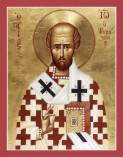 The Church celebrates the memory of this saint on November 13th and
January 30th, but on this day is celebrated the translation of his honored relics from the
Armenian village of Comana, where he died in exile in 407, to Constantinople where earlier, as
patriarch, he had governed the Church. Thirty years after his death, Patriarch Proklos made a
speech in memory of his spiritual father and mentor, and by this speech so roused the love of the
people and the emperor, Theodosios the Younger, towards the great saint that they all wanted the
relics of St. Chrysostom to be translated to Constantinople. It is related that the coffin
containing the relics could not be shifted from its place until the emperor had written a letter
to St. Chrysostom, begging his forgiveness (for Theodosios’ mother, Evdoxia, was guilty of
having persecuted the saint) and appealing to him to return to Constantinople, his former
residence. When this repentant letter was placed on the coffin, the latter became light in
weight. Before the translation, many of the sick, on touching the coffin, were healed. When the
relics arrived at the capital, the emperor again begged forgiveness over them in his
mother’s name, as though it were she herself speaking: ‘While I lived in this
temporal life, I acted in malice towards thee; but now that thou livest in eternal life, be thou
of help to my soul. My glory passes and there is nought to help me; help me, father, in thy
glory; help me before I come to be condemned before the judgment of Christ.’ When the saint
was carried into the Church of the Holy Apostles and placed on the patriarchal throne, the
assembled throng heard these words from his mouth: ‘Peace be unto all!’ The
translation of the relics of St. John Chrysostom was carried out in the year 438.
2. Our Holy Father Titus of the Kiev Caves.
He was at first a soldier, but receiving a wound in the head in battle, he retired from the world to the monastery of the Caves in Kiev, there to be healed and to receive the monastic schema. He spent his time in ceaseless mourning over his former sins. Before his death he was shown by a heavenly vision that all his sins had been forgiven. His relics lie in the caves of Theodosius.
FOR CONSIDERATION
Fasting is a great thing, but love is greater. If it is by fasting that devils are driven out, passions tamed, the body calmed, the spirit steadied, it is by love that God makes His abode with men. The Lord Himself emphasized fasting as necessary, but proclaimed love as the greatest commandment. In the first half of last century, Jeladin Bey, a Turk, ruled over Ochrid. He was a rebel against the sultan and an independent governor. At that time the Church was ruled by Metropolitan Kalinik. Jeladin and Kalinik, although of different faiths, were very good friends and often visited each other. It happened that Jeladin Bey condemned twenty-five Christians to death by hanging, and the execution was to take place on Great Friday. The metropolitan, deeply distressed by this event, went to Jeladin and besought him to mitigate the sentence. While they were talking, the hour of the midday meal arrived, and the bey invited the metropolitan to eat with him. A dish of lamb had been prepared for the meal. The metropolitan excused himself, as the fast (of the monastic rule, as well as of Holy Friday) prevented him from remaining to eat, and prepared to leave. The bey was angered and said to him: ‘Choose; either you eat with me and free twenty-five people from hanging, or you refrain and they hang.’ The metropolitan crossed himself and sat down to lunch, and Jeladin freed the people from the death sentence.
Daily Scripture Readings taken from The Orthodox New Testament, translated and published by Holy Apostles Convent, Buena Vista, Colorado, copyright © 2000, used with permission, all rights reserved.
Daily Prologue Readings taken from The Prologue of Ochrid, by Bishop Nikolai Velimirovic, translated by Mother Maria, published by Lazarica Press, Birmingham, England, copyright © 1985, all rights reserved. Edited by Dormition Skete.