

Daily Devotional
Tuesday, February 7, 2034 (NS), January 25, 2034 (OS)
No Fasting.
Tuesday of the Thirty-Fifth Week
25. The commemoration of our father among the saints, Gregory the Theologian, Archbishop of Constantinople.
Scripture Readings
Paschalion — Movable Calendar
Tuesday of the Thirty-Fifth Week
Epistle
The Reading is from the First General Epistle of Saint John [§ 72]. Brethren:
For Gk. usage, see 1 Jn. 3:9-22; for Sl. usage, see 1 Jn. 3:10-20, beginning in the middle of verse 10, “My beloved: Everyone who doeth not righteousness....”
3 9Everyone who hath been born of God doeth no sin, because His seed abideth in him; and he is not able to sin, because he hath been born of God. 10In this are manifest the children of God and the children of the devil. Everyone who doeth not righteousness is not of God, and neither is the one who loveth not his brother. 11Because this is the message which ye heard from the beginning, that we be loving one another, 12not as Cain, who was of the evil one and slew his brother. And on account of what did he slay him? Because his works were evil, but those of his brother righteous. 13Cease marvelling, my brethren, if the world hate you. 14We know that we have passed over out of death into life, because we love the brethren. The one not loving his brother abideth in death. 15Everyone who hateth his brother is a manslayer, and ye know that every manslayer hath not eternal life abiding in him. 16In this we have come to know love, because He laid down His life for us; and we ought to lay down our lives for the brethren. 17But whosoever may have the world’s means of livelihood, and may observe his brother having need, and shutteth up from him his compassion from the inward parts, how doth the love of God abide in him? 18My little children, let us not be loving in word, neither in tongue, but in deed and in truth. 19And in this we know that we are of the truth, and shall persuade our hearts before Him, 20that if our heart be condemning us, God is greater than our heart and knoweth all things. 21Beloved, if our heart be not condemning us, we have boldness toward God. 22And whatsoever we may ask, we receive from Him, because we keep His commandments and do the things that are pleasing before Him.
Gospel
The Reading is from the Holy Gospel according to Saint Mark [§ 64]. At that time:
14 10Judas the Iscariote, one of the twelve, went away to the chief priests, in order that he might deliver Him up to them. 11And after they heard it, they were glad and promised to give him money; and he was seeking how he might opportunely deliver Him up.
12And on the first day of the unleavened bread, when they used to slay the passover, His disciples said to Him, “Where dost Thou wish that we go and prepare, that Thou mightest eat the passover?” 13And He sendeth forth two of His disciples, and saith to them, “Go ye into the city, and a man shall meet you bearing an earthenware vessel of water; follow him. 14“And wheresoever he should enter, say to the master of the house, ‘The Teacher saith, “Where is the lodging-place, where I shall eat the passover with My disciples?”’ 15“And he will show you a large upper room, which hath been furnished and prepared; there make ready for us.” 16And His disciples went away, and came into the city, and found it even as He said to them; and they made ready the passover. 17And evening having come to pass, He cometh with the twelve. 18And as they reclined at table and ate, Jesus said, “Verily I say to you, that one of you who is eating with Me shall deliver Me up.” 19And they began to be grieved, and to say to Him, one by one, “It is not I, is it?” And another, “It is not I, is it?” 20But He answered and said to them, “It is one of the twelve, who dippeth with Me in the dish. 21“The Son of Man indeed goeth even as it hath been written concerning Him, but woe to that man by whom the Son of Man is delivered up! Good were it for that man if he had not been born.” 22And as they ate, Jesus took bread, blessed it, and broke it, and gave to them, and said, “Take, eat; this is My body.” 23And He took the cup, and gave thanks, and gave it to them; and they all drank of it. 24And He said to them, “This is My blood, that of the new covenant, which is being poured out for many. 25“Verily I say to you that in no wise will I drink any more of the fruit of the vine, until that day when I drink it new in the kingdom of God.”
26And having sung a hymn, they went out to the Mount of Olives. 27And Jesus saith to them, “Ye all shall be made to stumble because of Me during this night, for it hath been written: ‘I will smite the Shepherd, and the sheep shall be scattered abroad [cf. Zach. 13:7].’ 28“But after I have risen, I will go before you into Galilee.” 29But Peter said to Him, “Though all shall be made to stumble, yet not I.” 30And Jesus saith to him, “Verily I say to thee that today, during the night, before the cock crow twice, thou shalt deny Me thrice.” 31But he kept on speaking more vehemently, “If it should be necessary for me to die with Thee, in no wise will I deny Thee.” And in like manner also, they all were speaking.
32And they came to a place which was named Gethsemane; and He saith to His disciples, “Sit here while I pray.” 33And He taketh along with Him Peter and Iakovos and John, and began to be amazed and sorely troubled. 34And He saith to them, “My soul is very sad unto death. Tarry here and be watching.” 35And having gone forth a little, He fell upon His face on the ground, and was praying that, if it were possible, the hour might pass from Him. 36And He was saying, “Abba, Father, all things are possible to Thee. Take away this cup from Me; but not what I will, but what Thou wilt.” 37And He cometh and findeth them sleeping, and saith to Peter, “Simon, sleepest thou? Wast thou not able to watch one hour? 38“Be watching and praying that ye enter not into temptation; the spirit indeed is willing, but the flesh is weak.” 39And again He went away and prayed, saying the same utterance. 40And having returned, He found them again sleeping; for their eyes were weighed down, and they knew not what they should answer Him. 41And He cometh the third time, and saith to them, “Sleep on for what time remaineth and be taking your rest! It is enough, the hour hath come; behold, the Son of Man is being delivered up into the hands of the sinners. 42“Rouse yourselves, let us be going; behold the one delivering Me up hath drawn near.”
Menaion — Fixed Calendar
25. The commemoration of our father among the saints, Gregory the Theologian, Archbishop of Constantinople.
Epistle
The Reading is from the Epistle of Saint Paul to the Hebrews [§ 318]. Brethren:
7 26Such a High Priest was fitting for us: holy, guileless, undefiled, Who hath been separated from the sinners and hath become higher than the heavens, 27Who hath no need daily, even as the high priests, to offer up sacrifices, first for his own sins, then for those of the people; for this He did once for all after He offered up Himself. 28For the law appointeth men high priests who have weakness; but the word of the oath, which is after the law, appointeth the Son, Who hath been perfected forever.
8 1Now in reference to the things being spoken of, the chief point is: We have such a High Priest, Who sat down on the right of the throne of the majesty in the heavens, 2a Liturgist of the holies and of the tabernacle, the true one, which the Lord pitched, and not man.
for Sl. usage, see [1 Cor. 12:7-11].
Gospel
The Reading is from the Holy Gospel according to Saint John [§ 36]. The Lord said to the Jews who had come to Him:
10 9“I am the door; by Me if anyone should enter, he shall be saved, and shall go in and go out and find pasture. 10“The thief cometh not, except that he might steal, and slay, and destroy. I came that they may have life, and may have it abundantly. 11“I am the good shepherd. The good shepherd layeth down his life for the sheep. 12“But the hireling, who indeed is not a shepherd, whose own the sheep are not, seeth the wolf coming, and leaveth the sheep and fleeth; and the wolf seizeth them and scattereth the sheep. 13“Now the hireling fleeth, because he is a hireling and careth not about the sheep. 14“I am the good shepherd; and I know those that are Mine, and am known of those that are Mine. 15“Even as the Father knoweth Me, I also know the Father; and I lay down My life for the sheep. 16“And I have other sheep which are not of this fold; them also it is needful for Me to bring, and they shall hear My voice; and there shall be one flock and one Shepherd.”
Lives of the Saints (Prologue)
February 7th – Civil Calendar
January 25th – Church Calendar
1. St. Gregory the Theologian, Archbishop of Constantinople.
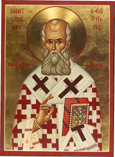 Born in Nazianzus of a Greek
father (who later became a Christian and a bishop) and a Christian mother, he studied in Athens
before his Baptism with St. Basil the Great and Julian the Apostate. He often foretold to Julian
that he would be an apostate and a persecutor of the Church, and so it came to pass. Gregory was
especially influenced by his mother, Nonna. He was baptized when he had completed his studies.
St. Basil consecrated him bishop of Sasima, and Emperor Theodosios called him to the vacant
archiepiscopal throne of Constantinople. His works were manifold, the best-known being his
theological writings, for which he received the title ‘the Theologian’. He is
particularly famed for the depth of his Sermons on the Holy Trinity. He also wrote against the
heretic Macedonius, who taught wrongly that the Spirit was a creature of God, and against
Apollinarius who taught that Christ did not have a human soul but that His divinity was in place
of His soul. He also wrote against the Emperor Julian the Apostate, his one time school-fellow.
In the year 381, when a quarrel broke out in the council concerning his election as archbishop,
he withdrew himself, declaring: ‘Those who deprive us of the (archiepiscopal) throne cannot
deprive us of God.’ He then left Constantinople and went to Nazianzus, remaining there in
retirement, prayer and the writing of instructive books until his death. And, although he was in
weak health all his life due to the ceaseless attacks of the heretics, he lived to the age of
seventy. His relics were later taken to Rome, and his head to the Cathedral of the Dormition in
Moscow. He was, and remains, a great and wonderful light of the Orthodox Church, as much for the
meekness and purity of his character as for the unsurpassable depth of his mind. He entered into
rest in the Lord in the year 389.
2. Our Holy Father Publius.
A senator at first, Publius came to know the light of Christ, left his honors and gave his goods to the poor and himself to the ascetic life in the vicinity of his town, Zeugma, on the Euphrates. He founded two communities and entered into rest in the Lord in the year 380.
3. Our Holy Father Mares.
He was distinguished by external beauty and a sweet singing voice. He retired from the world and lived in a hut for thirty-seven years in fasting and prayer and in cleansing his heart from thoughts. He entered into rest in the Lord as an elderly man of ninety in the year 430.
4. The Holy Martyr Felicitas and her seven sons.
She, together with her seven sons, was condemned to death for her Christian Faith in 164, in the reign of the Emperor Antoninus. She begged God only that she should not be killed before her sons, so that she might be able to encourage them in their torture and death not to deny Christ. And so it came to pass, by the providence of God. This mother joyfully bade her sons farewell one after the other, until she had seen all seven executed. Then she also, with thanksgiving to God, embraced a martyr’s death. They all suffered in Rome, where their relics are preserved.
FOR CONSIDERATION
They deceive themselves who self-confidently assert that they know men well and that no one can deceive them. Who, but the one God Who knows the secrets of the heart, can guess what kind of spiritual being any man is? Even the great saints were mistaken in people. For example: St. Basil for a long time considered a hypocritical heretic to be a holy man, and defended him against his many attackers until he was in the end, in bitter disappointment, convinced of the other’s deceit. St. Gregory the Theologian baptized a philosopher called Maximus and loved him so greatly that he shared his house and table with him. But this Maximus was as wicked and cunning as a snake, and after a while he managed by intrigues and bribes to be accepted by the citizens of Constantinople as patriarch in place of St. Gregory. When, after many intrigues, this trial was removed, Gregory was upbraided for having kept his greatest enemy at his side. ‘We are not to blame,’ replied the saint, ‘if we cannot see through a man’s wickedness. God alone knows man’s inner secrets. And we are told by the commandments to open our hearts with fatherly love to anyone who approaches us.’ The good, kindly man cannot easily comprehend the wickedness of the wicked man.
Daily Scripture Readings taken from The Orthodox New Testament, translated and published by Holy Apostles Convent, Buena Vista, Colorado, copyright © 2000, used with permission, all rights reserved.
Daily Prologue Readings taken from The Prologue of Ochrid, by Bishop Nikolai Velimirovic, translated by Mother Maria, published by Lazarica Press, Birmingham, England, copyright © 1985, all rights reserved. Edited by Dormition Skete.