

Daily Devotional
Sunday, February 5, 2034 (NS), January 23, 2034 (OS)
No Fasting.
The commemoration of the holy New-martyrs and Confessors of the Russian Land.
If the 25th of January falls on Monday, Tuesday, or Wednesday, chant the service of the New-martyrs on the preceding Sunday. If the 25th of January falls on Thursday, Friday, or Saturday, chant the service on the following Sunday. If the 25th of January falls on Sunday, chant the service for the New-martyrs that day, and the service to St. Gregory the Theologian on the 27th of January, in conjunction with that of St. John Chrysostom; in which case the hymns to St. Gregory precede those of St. John's. Thus the service can occur as early as the 22nd of January or as late as the 28th of that month.
If the service coincides with the Sunday of the Publican and the Pharisee, or with that of the Sunday of the Prodigal Son, or with Meatfare Sunday, the service of the New-martyrs is then chanted in conjunction with the Triodion and its Prokeimenon.
If a service to a major saint should fall on the same Sunday, we chant the service to the major saint on the closest Saturday, or on some other day.
If the church's feast day should fall on such a Sunday, chant the church's feast day in conjunction with the Triodion, with no further alteration. The service of the New-martyrs is then moved to the following Sunday.
| Fifth Period Mode One — First Eothinon |
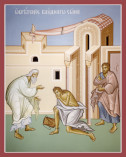
23. The commemoration of Hieromartyr Clement, Bishop of Ankyra.
Scripture Readings
Special Commemorations
The commemoration of the holy New-martyrs and Confessors of the Russian Land.
If the 25th of January falls on Monday, Tuesday, or Wednesday, chant the service of the New-martyrs on the preceding Sunday. If the 25th of January falls on Thursday, Friday, or Saturday, chant the service on the following Sunday. If the 25th of January falls on Sunday, chant the service for the New-martyrs that day, and the service to St. Gregory the Theologian on the 27th of January, in conjunction with that of St. John Chrysostom; in which case the hymns to St. Gregory precede those of St. John's. Thus the service can occur as early as the 22nd of January or as late as the 28th of that month.
If the service coincides with the Sunday of the Publican and the Pharisee, or with that of the Sunday of the Prodigal Son, or with Meatfare Sunday, the service of the New-martyrs is then chanted in conjunction with the Triodion and its Prokeimenon.
If a service to a major saint should fall on the same Sunday, we chant the service to the major saint on the closest Saturday, or on some other day.
If the church's feast day should fall on such a Sunday, chant the church's feast day in conjunction with the Triodion, with no further alteration. The service of the New-martyrs is then moved to the following Sunday.
Epistle
The Reading is from the Epistle of Saint Paul to the Romans [§ 99]. Brethren:
8 28We know that to those who love God all things work together for good, to those who are called according to purpose. 29For whom He foreknew, He also foreordained to be conformable to the image of His Son, in order for Him to be the firstborn among many brethren. 30But whom He foreordained, these also He called; and whom He called, these also He justified; and whom He justified, these also He glorified. 31What then shall we say to these things? If God is for us, who can be against us? 32He Who indeed spared not His own Son, but delivered Him up for us all, how shall He not with Him also graciously give us all things? 33Who shall bring an accusation against the elect of God? God is the One Who justifieth. 34Who is the one who condemneth? Christ is the One Who died, but much more is He the One also Who was raised, Who also is at the right of God, Who also intercedeth for us. 35Who shall separate us from the love of Christ? Shall affliction, or distress, or persecution, or famine, or nakedness, or danger, or sword? 36Even as it hath been written: “For on account of Thee, we are being put to death the whole day; we were counted as sheep of slaughter [Ps. 43(44):23(22)].” 37But in all these things we more than conquer through the One Who loved us. 38For I have been persuaded that neither death, nor life, nor angels, nor principalities, nor powers, nor things present, nor things coming, 39nor height, nor depth, nor any other created thing, shall be able to separate us from the love of God, which is in Christ Jesus our Lord.
Gospel
The Reading is from the Holy Gospel according to Saint Luke [§ 106]. The Lord said to His disciples, “Be taking heed of men:
21 12“For they shall lay their hands upon you and persecute you, delivering you up to synagogues and prisons, bringing you before kings and governors on account of My name; 13“but it shall prove to be a testimony for you. 14“Therefore settle it for yourselves in your hearts not to premeditate to make a defense; 15“for I will give you a mouth and wisdom, which all those who oppose you shall not be able to contradict nor withstand. 16“And ye shall be delivered up also by parents, and kinfolk, and friends, and brethren; and they shall put some of you to death. 17“And ye shall be hated by all for My name’s sake. 18“But a hair of your head in no wise shall perish. 19“In your patience win your souls.”
Paschalion — Movable Calendar
Fifth Period
Sunday of the Thirty-Fourth Week or Sunday of the Prodigal Son
Mode One — First Eothinon
Epistle
The Reading is from the First Epistle of Saint Paul to the Corinthians [§ 135]. Brethren:
6 12All things are lawful to me, but all things are not expedient; all things are lawful to me, but I will not be brought under the power of any. 13Foods for the belly, and the belly for foods; but God shall bring to nought both this and these. Now the body is not for fornication, but for the Lord; and the Lord for the body. 14And God both raised up the Lord, and will raise up us by His own power. 15Ye know that your bodies are members of Christ, do ye not? Having taken up then the members of Christ, shall I make them members of a harlot? May it not be! 16Or know ye not that he that is joined to the harlot is one body? For, “The two,” saith He, “shall be into one flesh [Gen. 2:24].” 17But he who is joined to the Lord is one spirit. 18Keep on fleeing fornication. Every sin whatsoever a man might do is outside the body, but he who committeth fornication sinneth against his own body. 19Or know ye not that your body is a temple of the Holy Spirit Who is in you, Whom ye have from God, and ye are not your own? 20For ye were bought with a price; glorify then God in your body and in your spirit, which are God’s.
Gospel
The Reading is from the Holy Gospel according to Saint Luke [§ 79]. The Lord said this parable:
15 11“A certain man had two sons. 12“And the younger of them said to the father, ‘Father, give to me the portion of the property which falleth to me.’ And he divided to them his means of living. 13“And not many days after, the younger son, having gathered all together, went abroad into a distant land, and there scattered his property, living profligately. 14“But after he spent all, there arose a severe famine throughout that land, and he began to be in want. 15“And he went and joined himself to one of the citizens of that land; and he sent him into his fields to feed swine. 16“And he was longing to fill his belly from the husks, which the swine were eating; and no one was giving to him. 17“But having come to himself, he said, ‘How many hired servants of my father abound in loaves, and I am perishing with hunger! 18“‘I will arise and go to my father, and will say to him, “Father, I sinned against heaven and before thee, 19“‘“and am no longer worthy to be called thy son; make me as one of thy hired servants.”’ 20“And he rose up and went to his father. But when he was yet far away, his father saw him and was moved with compassion, and ran, and fell upon his neck, and ardently kissed him. 21“And the son said to him, ‘Father, I sinned against heaven and before thee, and am no longer worthy to be called thy son.’ 22“But the father said to his slaves, ‘Bring forth the robe, the chief one, and clothe him, and provide a ring for his hand and sandals for the feet. 23“‘And bring the calf, the fattened one, and slay it; and let us eat and be merry; 24“‘for this my son was dead and is alive again; and he was lost and is found.’ And they began to be merry. 25“Now his son, the elder one, was in a field; and as he came and drew near to the house, he heard music and dancing. 26“And he summoned one of his servants, and began inquiring what these things may be. 27“And he said to him, ‘Thy brother is come, and thy father slew the calf, the fattened one, because he received him back safe and sound.’ 28“But he was angry and not willing to go in. Then his father went out and besought him. 29“And he answered and said to his father, ‘Behold, so many years I am serving thee, and never did I transgress thy commandment, and never didst thou give a kid to me, in order that I might make merry with my friends; 30“‘but when this thy son came, the one who devoured thy means of living with harlots, thou didst slay for him the calf, the fattened one.’ 31“And he said to him, ‘Child, thou art always with me, and all that is mine is thine. 32“‘But to make merry and to rejoice was fitting, because this thy brother was dead and is alive again, and was lost and is found.’”
Menaion — Fixed Calendar
23. The commemoration of Hieromartyr Clement, Bishop of Ankyra.
Epistle
The Reading is from the Epistle of Saint Paul to the Philippians [§ 246]. Brethren:
3 20Our citizenship existeth in the heavens, from where we also patiently await the Savior, the Lord Jesus Christ, 21Who shall transform the body of our humiliation, that it may become conformed to the body of His glory, according to the energy of Him Who is able even to subject all things to Himself.
4 1Therefore, my brethren, beloved and longed for, my joy and crown, thus be standing in the Lord, beloved ones. 2I beseech Evodia and I beseech Syntyche to be of the same mind in the Lord; 3yea, I ask thee also, genuine yoke-fellow, keep on assisting those women who struggled together with me in the Gospel, and Clement also, and the rest of my fellow workers, whose names are in the book of life.
for Sl. usage, see [Heb. 13:7-16].
Gospel
The Reading is from the Holy Gospel according to Saint Mark [§ 10]. At that time:
2 23During the sabbath days Jesus was going along through the sown fields; and His disciples began to make their way plucking the ears of grain. 24And the Pharisees were saying to Him, “Behold, why do they that which is not lawful on the sabbath days?” 25And He was saying to them, “Did ye not ever read what David did when he had need and hungered, he and those with him: 26“how he entered into the house of God in the time of Abiathar the high priest, and ate the loaves set forth before the presence of God, which it is not lawful to eat, except for the priests, and gave also to those who were with him?” 27And He was saying to them, “The sabbath was made for man, not man for the sabbath. 28“Therefore the Son of Man is Lord also of the sabbath.”
3 1And He entered again into the synagogue; and a man was there whose hand had been withered. 2And they were watching Him closely, whether He would cure him on the sabbath, in order that they might accuse Him. 3And He saith to the man who had the withered hand, “Arise and stand in the midst.” 4And He saith to them, “Is it lawful on the sabbath days to do good or to do evil, to save life or to kill?” But they were silent. 5And having looked round about on them with wrath, being grieved for the hardness of their heart, He saith to the man, “Stretch forth thy hand.” And he stretched it forth, and his hand was restored sound as the other.
for Sl. usage, see [Jn. 10:9-16].
Synaxarion Readings
Sunday of the Prodigal Son
If anyone be a prodigal as I, take courage and turn back; for the gates of God’s mercies are opened to all.
On this day we celebrate the Sunday of the Prodigal Son, dedicated as the second service of the Triodion by the divine fathers for the following reason. There are some who recognize much in themselves that is unbecoming, who live a life of great dissipation from their youth, whose lives are full of drunkenness and immorality, who having fallen thus into the depths of evil, become despondent, giving birth to pride, from whence they have no desire to advance to any of the virtues, preferring their bondage to evil and falling ever deeper into evil. Having a fatherly love for even these individuals, and desiring to lead them out of their despair, the holy fathers prescribed this parable for the second preparatory Sunday in order to tear up the passion of despair by the roots, to lead them to acceptance of the virtues, and to demonstrate to sinners the abundance of God’s compassion upon sinners and prodigals in His great goodness and love for mankind. For there is no sin which cannot be overcome by the knowledge of His love for mankind, and this is what is presented in this parable of Christ.
Now the sons of man—that is, of the Logos, God and Man—are two: the righteous and the sinful. It is the eldest who abides ever in God’s blessings, following His commandments and remaining always by Him. But the younger son, having become attached to sin and renouncing his closeness to God through shameful deeds, has wasted God’s love for mankind and for him and has lived as a prodigal. For having completely rejected Him after Whose image he was created, and having followed an evil demon, willingly enslaving himself to this demon’s pleasure, he was unable to fulfill his desire. For sin is an unsatisfying thing that becomes a habitual source of only temporary pleasure. It may be compared to the husks that are fed to swine. At first it seems that they might be something tasty, but they turn out to be very dry and are much like weeds, which is how sin takes possession. For the prodigal son had hardly come to his senses when, perishing from hunger for virtue, he comes to his father, saying, “Father, I have sinned before heaven and before thee, and I am not worthy to be called thy son.” Yet the father receives him in repentance, not reproaching him but embracing him and kissing him in a display of divine and fatherly love. And he clothes him, a symbol of Baptism, putting a ring on his finger, a symbol of the grace of the All-Holy Spirit. He also puts sandals on his feet, not so much as a protection from some serpent or scorpion that might sting him on his path to God, but rather as a means of crushing the heads of those creatures. And then in a tremendous display of joy he slaughters the fatted calf for him, his only-begotten Son, and the Father grants him communion of His body and blood. Now the elder son expresses his amazement at his father’s limitless mercy. But the lover of mankind exhorts him to silence with loving and kind words of humility, saying, “Thou art ever with me, and it was meet that we should make merry and be glad, for my son was formerly dead in his sin and is alive again, having repented of the foolish things he has done. He was lost, since he was far from me in his licentious habits, and he was found by me, suffering in my compassion and calling him back in my mercy.” This parable may be applied to us as well, which is why the holy fathers have prescribed it for today. We who have sinned as the prodigal are encouraged to weed out despair and fear through repentance, confession, and good works. For this is a great aid and a powerful weapon against the assaults of the adversary.
In Thine ineffable love for mankind, O Christ our God, have mercy upon us. Amen.
Translated from Triodion, siest ‘Tripesnets: Triod’ Postnaya, Moscow, 1904, by Robert Parent.
Lives of the Saints (Prologue)
February 5th – Civil Calendar
January 23rd – Church Calendar
1. The Hieromartyr Clement, Bishop of Ankyra.
He was born in 258 in the town of Ankyra of a pagan father and a Christian mother. His devout mother, Ephrosyne, prophesied a martyr’s death for her son, and left this world when Clement was twelve years old. Her friend Sophia took Clement into her own home as her son and saw that he was brought up a Christian. Clement became so famed for his virtuous life that he was chosen as bishop of Ankyra at the age of twenty. He acquired a mature wisdom in his early years, and harnessed and conquered his body by great restraint. He ate only bread and vegetables, and never anything slaughtered or with blood. In the reign of Diocletian, he was tortured as terribly ‘as anyone has ever been since the foundation of the world’. He spent twenty-eight years under torture and imprisonment. Eleven different torturers tormented him. One time when they were smiting him on the face, spitting on him and breaking his teeth, he cried out to Domentian the torturer: ‘You are doing me honor, O Domentian, not torturing me; for the mouth of my Lord Jesus Christ was struck in like manner, and His cheeks slapped; and lo, I, unworthy as I am, am now made worthy of this!’ When he was brought before the Emperor Diocletian in Rome, the emperor placed on one side various instruments of torture, and on the other side gifts—medals, clothing, money—whatever the emperor was able to bestow, and then told Clement to choose. Christ’s martyr, with a scornful glance at all the emperor’s gifts, chose the instruments of torture. And he was terribly tortured; piece by piece the flesh was flayed from his body until the bones showed white beneath. He was healed of these wounds, and was finally beheaded by a soldier in 312, while he was presiding at the Liturgy as bishop in the church in Ankyra. St. Clement’s miracles are without number.
2. Commemoration of the Sixth Ecumenical Council.
Held in Constantinople in 680-681 and 692, this council condemned the Monothelite heresy, which held the erroneous teaching that there is in Christ only a divine will and not a human one. In addition to that, it made some rulings concerning the order and discipline of the clergy.
3. St. Paulinus the Merciful.
He was first a Roman senator and then Bishop of Nola. Following the example of his friend, St. Ambrose, he received Baptism, after which he withdrew to the Spanish Pyrenees, where he lived a life of asceticism. But, as no light can be hidden, so St. Paulinus was found and chosen as Bishop of Nola. He was a good and merciful shepherd, and entered peacefully into rest in the year 431. His relics are preserved in the Church of St. Bartholomew in Rome.
FOR CONSIDERATION
Compassion has always been a characteristic of a true pastor of Christ’s flock. In his sermons, St. John Chrysostom stressed and praised nothing more strongly than compassion. St. John the Merciful, Patriarch of Alexandria, bewailed every day in which he was not given the opportunity to show mercy to someone. St. Paulinus was deservedly called the Merciful, for he was truly merciful in the fullest Christian meaning of the word. One time, when the Vandals were looting Nola, they also took many people into slavery. A certain widow, whose only son the Vandal prince, Rig, had carried away into slavery, came to her bishop, and in tears, sought money of him to buy her son back. Having nothing, the bishop dressed himself in the garments of a poor man and told the widow to take him before the prince and exchange him for her son. The prince returned her son to her and took Paulinus off to Africa, where he served as the prince’s gardener until he was freed by the providence of God and returned to Nola with the rest of the slaves.
Daily Scripture Readings taken from The Orthodox New Testament, translated and published by Holy Apostles Convent, Buena Vista, Colorado, copyright © 2000, used with permission, all rights reserved.
Daily Prologue Readings taken from The Prologue of Ochrid, by Bishop Nikolai Velimirovic, translated by Mother Maria, published by Lazarica Press, Birmingham, England, copyright © 1985, all rights reserved. Edited by Dormition Skete.