

Daily Devotional
Tuesday, January 31, 2034 (NS), January 18, 2034 (OS)
No Fasting.
Tuesday of the Thirty-Fourth Week
The commemoration of our fathers among the saints, Athanasios and Kyril, Archbishops of Alexandria.
Scripture Readings
Paschalion — Movable Calendar
Tuesday of the Thirty-Fourth Week
Epistle
The Reading is from the Second General Epistle of Saint Peter [§ 67]. Beloved:
2 9The Lord knoweth how to deliver the pious out of temptation, and to keep the unjust who are under punishment until a day of judgment, 10and, most of all, those who walk after the flesh in the lust of defilement and despise dominion. They are daring, self-willed! They tremble not at blaspheming dignities; 11whereas angels, who are greater in strength and power, do not bring a reviling condemnation against them before the Lord. 12But these—as irrational animals, in accordance with nature, having been born for capture and corruption, blaspheming in which things they are ignorant—shall be destroyed in their corruption, 13and are about to receive the wages of unrighteousness, since they deem it pleasure living softly in the day. Spots they are and blemishes, revelling in their deceits, feasting with you, 14having eyes full of an adulteress and of incessant sin, enticing unstable souls, having a heart which hath been exercised with greedy desires, children of a curse! 15Forsaking the straight way, they were led astray, following the way of Balaam, son of Bosor, who loved the wages of unrighteousness. 16But he had reproof of his own transgression of the law: the dumb beast of burden which spoke in a man’s voice hindered the madness of the prophet. 17These are waterless fountains, clouds being driven by a storm, for whom the gloom of darkness hath been kept forever. 18For when they speak great swelling words of vanity, they entice with the desires of the flesh, by licentious acts, the ones who verily escape from those who conduct themselves in error, 19promising them freedom who are themselves slaves of corruption; for by whom anyone hath been defeated, by the same hath he been enslaved. 20For if, after they escaped the pollutions of the world by a full knowledge of the Lord and Savior Jesus Christ, they then are again entangled in these and defeated, the last state hath become worse to them than the first. 21For it would have been better for them not to have acknowledged the way of righteousness, than, having acknowledged it, to have turned from the holy commandment which was delivered to them. 22But the word of the proverb hath happened to them: “The dog returned to its own vomit [cf. Prov. 26:11]”; and, “The sow, having washed herself, to her wallowing in the mire.”
Gospel
The Reading is from the Holy Gospel according to Saint Mark [§ 60]. The Lord said to His disciples:
13 14“Whenever ye see ‘the abomination of the desolation [cf. Dan. 9:27, 12:11],’ which was spoken of by Daniel the prophet, standing where it ought not—the one who readeth, let him understand—then let those in Judæa flee to the mountains. 15“And the one who is on the housetop, let him not come down into the house, nor go in to take away anything out of his house. 16“And the one who is in the field, let him not return to the things behind, to take up his outer garment. 17“And woe to those who are with child, and to those who give suck in those days! 18“But be praying that your flight might not take place in winter. 19“For there shall be affliction in those days, such as hath not been the like from the beginning of creation which God created until the present, and never shall be. 20“And if the Lord did not shorten those days, no flesh would be saved; but for the elect’s sake, whom He chose for Himself, He shortened the days. 21“And then if anyone should say to you, ‘Behold, here is the Christ; behold, there,’ do not begin to believe it. 22“For false christs and false prophets shall be raised up, and shall produce signs and wonders, with a view to lead astray, if possible, even the elect. 23“Be taking heed; behold, I have told you all things beforehand.”
Menaion — Fixed Calendar
The commemoration of our fathers among the saints, Athanasios and Kyril, Archbishops of Alexandria.
Epistle
The Reading is from the Epistle of Saint Paul to the Hebrews [§ 334]. Brethren:
13 7Be remembering those who lead you, who spoke to you the word of God, whose faith keep on imitating, observing attentively the end of their conduct: 8Jesus Christ, the same yesterday and today and to the ages. 9Cease being carried about by various and strange teachings. For it is good for the heart to be confirmed by grace, not by foods, in which those walking therein were not profited. 10We have an altar from which those serving the tabernacle have no authority to eat; 11for the bodies of those animals, “whose blood is being brought into the holies for sins” by the high priest, “are being burned outside of the encampment [cf. Lev. 16:27].” 12Wherefore Jesus also, that He might sanctify the people by His own blood, suffered outside of the gate. 13Let us be going forth therefore to Him outside of the encampment, bearing His reproach; 14for we have no abiding city here, but we seek the coming one. 15Through Him, then, let us be offering up a “sacrifice of praise [Lev. 7:2(12)]” continually to God, that is, “the fruit of the lips [cf. Hos. 14:3(2); Is. 57:19],” giving thanks to His name. 16But cease being forgetful of doing good and of contributing; for God is well pleased with such sacrifices.
Gospel
The Reading is from the Holy Gospel according to Saint Matthew [§ 11]. The Lord said to His disciples:
5 14“Ye are the light of the world. A city situated on the top of a mountain cannot be hid. 15“Nor do they light a lamp and put it under the bushel, but upon the lampstand, and it giveth light to all those in the house. 16“Thus, let your light shine before men, that they might see your good works, and might glorify your Father Who is in the heavens.
17“Do not begin to think that I came to abolish the law or the prophets; I came not to abolish, but to fulfill. 18“For verily I say to you, until the heaven and the earth shall have passed away, one iota or one tittle in no wise shall pass away from the law, until all shall have taken place. 19“Whosoever then shall break one of the least of these commandments, and shall teach men so, he shall be called least in the kingdom of the heavens; but whosoever shall do and teach them, this one shall be called great in the kingdom of the heavens.”
Lives of the Saints (Prologue)
January 31st – Civil Calendar
January 18th – Church Calendar
1. St. Athanasius the Great, Archbishop of Alexandria.
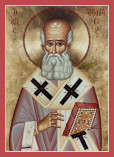 Born in Alexandria in 296, he had from
childhood an inclination to the spiritual life. He was a deacon with Archbishop Alexander and
accompanied him to Nicaea, to the First Ecumenical Council in 325. At this council, Athanasius
became famed for his learning, his devotion and his zeal for Orthodoxy, and contributed very
greatly to the containing of the Arian heresy and the strengthening of Orthodoxy. After the death
of Alexander, Athanasius was chosen as Archbishop of Alexandria. He remained in his
archiepiscopal calling for more than forty years, although he was not on the archiepiscopal
throne the whole time. He was persecuted by heretics through almost the whole of his life,
particularly by the Emperors Constantius, Julian and Valens, by Bishop Evsevios (Eusebius) of
Nikomedia and many others, and by the heretic Arius and his followers. He was forced to hide from
his persecutors in a well, a grave, private houses and the deserts. Twice he was forced to flee
to Rome. Only just before his death did he have a peaceful period as a good shepherd with his
flock, which truly loved him. There are few saints who have been so callously slandered and so
criminally persecuted as St. Athanasius. But his great soul endured all with patience for the
love of Christ and at last emerged victorious from all these terrible and lengthy struggles. He
often went to St. Anthony for advice and moral support, revering him as his spiritual father. He
suffered greatly for the truth, until the Lord gave him rest in His kingdom as His faithful
servant in the year 373.
2. St. Maxim, Archbishop of Wallachia.
Son of the Serbian despot Stefan the Blind and his wife Angelina, he received the monastic schema in the monastery of Manasija. Having pressure put on him by the Turks, he fled into the mountainous part of Romania, where he was consecrated to the vacant archiepiscopal see of Wallachia. He reconciled the disputing military commanders Radul and Bogdan and averted war between them. He returned to Krušedol in his last years, founded a monastery there, and after great spiritual endeavor, entered into rest on January 18th, 1546. His incorrupt and wonder-working relics lie even to this day in that monastery.
FOR CONSIDERATION
To the question, why did the Son of God reveal Himself to the world as man and not in the shape of some other creature, the wise Saint Athanasius replied thus: ‘If they ask why He did not reveal Himself in the form of some greater creature: for example, the sun, the moon or stars, or as flame or space, but as man, let them know that the Lord did not come simply to reveal Himself but to heal and teach those that suffer. For simply to reveal Himself and make His spectators marvel would mean to come as a show. Coming as a healer and teacher, He had not only to come, but to come in such a way that the revelation should be bearable to the wretched men whom He had come to serve. No single creature has been in error in the eyes of God save man alone; neither the sun nor the moon nor the sky, the stars nor water nor space has been unfaithful to its state, but on the contrary, knowing their Creator and their King—the Logos—they all live as they were created. Only human beings have turned themselves from good and changed that truth which belongs to God into deceit, as they transferred the knowledge of Him to devils and idols. What is there, therefore, unlikely in the Logos’ (the Son of God’s) revealing Himself as man in order to save mankind?’ Indeed, we ask the unbelievers of our generation: ‘In what form would you wish God to reveal Himself, if not as man?’
Daily Scripture Readings taken from The Orthodox New Testament, translated and published by Holy Apostles Convent, Buena Vista, Colorado, copyright © 2000, used with permission, all rights reserved.
Daily Prologue Readings taken from The Prologue of Ochrid, by Bishop Nikolai Velimirovic, translated by Mother Maria, published by Lazarica Press, Birmingham, England, copyright © 1985, all rights reserved. Edited by Dormition Skete.