

Daily Devotional
Sunday, January 29, 2034 (NS), January 16, 2034 (OS)
No Fasting.
| Sunday of the Thirty-Third Week or Sunday of the Publican and the Pharisee Mode Plagal Four — Eleventh Eothinon |
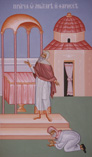
The commemoration of the veneration of the precious chains of the holy Apostle Peter.
Scripture Readings
Paschalion — Movable Calendar
Sunday of the Thirty-Third Week or Sunday of the Publican and the Pharisee
Mode Plagal Four — Eleventh Eothinon
Epistle
The Reading is from the Second Epistle of Saint Paul to Saint Timothy [§ 296]. Child Timothy:
3 10Thou hast closely followed my teaching, conduct, purpose, faith, long-suffering, love, patience, 11persecutions, sufferings, such as happened to me in Antioch, in Iconium, in Lystra—what persecutions I endured! And out of them all the Lord delivered me. 12Yes, and all those who wish to live piously in Christ Jesus shall be persecuted. 13But evil men and cheats shall advance to the worse, leading astray and being led astray. 14But thou, keep on abiding in what thou didst learn and wast assured of, knowing from whom thou didst learn, 15and that from a babe thou hast known the sacred writings, which are able to make thee wise in regard to salvation through faith which is in Christ Jesus.
Gospel
The Reading is from the Holy Gospel according to Saint Luke [§ 89]. The Lord said this parable:
18 10“Two men went up into the temple to pray, the one a Pharisee and the other a tax collector. 11“The Pharisee, having assumed a stance, was praying these things to himself, ‘God, I thank Thee that I am not as the rest of men—rapacious, unjust, adulterers, or even as this one, the tax collector. 12“‘I fast twice a week; I tithe all things, as much as I acquire.’ 13“And the tax collector, having stood afar off, was not willing even to lift up his eyes to the heaven, but kept beating upon his breast, saying, ‘God, be gracious to me the sinner.’ 14“I say to you, this one went down to his house having been justified rather than that one; for everyone who exalteth himself shall be humbled, and the one who humbleth himself shall be exalted.”
Menaion — Fixed Calendar
The commemoration of the veneration of the precious chains of the holy Apostle Peter.
Epistle
The Reading is from the Acts of the Apostles [§ 29].
12 1At that time, Herod the king put forth his hands to maltreat some of those from the Church. 2And he killed Iakovos the brother of John with a sword. 3And because he saw that it pleased the Jews, he in addition went on to seize Peter also—and they were the days of unleavened bread— 4whom after he laid hold of, he also put in prison, and delivered him up to four sets of four soldiers to guard him, purposing after the passover to bring him forth to the people. 5Peter, therefore, on the one hand, was being guarded in the prison, but on the other hand, earnest prayer was being made by the Church to God on his behalf. 6And when Herod was about to bring him forth, on that very night Peter was sleeping, bound with two chains between two soldiers; and guards also were before the door keeping the prison. 7And behold, an angel of the Lord stood by him, and a light shone in the chamber; and he struck the side of Peter, and woke him up, saying, “Rise up quickly.” And the chains from his hands fell off of him. 8And the angel said to him, “Gird thyself about, and bind on thy sandals.” And so he did. And he saith to him, “Cast about thee thine outer garment, and follow thou me.” 9And he went out and kept on following him, and did not know that it was real that which was happening by means of the angel, but he kept on thinking he saw a vision. 10And after they passed a first guard and a second, they came up to the gate, the iron one, which leadeth into the city, which was opened to them of itself; and having gone out, they advanced one street, and straightway the angel departed from him. 11And after Peter came to himself, he said, “Now I know of a truth, that the Lord sent forth His angel, and took me out of the hand of Herod and all the expectation of the people of the Jews.”
Gospel
The Reading is from the Holy Gospel according to Saint John [§ 67]. At that time:
21 14Jesus was made manifest to His disciples after He was raised from the dead.
15When therefore they ate breakfast, Jesus saith to Simon Peter, “Simon, son of Jonas, lovest thou Me more than these?” He saith to Him, “Yes, Lord, Thou knowest that I have affection for Thee.” He saith to him, “Be feeding My little lambs.” 16He saith to him again a second time, “Simon, son of Jonas, lovest thou Me?” He saith to Him, “Yes, Lord, Thou knowest that I have affection for Thee.” He saith to him, “Be shepherding My sheep.” 17He saith to him the third time, “Simon, son of Jonas, hast thou affection for Me?” Peter was grieved because He said to him the third time, “Hast thou affection for Me?” And he said to Him, “Lord, Thou knowest all things; Thou knowest that I have affection for Thee.” He saith to him, “Be feeding My sheep. 18“Verily, verily, I say to thee, when thou wast younger, thou used to gird thyself and walk about where thou wouldest; but whenever thou growest old, thou shalt stretch forth thy hands, and another shall gird thee, and bring thee where thou wouldest not.” 19But this He said signifying by what kind of death he shall glorify God. And having said this, He saith to him, “Follow thou Me.” 20And Peter, having turned about, seeth the disciple, whom Jesus loved, following—who also leaned back on His breast at the supper—and said, “Lord, who is the one who is delivering Thee up?” 21After Peter saw him, he saith to Jesus, “But Lord, this man—what?” 22Jesus saith to him, “If I wish him to tarry while I am coming, what is that to thee? Do thou be following Me.” 23Then this saying went out among the brethren that “that disciple dieth not”; and yet Jesus did not say that “he dieth not,” but, “If I wish him to tarry while I am coming, what is that to thee?”
24This is the disciple who beareth testimony concerning these things, and wrote these things; and we know that his testimony is true. 25And there are also many other things, which if as much as Jesus did may be written one by one, I suppose even the world itself could not contain the books that would be written. Amen.
Synaxarion Readings
Sunday of the Publican and the Pharisee
O Creator of all above and below, as Thou receivest the thrice-holy hymn from the angels, so also from mankind receive the Triodion. He who lives like a Pharisee is far from the Church, for Christ is received within, O ye humble of heart.
With God on this present day we begin the Triodion, the hymns of which were composed by many of our holy and God-bearing fathers, inspired by the Holy Spirit according to their worthiness. The first of all was the great author St. Cosmas of Maiuma, who composed the three odes (symbolic of the Holy and life-creating Trinity) for the Great and Holy Week of the Passion of our Lord and God and Savior Jesus Christ. After him, others of the fathers, including Saints Theodore and Joseph of the Studite Monastery, following his zealous example, arranged the services of the other weeks of the Holy and Great Forty-day Fast, reserving them at first for the use of the Studite Monastery. Furthermore they composed and arranged hymns, seeking them and collecting them from other books of the fathers. Since, according to the Triodion, Sunday, the celebration of the Resurrection, is the first day of the week as well as the last or eighth day, they prescribed the first ode (canticle) of the canon to be sung on the second day of the week, i.e. Monday. The second ode was prescribed for Tuesday, the third day of the week, the third ode for Wednesday, the fourth ode for Thursday, the fifth ode for Friday, and the sixth and seventh odes for Saturday. The rest, the eighth and ninth odes, are prescribed for every day.
It must be known, however, that although it is called the Triodion, it does have services with other than three-ode canons. It is so named because the majority of the services have three-ode canons, especially during Holy Week. For it was our holy fathers’ idea that through the entire Triodion would be commemorated in a concise form all God’s benefits to us from the beginning, using it as a reminder for all of us that we were created by Him, and were exiled from Paradise through the tasting of the fruit, rejecting the commandment that was given to us for our knowledge, and we were cast out through the envy of the arch villain serpent and enemy, who was made to crawl for his arrogance; that we remained cut off from the benefits of Paradise and were led by the devil; that the Son and Logos of God, having suffered in His mercy, bowing the heavens, descended and made His abode in the Virgin and became man for our sake, showing us through His life the ascent into the heavens, through humility first of all, then by fasting and the rejection of evil, and through His other deeds; that He suffered and rose from the dead and ascended once more into heaven, and He sent down the Holy Spirit upon His holy disciples and apostles, who all proclaimed Him to be the Son of God and the most perfect God. And that once more the divine apostles acted through the grace of the most Holy Spirit and gathered all the saints from the ends of the earth through their preaching, filling the world on high, which was the intention of the Creator from the beginning.
Now the purpose of the Triodion intended by the holy fathers on these three present feasts of the Publican and the Pharisee, the Prodigal Son, and the Second Coming is a kind of preparatory lesson and stimulation to prepare ourselves for the spiritual labors of the Fast, having put aside our usual corrupt habits. First of all they present to us the parable of the Publican and the Pharisee, and they call the week following precursory. For those who desire to go off to do military battle first ascertain the time of the battle from the leaders, so that having cleaned and polished their weapons, and preparing well all their other matters, and having removed all obstacles from their path, they earnestly go forth to their labors, taking the necessary supplies. Often before battle they tell anecdotes and tales and parables to incite their hearts to zeal, driving off idleness, fear, despair, and other unworthy feelings. So the divine fathers herald the coming fast against the armies of demons as a struggle which constrains our souls to cleanse ourselves of the poison accumulated over a long period of time. Not yet possessing those benefits, let us strive to obtain them, and arming ourselves properly, so let us embark on the labors of the Fast.
Now the first weapon among the virtues is repentance and humility. And the adversary of attaining the greatest humility is pride and arrogance. So they place before us first of all this present trustworthy parable from the divine Gospel. It encourages us to shun the desire for the pride and arrogance of the Pharisee and to cultivate the opposite desire of the Publican for humility and repentance. For the greatest and most grievous passion is pride and arrogance, since this is how the devil fell from the heavens before the morning star and was cast into darkness. Because of this Adam, the father of our race, was driven from Paradise through partaking of the fruit. Through this example the holy fathers encourage all not to be proud of their successes, but to always be humble. For the Lord sets Himself against the proud, but He gives grace to the humble. Better a man who has sinned, if he knows that he has sinned and repents, than a man who has not sinned and thinks of himself as righteous. For Christ said, “I say to you that the publican went down to his house justified rather than the Pharisee.” This parable reveals that no one should exalt himself, even though he has done good deeds, but rather should always be humble and pray from his heart to God, for even if he should fall into the most serious sin, salvation is not far off.
Through the prayers of all Thy holy hymnographers, O Christ our God, have mercy on us. Amen.
Translated from Triodion, siest ‘Tripesnets: Triod’ Postnaya, Moscow, 1904, by Robert Parent.
Lives of the Saints (Prologue)
January 29th – Civil Calendar
January 16th – Church Calendar
1. The Veneration of the Chains of the Holy Apostle Peter.
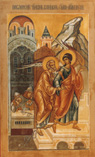 Today we commemorate the
chains with which Peter was shackled by the lawless Herod and which, when an angel appeared
to him in prison, fell from him (Acts 12:7). The faithful kept these chains, both in memory
of the great apostle and also because of their healing power, for many of the sick were
healed by touching them (as with the towel of the Apostle Paul: Acts 19:12). The Patriarch
of Jerusalem, St. Juvenal, made a gift of these chains to the Empress Evdokia, the exiled
wife of the Emperor Theodosios the Younger. She divided them in half, sending one half to
the Church of the Holy Apostles in Constantinople and the other to her daughter, the
Empress Eudoxia, wife of Valentian of Rome. This Eudoxia built the Church of St. Peter and
placed these chains in it, together with those in which Peter was shackled before his death
under the Emperor Nero. |
2. The Holy Martyrs Speusippus, Eleusippus, Meleusippus and their grandmother Leonilla.
They suffered for Christ in Cappadocia in the reign of the Emperor Marcus Aurelius (161-180). The three brothers were triplets. At first only Leonilla was a Christian, while her grandsons were pagans. After much exhortation on the part of the pious Leonilla and a local priest, the three brothers were baptized. Being baptized, they began with youthful fervor to witness to their faith, and in their zeal went out and smashed all the idols in the area. Accused and brought before the judge, they acknowledged their action and openly confessed their faith in Christ. The judge threw them into prison, then summoned their grandmother and directed her to go to the prison and counsel her grandsons to deny Christ and worship idols. Leonilla went off without a word to the prison, but instead of advising her grandsons to deny the true Faith, she set about encouraging them not to give up, but to persevere to the end in all their sufferings and die for Christ. When the judge examined them again and saw their yet stronger steadfastness in the Faith, he condemned them to death. All three were first hanged on one tree, where they hung ‘like the strings of a lute,’ and after that flogged and then finally burned. A woman, Jovilla, stirred by the courage of these martyrs, cried out: ‘I too am a Christian!’ They immediately seized her and beheaded her with a sword, together with the aged Leonilla.
3. Our Holy Father, the New-martyr Damaskenos of Gabrovo.
He lived in asceticism at Hilandar, where he became abbot. When he sought a debt due to the monastery from some Turks, they persuaded a Moslem woman to go into the house where Damaskenos lived. The Turks then came and found the woman, and dragged Damaskenos off before the judge. He was given the alternative: hanging or conversion to Islam, to which he replied decisively: ‘It would be foolishness were I for temporal life to buy eternal peril.’ He was hanged in 1771 in Svishtov. So Damaskenos sacrificed his life to save his soul. But his murderers immediately met God’s punishment. They got into a boat to cross the Danube, but suddenly a storm capsized them and they drowned.
4. Our Holy Father Romil.
Born in Vidin, he was a disciple of St. Gregory the Sinaite, and lived the ascetic life in several monasteries. St. Romil entered into rest at Ravanica in Serbia in about 1375.
FOR CONSIDERATION
Nothing breaks human pride so well as the habit of obedience to one’s elders. In ancient Sparta, obedience was regarded as a great virtue. A tale is told of a Spartan soldier in battle, hurrying to engage the enemy. Just as he drew his sword to cut down his adversary, the trumpet sounded for the end of the battle and he resheathed his sword. When someone who had seen this asked him why he had not run the enemy through, he replied: ‘It is better to obey the commander than to kill the enemy.’ Christian obedience is different from this Spartan obedience in that it is voluntary and has as its goal the salvation of the soul; that is, it exists not in order to safeguard an earthly kingdom but for the attaining of the kingdom of heaven. St. John Kolovos began his ascetic life with an elder in the Thebaid. The elder, in order to teach his disciple obedience, planted a dead tree in the earth and told him to water it every day. John watered the dead wood assiduously for three years, and then it suddenly turned green and bore fruit. This is the fruit of willing obedience. The Lord Himself was obedient to death on the Cross (Phil. 2:8).
Daily Scripture Readings taken from The Orthodox New Testament, translated and published by Holy Apostles Convent, Buena Vista, Colorado, copyright © 2000, used with permission, all rights reserved.
Daily Prologue Readings taken from The Prologue of Ochrid, by Bishop Nikolai Velimirovic, translated by Mother Maria, published by Lazarica Press, Birmingham, England, copyright © 1985, all rights reserved. Edited by Dormition Skete.