

Daily Devotional
Tuesday, March 2, 2032 (NS), February 18, 2032 (OS)
No Fasting.
Tuesday of the Thirty-Fifth Week
The commemoration of our holy father among the saints, Leo, Pope of Rome.
Scripture Readings
Paschalion — Movable Calendar
Tuesday of the Thirty-Fifth Week
Epistle
The Reading is from the First General Epistle of Saint John [§ 72]. Brethren:
For Gk. usage, see 1 Jn. 3:9-22; for Sl. usage, see 1 Jn. 3:10-20, beginning in the middle of verse 10, “My beloved: Everyone who doeth not righteousness....”
3 9Everyone who hath been born of God doeth no sin, because His seed abideth in him; and he is not able to sin, because he hath been born of God. 10In this are manifest the children of God and the children of the devil. Everyone who doeth not righteousness is not of God, and neither is the one who loveth not his brother. 11Because this is the message which ye heard from the beginning, that we be loving one another, 12not as Cain, who was of the evil one and slew his brother. And on account of what did he slay him? Because his works were evil, but those of his brother righteous. 13Cease marvelling, my brethren, if the world hate you. 14We know that we have passed over out of death into life, because we love the brethren. The one not loving his brother abideth in death. 15Everyone who hateth his brother is a manslayer, and ye know that every manslayer hath not eternal life abiding in him. 16In this we have come to know love, because He laid down His life for us; and we ought to lay down our lives for the brethren. 17But whosoever may have the world’s means of livelihood, and may observe his brother having need, and shutteth up from him his compassion from the inward parts, how doth the love of God abide in him? 18My little children, let us not be loving in word, neither in tongue, but in deed and in truth. 19And in this we know that we are of the truth, and shall persuade our hearts before Him, 20that if our heart be condemning us, God is greater than our heart and knoweth all things. 21Beloved, if our heart be not condemning us, we have boldness toward God. 22And whatsoever we may ask, we receive from Him, because we keep His commandments and do the things that are pleasing before Him.
Gospel
The Reading is from the Holy Gospel according to Saint Mark [§ 64]. At that time:
14 10Judas the Iscariote, one of the twelve, went away to the chief priests, in order that he might deliver Him up to them. 11And after they heard it, they were glad and promised to give him money; and he was seeking how he might opportunely deliver Him up.
12And on the first day of the unleavened bread, when they used to slay the passover, His disciples said to Him, “Where dost Thou wish that we go and prepare, that Thou mightest eat the passover?” 13And He sendeth forth two of His disciples, and saith to them, “Go ye into the city, and a man shall meet you bearing an earthenware vessel of water; follow him. 14“And wheresoever he should enter, say to the master of the house, ‘The Teacher saith, “Where is the lodging-place, where I shall eat the passover with My disciples?”’ 15“And he will show you a large upper room, which hath been furnished and prepared; there make ready for us.” 16And His disciples went away, and came into the city, and found it even as He said to them; and they made ready the passover. 17And evening having come to pass, He cometh with the twelve. 18And as they reclined at table and ate, Jesus said, “Verily I say to you, that one of you who is eating with Me shall deliver Me up.” 19And they began to be grieved, and to say to Him, one by one, “It is not I, is it?” And another, “It is not I, is it?” 20But He answered and said to them, “It is one of the twelve, who dippeth with Me in the dish. 21“The Son of Man indeed goeth even as it hath been written concerning Him, but woe to that man by whom the Son of Man is delivered up! Good were it for that man if he had not been born.” 22And as they ate, Jesus took bread, blessed it, and broke it, and gave to them, and said, “Take, eat; this is My body.” 23And He took the cup, and gave thanks, and gave it to them; and they all drank of it. 24And He said to them, “This is My blood, that of the new covenant, which is being poured out for many. 25“Verily I say to you that in no wise will I drink any more of the fruit of the vine, until that day when I drink it new in the kingdom of God.”
26And having sung a hymn, they went out to the Mount of Olives. 27And Jesus saith to them, “Ye all shall be made to stumble because of Me during this night, for it hath been written: ‘I will smite the Shepherd, and the sheep shall be scattered abroad [cf. Zach. 13:7].’ 28“But after I have risen, I will go before you into Galilee.” 29But Peter said to Him, “Though all shall be made to stumble, yet not I.” 30And Jesus saith to him, “Verily I say to thee that today, during the night, before the cock crow twice, thou shalt deny Me thrice.” 31But he kept on speaking more vehemently, “If it should be necessary for me to die with Thee, in no wise will I deny Thee.” And in like manner also, they all were speaking.
32And they came to a place which was named Gethsemane; and He saith to His disciples, “Sit here while I pray.” 33And He taketh along with Him Peter and Iakovos and John, and began to be amazed and sorely troubled. 34And He saith to them, “My soul is very sad unto death. Tarry here and be watching.” 35And having gone forth a little, He fell upon His face on the ground, and was praying that, if it were possible, the hour might pass from Him. 36And He was saying, “Abba, Father, all things are possible to Thee. Take away this cup from Me; but not what I will, but what Thou wilt.” 37And He cometh and findeth them sleeping, and saith to Peter, “Simon, sleepest thou? Wast thou not able to watch one hour? 38“Be watching and praying that ye enter not into temptation; the spirit indeed is willing, but the flesh is weak.” 39And again He went away and prayed, saying the same utterance. 40And having returned, He found them again sleeping; for their eyes were weighed down, and they knew not what they should answer Him. 41And He cometh the third time, and saith to them, “Sleep on for what time remaineth and be taking your rest! It is enough, the hour hath come; behold, the Son of Man is being delivered up into the hands of the sinners. 42“Rouse yourselves, let us be going; behold the one delivering Me up hath drawn near.”
Menaion — Fixed Calendar
The commemoration of our holy father among the saints, Leo, Pope of Rome.
No readings given.
Lives of the Saints (Prologue)
March 3rd – Civil Calendar: Non-Leap Year
March 2nd – Civil Calendar: Leap Year
February 18th – Church Calendar
1. St. Leo the Great, Pope of Rome.
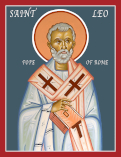 Born in Italy of devout parents, he was
first archdeacon with Pope Sixtus the Third, then elected against his own will to the papal
throne after Sixtus’ death. When Attila drew near to Rome with his Huns and prepared to
ravage and burn the city, Leo went out to him in his episcopal vestments, tamed the wrath of the
Hun leader and averted the fall of Rome. Attila was willing to be guided by Leo both because of
his holiness and because of a vision he had of the Apostles Peter and Paul, standing behind Leo
and threatening Attila with a flaming sword.
Leo not only saved Rome; he also contributed greatly to the safeguarding of Orthodoxy against the heresy of Eftyches and Dioscoros. This heresy consisted in the merging of the divine and human natures of Christ into one, and following from this, the denial of the existence of two wills in the Person of our Lord and Savior. This led to the summoning of the Fourth Ecumenical Council at Chalcedon, at which St. Leo’s Epistle was read—a letter which St. Leo, after writing it, had placed on the tomb of St. Peter, and which St. Peter had corrected. As death drew near, he spent forty days in fasting and prayer by the tomb of the Apostle Peter, begging him to tell him if his sins were forgiven. The apostle appeared to him and assured him that they were, except for his sins in the ordaining of priests (from which it is seen how grave a sin it is to ordain an unworthy man). The saint fell to prayer again, until he was told that these also were wiped out. Then he gave his soul to the Lord in peace. St. Leo entered into rest in the year 461.
FOR CONSIDERATION
Grass is the most important thing in a meadow, as are grain in a field and vegetables in a market-garden. No one would boast of the fence of a meadow rather than its hay, or of the hut in a field rather than its crop, or the ditch in a market garden rather than its vegetables. Why do people boast of their country, or of the highways in that country, or its frontier ditches or the towns in it—or about anything else that has just about as much value as the fence of a meadow or the hut in a field or the ditch in a market garden when weighed against the main crop; that is, people? People do not exist for the sake of the country, but the country for their sake. Christ came to save, not the country, but the people. A country is valued by the goodness of its citizens. But of what use is a great country to evil men? They fill the field with brambles.
Daily Scripture Readings taken from The Orthodox New Testament, translated and published by Holy Apostles Convent, Buena Vista, Colorado, copyright © 2000, used with permission, all rights reserved.
Daily Prologue Readings taken from The Prologue of Ochrid, by Bishop Nikolai Velimirovic, translated by Mother Maria, published by Lazarica Press, Birmingham, England, copyright © 1985, all rights reserved. Edited by Dormition Skete.