

Daily Devotional
Monday, February 16, 2032 (NS), February 3, 2032 (OS)
No Fasting.
Monday of the Thirty-Eighth Week
The commemoration of the Afterfeast of the Meeting of the Lord, and the holy and Righteous Symeon the God-receiver, and the holy Prophetess Anna.
Scripture Readings
Paschalion — Movable Calendar
Monday of the Thirty-Eighth Week
Epistle
The Reading is from the Epistle of Saint Paul to the Philippians [§ 248]. Brethren:
4 10I rejoiced in the Lord greatly that now at length your thinking concerning me sprouted afresh, upon which ye indeed were thinking, but ye were lacking opportunity. 11Not that I speak as to lack; for I learned in whatever state I am to be self-sufficient. 12I know both how to be humbled, and I know how to abound; in everything and in all things I have been initiated both to be full and to hunger, both to abound and to lack. 13I can do all things in Christ, the One Who empowereth me. 14Yet ye did well sharing in mine affliction. 15But ye Philippians know also that in the beginning of the Gospel, when I departed from Macedonia, not one church took part with me in regard to an account of giving and receiving, except ye only. 16For even in Thessalonica ye sent in regard to my necessity both once and twice. 17Not that I am seeking after the gift, but I am seeking after the fruit that is abounding to your account. 18But I have received in full all things, and abound; I have been made full, having received from Epaphroditos the things from you, an odor of a sweet smelling fragrance, an acceptable sacrifice, well-pleasing to God. 19But my God shall fill to the full your every need according to His wealth in glory, in Christ Jesus. 20Now to the God and Father of us be glory to the ages of the ages. Amen.
21Greet every saint in Christ Jesus. The brethren with me greet you. 22All the saints greet you, but most of all those of Cæsar’s house.
23The grace of our Lord Jesus Christ be with you all. Amen.
Gospel
The Reading is from the Holy Gospel according to Saint Luke [§ 43]. At that time:
9 18It came to pass, as Jesus was praying alone, the disciples were with Him, and He questioned them, saying, “Whom do the crowds say that I am?” 19And they answered and said, “John the Baptist, but others say Elias; and others say that some prophet of the ancients hath risen.” 20And He said to them, “But ye, whom do ye say that I am?” And Peter answered and said, “The Christ of God.” 21And He strictly warned them and commanded them to tell this to no one, 22saying, “It is necessary for the Son of Man to suffer many things, and to be rejected by the elders and chief priests and scribes, and be killed, and be raised the third day.”
Menaion — Fixed Calendar
The commemoration of the Afterfeast of the Meeting of the Lord, and the holy and Righteous Symeon the God-receiver, and the holy Prophetess Anna.
Epistle
The Reading is from the Epistle of Saint Paul to the Hebrews [§ mid 321]. Brethren:
9 11Christ, Who came as High Priest of the coming good things, by means of the greater and more perfect tabernacle—not made by hand, that is, not of this creation, 12nor by blood of goats and of calves, but by His own blood—entered once for all into the Holies, having Himself obtained eternal redemption. 13For if the blood of bulls and of goats and ashes of a heifer, sprinkling those who have been defiled, sanctifieth to the purity of the flesh, 14how much more shall the blood of the Christ, Who through the eternal Spirit offered Himself without blemish to God, purify your conscience from dead works in order to worship the living God?
Gospel
For the God-receiver:
The Reading is from the Holy Gospel according to Saint Luke [§ 8]. At that time:
2 25There was a man in Jerusalem whose name was Symeon, and this man was just and pious, waiting for the consolation of Israel, and the Holy Spirit was upon him. 26And it had been divinely revealed to him by the Holy Spirit that he should not see death before he should see the Christ of the Lord. 27And he came in the Spirit into the temple. And when the parents were bringing in the little Child Jesus, in order to do for Him according to the custom of the law, 28he also received Him into his arms and blessed God and said, 29“Now lettest Thy slave depart in peace, O Master, according to Thy word; 30“for mine eyes have seen Thy salvation, 31“which Thou didst prepare before the face of all the peoples, 32“a light for revelation to the nations and the glory of Thy people Israel.” 33And Joseph and His Mother were marvelling at the things which were spoken concerning Him. 34And Symeon blessed them, and said to Mariam His Mother, “Behold, this One is set for the fall and rising up of many in Israel, and for a sign which is contradicted— 35“and as to thee a sword shall go through thine own soul also—in order that the reckonings of many hearts might be revealed.” 36And there was Anna, a prophetess, a daughter of Phanuel, of the tribe of Aser. She was advanced in many days, having lived with a husband seven years from her virginity. 37And she was a widow about eighty-four years, who departed not from the temple, and worshipped God with fastings and entreaties night and day. 38And she, having stood by, at the same hour, was giving thanks to the Lord and kept on speaking about Him to all those waiting for redemption in Jerusalem.
39And when they performed all things according to the law of the Lord, they returned to Galilee, to their city Nazareth.
40And the little Child was growing and showing Himself strong in spirit, being filled with wisdom; and the grace of God was upon Him.
Lives of the Saints (Prologue)
February 16th – Civil Calendar
February 3rd – Church Calendar
1. St. Simeon the God-Receiver.
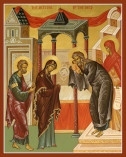 This Simeon was chosen, in the time of the
Egyptian Pharaoh Ptolemy Philadelphus (285-246 B.C.), as one of the famous Seventy to whom was
committed the task of translating the Old Testament from the Hebrew into Greek. Simeon worked
conscientiously, but when translating the Prophet Isaias, he came to the prophecy: ‘Behold,
the virgin shall conceive and bear a son’. He was puzzled and took a knife to scratch out
the word ‘virgin’ and substitute ‘young woman,’ and thus translate it
into Greek. But at that moment an angel of God appeared to him and held him back from his
intention, explaining to him that the prophecy was true and rightly-expressed. And to confirm its
veracity, the messenger from God said that he, Simeon, by the will of God, would not die until he
had seen the Messiah born of a virgin. The righteous Simeon rejoiced at these heavenly tidings,
left the prophecy unchanged and thanked God that He had found him worthy to live to see the
Promised One. When the Christ Child was brought to the temple in Jerusalem by the Virgin Mary,
the Spirit of God revealed this to Simeon, who was now a very old man with snow-white hair. He
went quickly to the temple and found there both the Virgin and the Child, bathed in a light that
shone round their heads like a halo. The joyful elder took Christ in his arms and prayed to God
to let him leave this world: ‘Now lettest Thy slave depart in peace, O Master, according to
Thy word; for mine eyes have seen Thy salvation.’ Thither came also Anna the prophetess,
the daughter of Phanuel, who recognized the Messiah and made Him known to the people. Anna was
then 84 years old. Soon after that, St. Simeon departed this life. This righteous elder is
venerated as the protector of young children.
2. The Holy Martyrs Adrian and Evoulos (Eubulus).
These two holy souls came from their home town, Baneas, in Caesarea of Cappadocia, to visit imprisoned Christians and to uphold and encourage them. They themselves were taken and condemned to death. Adrian was slain with the sword and Evoulos was thrown to the wild beasts in the year 309. Thus with no trace of lament for this life, they entered with joy and honor into eternal life.
FOR CONSIDERATION
The great heavenly glory attained by St. Simeon, who held the holy Savior in his arms, is clearly attested in this incident taken from the life of St. Peter the Athonite (June 12th). As a military commander, Peter was taken captive in some battle, bound and cast into prison in the town of Samara on the banks of the Euphrates. Lying long in prison, Peter begged St. Nicholas with tears to pray to God for him, that he might be freed from prison, vowing that he would consecrate himself wholly to God. St. Nicholas appeared to him in a dream and said that he had prayed for him, but that God was delaying his deliverance because he, Peter, had earlier made a similar vow and had not fulfilled it. St. Nicholas then advised him to pray to St. Simeon, ‘who has great power before God, and stands near His throne with the most holy Mother of God and St. John the Forerunner’. Peter followed this advice and began to pray to St. Simeon. St. Nicholas appeared to him again—this time with St. Simeon—in a vision, not a dream. Peter saw Simeon, wonderful in appearance with light streaming from his countenance. He was clad in the robes of a priest of the Old Covenant and bore a golden scepter in his hand. St. Simeon said to Peter: ‘Do you wish to fulfill your vow and become a monk?’ Peter replied: ‘Yes, lord, with the help of God.’ Then Simeon touched Peter’s fetters lightly with his scepter and they melted as if made of wax. And he opened the door of the prison and led Peter out.
Daily Scripture Readings taken from The Orthodox New Testament, translated and published by Holy Apostles Convent, Buena Vista, Colorado, copyright © 2000, used with permission, all rights reserved.
Daily Prologue Readings taken from The Prologue of Ochrid, by Bishop Nikolai Velimirovic, translated by Mother Maria, published by Lazarica Press, Birmingham, England, copyright © 1985, all rights reserved. Edited by Dormition Skete.