

Daily Devotional
Thursday, August 28, 2031 (NS), August 15, 2031 (OS)
No Fasting.
Thursday of the Thirteenth Week
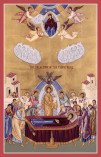
| The commemoration of the Dormition of our most holy Lady Theotokos. |
Scripture Readings
Paschalion — Movable Calendar
Thursday of the Thirteenth Week
Epistle
The Reading is from the Second Epistle of Saint Paul to the Corinthians [§ 190]. Brethren:
10 7If anyone hath persuaded himself to be of Christ, let him consider this of himself, that even as he is of Christ, even so are we of Christ. 8For even if I also should boast somewhat more abundantly concerning our authority, which the Lord gave to us for building up, and not for your pulling down, I shall not be put to shame, 9in order that I might not seem as if I would frighten you by means of the epistles. 10“For on the one hand, the epistles,” saith one, “are weighty and strong, but on the other hand his bodily presence is weak, and his speech contemptible.” 11Let such a one take this into account, that, such as we are in word by epistles when we are absent, such are we also in deed when we are present. 12For we dare not to reckon or compare ourselves with some who commend themselves; but they, measuring themselves by themselves, and comparing themselves with themselves, do not comprehend. 13But we will not boast beyond measure, but according to the measure of the province which God apportioned to us as a measure, to reach even as far as you. 14For we are not stretching ourselves overmuch, as though we did not reach to you; for we also came as far as to you in the Gospel of the Christ, 15not boasting of things beyond measure in the toils of others, but having hope, when your faith is increased, to be magnified among you according to our province unto abundance, 16to preach the Gospel to what lieth beyond you, and not to boast in another’s province, in things ready. 17“But the one who boasteth, let him boast in the Lord [cf. Jer. 9:23, 24].” 18For not the one who commendeth himself is that one who is approved, but the one whom the Lord commendeth.
Gospel
The Reading is from the Holy Gospel according to Saint Mark [§ 14]. The Lord said:
3 28“Verily I say to you, that all sins shall be forgiven to the sons of men, and howsoever many blasphemies they shall utter to blaspheme; 29“but whosoever shall blaspheme against the Holy Spirit hath not forgiveness forever, but is liable to everlasting condemnation”— 30because they were saying, “He hath an unclean spirit.” 31Then came His Mother and His brethren; and they stood outside, and sent off word to Him, calling Him. 32And a crowd was sitting about Him; and they said to Him, “Behold, Thy Mother and Thy brethren outside are seeking for Thee.” 33And He answered them, saying, “Who is My mother or My brethren?” 34And He looked round about on those who sat about Him in a circle, and said, “Behold, My mother and My brethren! 35“For whosoever shall do the will of God, the same is My brother and My sister and My mother.”
Menaion — Fixed Calendar
The commemoration of the Dormition of our most holy Lady Theotokos.
Epistle
The Reading is from the Epistle of Saint Paul to the Philippians [§ 240]. Brethren:
2 5Let this mind be in you which was also in Christ Jesus, 6Who, existing in the form of God, deemed it not a prize to be seized to be equal with God; 7but He emptied Himself and took the form of a slave, and came to be in the likeness of men. 8And having been found in fashion as a man, He humbled Himself and became obedient even to death—indeed, the death of a cross. 9Wherefore God also exalted Him exceedingly, and freely gave to Him a name that is above every name, 10that in the name of Jesus every knee should bow, of those in heaven and on earth and under the earth; 11and every tongue should confess for itself that Jesus Christ is Lord, to the glory of God the Father.
Gospel
In the Orthros
The Reading is from the Holy Gospel according to Saint Luke [§ 4].
1 39In those days Mariam rose up and went into the hill country with haste, into a city of Juda; 40and she entered into the house of Zacharias, and greeted Elisabeth. 41And it came to pass, as Elisabeth heard the salutation of Mary, the babe leaped in her womb; and Elisabeth was filled with the Holy Spirit. 42And she cried out with a loud voice, and said, “Blessed art thou among women, and blessed is the fruit of thy womb. 43“And whence is this to me, that the Mother of my Lord should come to me? 44“For behold, as the sound of thy salutation came into mine ears, the babe in my womb leaped in exultant joy. 45“And happy is she who believed, for there shall be a fulfillment of those things which were spoken to her from the Lord.” 46And Mariam saith:
“My soul doth magnify the Lord, 47“and my spirit hath rejoiced in God my Savior,
48“for He looked upon the low estate of His slave. For behold, from henceforth all generations shall call me blessed.
49“For the mighty One did great things to me, and holy is His name.”... 56And Mariam stayed with her about three months, and returned to her own house.
In the Liturgy
The Reading is from the Holy Gospel according to Saint Luke [§ 54]. At that time:
10 38 Jesus entered into a certain village. And a certain woman, by name Martha, received Him into her house. 39And she had a sister called Mary, who also sat down beside the feet of Jesus, and was listening to His word. 40But Martha was distracted about much serving, and she came up to Him and said, “Lord, is it no concern to Thee that my sister left me to serve alone? Speak to her therefore that she should help me.” 41And Jesus answered and said to her, “Martha, Martha, thou art anxious and troubled about many things. 42“But there is need of one thing, and Mary chose the good part, which shall not be taken away from her.”...
11 27And it came to pass, as He was speaking these things, a certain woman out of the crowd lifted up her voice and said to Him, “Blessed is the womb that bore Thee, and the breasts which Thou didst suck.” 28But He said, “Yea rather, blessed are they who hear the word of God and keep it.”
Lives of the Saints (Prologue)
August 28th – Civil Calendar
August 15th – Church Calendar
1. The Dormition of the Most Holy Mother of God.
 The Lord Who, on Sinai, gave the Fifth
Commandment: ‘Honor thy father and thy mother,’ showed by His own example how one
must reverence one’s parents. Hanging in agony on the Cross, He remembered His Mother, and
indicating the Apostle John, said to her: ‘Woman, behold thy son!’ and to John:
‘Behold thy mother!’ And with this concern for His Mother, He breathed His last. John
had a home on Sion in Jerusalem, where he settled the Mother of God and left her to pass her
remaining days on earth. By her prayers, her kindly advice, her meekness and patience, she was of
immense help to her Son’s apostles. She spent virtually the rest of her life in Jerusalem,
often going round the places that reminded her of the great events and the great works associated
with and performed by her Son. She especially visited Golgotha, Bethlehem and the Mount of
Olives. Of her journeys farther afield, her visit to St. Ignatius the God-Bearer is recorded, as
are those to St. Lazarus the Four-days-dead, Bishop of Cyprus, to the Holy Mountain, to which she
gave her blessing, and her stay in Ephesus with the Apostle John during a fierce persecution of
Christians in Jerusalem. In old age, she often prayed to her Lord and God on the Mount of Olives,
on the spot from which He ascended, to take her from this world. One day, the Archangel Gabriel
appeared to her and revealed that she would enter into rest in three days’ time, and the
angel gave her a palm-branch to be carried in her funeral procession. She returned home with
great joy, with the heartfelt hope that she would see Christ’s apostles once more in this
life. The Lord fulfilled her desire and all the apostles, brought by angels and clouds, gathered
together at St. John’s house on Sion. It was with great joy that she saw the holy apostles,
and she encouraged, advised and upheld them, then peacefully gave her soul into God’s hands
without the slightest physical pain or struggle. The apostles took the coffin containing her
body, from which an aromatic fragrance arose, and accompanied by many Christians, took it to the
Garden of Gethsemane, to the grave of Ss. Joachim and Anna. By God’s providence, they were
hidden from the wicked Jews by a cloud. A Jewish priest, Anthony, touched the coffin with his
hand, intending to overturn it, but at that moment an angel of God cut off both his hands. He
cried out with the pain, begging the apostles’ help, and was healed in confessing his faith
in the Lord Jesus Christ. It was left to the Apostle Thomas, who was delayed, again by
God’s providence, to reveal a new and glorious mystery about the holy Mother of God. He
arrived on the third day, and desired to embrace the body of the holy and most pure. When the
apostles opened her grave, he found only the winding-sheet—the body was not in the grave. That
evening, she appeared to the apostles, surrounded by a multitude of angels, and said to them:
‘Rejoice; I will be with you always!’ It is not known exactly how old the Mother of
God was at the time of her falling-asleep, but the prevailing belief is that she had reached the
age of seventy.
FOR CONSIDERATION
Oh, how much there is for every one of the faithful to learn from the life of the Virgin Mother of God! Let us consider here only two things. She had the habit of going frequently to Golgotha, to the Mount of Olives, the Garden of Gethsemane and Bethlehem, and to other places to which her Son had given special meaning. In all these places, and especially on Golgotha, she prayed to God. She thus gave the first example and impetus to the faithful of the practice of visiting the holy places out of love towards Him Who, by the presence of His suffering and glory, made them holy and famous. Secondly, we see how she, in prayer for her swift departure from this life, prayed that her soul, at its parting from the body, might not see the punishment of darkness and its terrors, and shielded from the overshadowing of darkness, might not encounter the power of Satan. If she who bore the Harrier of Hades and herself had a tremendous power over demons could thus pray, what then of us? In her great humility, she commended herself to God, not trusting to her own works. So much the less should we trust in our own works, and so much the more should we commend ourselves to God’s hands, beseeching His mercy most especially in that moment of the soul’s parting from the body.
Daily Scripture Readings taken from The Orthodox New Testament, translated and published by Holy Apostles Convent, Buena Vista, Colorado, copyright © 2000, used with permission, all rights reserved.
Daily Prologue Readings taken from The Prologue of Ochrid, by Bishop Nikolai Velimirovic, translated by Mother Maria, published by Lazarica Press, Birmingham, England, copyright © 1985, all rights reserved. Edited by Dormition Skete.