

Daily Devotional
Friday, May 16, 2031 (NS), May 3, 2031 (OS)
Fast Day, but Wine and Olive Oil Allowed.
Friday of the Fifth Week
The commemoration of the holy Martyrs Timothy the Reader and Mavra of Antinoe in Egypt, and our venerable Father Theodosios, Abbot of the Monastery of the Caves, initiator of the cnobitic monastic life in Russia.
Scripture Readings
Paschalion — Movable Calendar
Friday of the Fifth Week
Epistle
The Reading is from the Acts of the Apostles [§ 36]. In those days:
15 5There rose up certain of those from the sect of the Pharisees who believed, saying, “It is necessary to circumcise them, and to command them to keep the law of Moses.”
6And the apostles and the presbyters were gathered together to see about this matter. 7And after much discussion took place, Peter rose up and said to them, “Men, brethren, ye know that from former days God Himself chose among us for the nations to hear by my mouth the word of the Gospel, and to believe. 8“And God, the Knower of hearts, bore witness to them, giving them the Holy Spirit, even as also to us; 9“and He made no distinction between both us and them, having purified their hearts by faith. 10“Now then why tempt ye God by putting a yoke upon the neck of the disciples which neither our fathers nor we were able to bear? 11“But through the grace of the Lord Jesus Christ, we believe we are to be saved in like manner as they.” 12And all the multitude became silent, and were listening to Barnabas and Paul relating how many signs and wonders God wrought among the nations through them. 13And after they became silent, Iakovos answered, saying, “Men, brethren, hear me. 14“Symeon related how God first visited to take from the nations a people for His name. 15“And to this agree the words of the prophets, even as it hath been written: 16“‘“After these things I will return, and will build again the tabernacle of David which is fallen, and I will build again the things which have been dug down, and I will set it up [cf. Amos 9:11], 17“‘“so that the residue of men might seek after the Lord, even all the nations upon whom My name hath been called upon them,” saith the Lord Who doeth all these things [cf. Amos 9:12].’ 18“Known to God are all His works from eternity. 19“Wherefore I judge that we are not to trouble those who from the nations are turning to God, 20“but that we write to them to abstain from the pollutions of the idols, and from fornication, and from what is strangled, and from blood. 21“For Moses from generations of old hath in every city those proclaiming him, since he is read every sabbath day.” 22Then it seemed good to the apostles and to the presbyters, with the whole Church, to send chosen men from among them to Antioch with Paul and Barnabas, namely, Judas surnamed Barsavas, and Silas, leading men among the brethren, 23having written by their hand thus: “The apostles and the presbyters and the brethren to those brethren who are of the nations in Antioch and Syria and Cilicia: Greetings. 24“Whereas we have heard that certain from among us who went out troubled you with words, upsetting your souls, saying, ‘Be circumcised and keep the law’—to whom we gave no such command— 25“it seemed good to us, having come to be of one accord, to send chosen men to you with our beloved Barnabas and Paul, 26“men who have handed over their lives for the name of our Lord Jesus Christ. 27“We have sent forth therefore Judas and Silas, who shall themselves also relate verbally the same things. 28“For it seemed good to the Holy Spirit, and to us, to lay upon you no further burden than these necessary things: 29“that ye abstain from sacrifices to idols, and from blood, and from what is strangled, and from fornication; from which, if ye keep yourselves, ye shall do well. Fare-well.”
30So when they were dismissed, they went to Antioch; and after they gathered together the multitude, they delivered the epistle. 31And having read it, they rejoiced for the consolation. 32Both Judas and Silas, being themselves also prophets, by much discourse exhorted the brethren and confirmed them. 33And after they continued for a time, they were sent forth in peace from the brethren to the apostles. 34But it seemed good to Silas to abide there.
Gospel
The Reading is from the Holy Gospel according to Saint John [§ 37]. The Lord said to those Jews who had come to Him:
10 17“On this account My Father loveth Me, because I lay down My soul, that I might take it again. 18“No one taketh it from Me, but I lay it down of Myself. I have authority to lay it down, and I have authority to take it again. This commandment I received from My Father.” 19A division therefore again arose among the Jews on account of these words. 20And many of them were saying, “He hath a demon and is mad; why hear ye Him?” 21Others were saying, “These are not the words of one who is possessed by a demon. A demon is not able to open the eyes of the blind, is he?”
22And it came to be the feast of the dedication in Jerusalem, and it was winter. 23And Jesus was walking about in the temple in Solomon’s porch. 24Then the Jews came round about Him and were saying to Him, “Until when dost Thou lift up our soul? If Thou art the Christ, tell us openly.” 25Jesus answered them, “I told you, and ye believe not. The works which I do in the name of My Father, these bear witness concerning Me. 26“But ye believe not; for ye are not of My sheep, even as I said to you. 27“The sheep, those that are Mine, hear My voice, and I know them, and they follow Me. 28“And I give them eternal life.”
Menaion — Fixed Calendar
The commemoration of the holy Martyrs Timothy the Reader and Mavra of Antinoe in Egypt, and our venerable Father Theodosios, Abbot of the Monastery of the Caves, initiator of the cnobitic monastic life in Russia.
Epistle
For the venerable Father:
The Reading is from the Epistle of Saint Paul to the Hebrews [§ 334]. Brethren:
13 7Be remembering those who lead you, who spoke to you the word of God, whose faith keep on imitating, observing attentively the end of their conduct: 8Jesus Christ, the same yesterday and today and to the ages. 9Cease being carried about by various and strange teachings. For it is good for the heart to be confirmed by grace, not by foods, in which those walking therein were not profited. 10We have an altar from which those serving the tabernacle have no authority to eat; 11for the bodies of those animals, “whose blood is being brought into the holies for sins” by the high priest, “are being burned outside of the encampment [cf. Lev. 16:27].” 12Wherefore Jesus also, that He might sanctify the people by His own blood, suffered outside of the gate. 13Let us be going forth therefore to Him outside of the encampment, bearing His reproach; 14for we have no abiding city here, but we seek the coming one. 15Through Him, then, let us be offering up a “sacrifice of praise [Lev. 7:2(12)]” continually to God, that is, “the fruit of the lips [cf. Hos. 14:3(2); Is. 57:19],” giving thanks to His name. 16But cease being forgetful of doing good and of contributing; for God is well pleased with such sacrifices.
Gospel
The Reading is from the Holy Gospel according to Saint Matthew [§ 43]. The Lord said to His disciples:
11 27“All things were delivered to Me by My Father. And no one doth fully know the Son, except the Father; nor doth anyone fully know the Father, except the Son, and he to whomsoever the Son is willing to reveal Him. 28“Come to Me, all ye who labor and are burdened, and I will give you rest. 29“Take up My yoke upon you and learn from Me, for I am meek and humble in heart; and ye shall find rest to your souls. 30“For My yoke is good and My burden is light.”
Lives of the Saints (Prologue)
May 16th – Civil Calendar
May 3rd – Church Calendar
1. The Holy Martyrs Timothy and Mavra.*
Strange was the destiny of these wonderful martyrs, husband and newly-wedded wife. Twenty days after their wedding, they were taken for trial for their Christian Faith before Arrianos, the pagan governor of the Thebaid, in the time of the Emperor Diocletian. Timothy was a reader in the church where he lived. ‘Who are you?’ the governor asked him. Timothy replied: ‘I am a Christian and a reader in the Church of God.’ The governor said to him further: ‘You see, don’t you, the instruments prepared for torture?’ Timothy replied: ‘But you don’t see the angels of God, which are strengthening me.’ Then the governor commanded that he be pierced through the ears with iron rods, so that the pupils of his eyes leapt out with the pain. They then suddenly hanged him by the feet and stuffed his mouth with wood. Mavra was at first afraid of torture, but when her husband gave her courage, she also confessed her steadfast faith before the governor. He commanded that, first, her hair be torn out, then all her fingers cut off. After many other tortures, to which they would quickly have succumbed had they not been strengthened by the grace of God, they were both crucified, one in sight of the other. And thus, hanging on their crosses, they remained alive for nine full days, counseling each other and encouraging each other in endurance. On the tenth day they gave their spirits into God’s hands, the God for Whom they had suffered crucifixion, and thus became worthy of His kingdom. They suffered with honor for Christ in 286.
* Author’s note: ‘Mavra’ means ‘black,’ from which it comes that in Macedonia the day of these saints is known as ‘Black Day’. On the island of Zakynthos there is a church of Saints Timothy and Mavra, in which many miraculous healings have taken place.
2. Our Holy Father Theodosius (Feodosy) of the Kiev Caves.
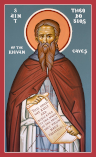 From his earliest youth, he fled from laughter and merriment and gave himself to pondering on
God and prayer. Because of this, he was often beaten by his mother, and especially when she saw
one day an iron belt around his naked body, from which his shirt was stained with blood. Reading
one day in the Gospel the words of the Lord: ‘He who loves father or mother more than Me,
is not worthy of Me,’ he left his parents’ home and fled to Kiev, to the cave of our
holy father Anthony. Anthony received him and quickly made him a monk. When his mother found him,
and called him to return home, he spoke with her and she then became a nun in a women’s
monastery. By his asceticism, his meekness and his goodness, Theodosius quickly outstripped all
the other monks and became very dear to Anthony, who made him abbot of the monastery. In his
time, the number of brethren in the monastery grew very rapidly, churches and cells were built,
and the Rule of the Studion was introduced in its fullness. God endowed Theodosius with great
grace in response to his virginal purity, labors in prayer and love for his neighbor, and so this
man of God had great power over unclean spirits and healed sicknesses and had insight into the
destinies of men. With St. Anthony, St. Theodosius is regarded as the restorer and organizer of
Russian monasticism. He entered peacefully into rest in 1074, and his healing relics rest beside
those of St. Anthony.
FOR CONSIDERATION
Abba John Kolovos asked his monks: ‘Who or what sold Joseph?’ One of them answered: ‘His brethren.’ To this the elder said: ‘Not his brothers, but his humility.’ Joseph could have revealed that he was their brother, and thus oppose the sale. But he kept silent about that. By humility, then, was he sold, and this same humility later made him ruler of Egypt. We guard ourselves too carefully from the outward difficulties encountered in giving ourselves over to the will of God, and so we lose the good fruits that are reaped in difficult circumstances endured with humility. Abba Poemen spoke wisely thus: ‘We have set aside the light yoke; that is, self-instruction, and loaded ourselves with the heavy one; that is, self-righteousness.’ Christians accept every difficulty as payment for past or present sins, seeking the will of God with faith in all things, and looking to the end with hope.
Daily Scripture Readings taken from The Orthodox New Testament, translated and published by Holy Apostles Convent, Buena Vista, Colorado, copyright © 2000, used with permission, all rights reserved.
Daily Prologue Readings taken from The Prologue of Ochrid, by Bishop Nikolai Velimirovic, translated by Mother Maria, published by Lazarica Press, Birmingham, England, copyright © 1985, all rights reserved. Edited by Dormition Skete.