

Daily Devotional
Tuesday, April 22, 2031 (NS), April 9, 2031 (OS)
No Fasting.
Tuesday of the Second Week
The commemoration of the Martyr Efpsychios of Cæsarea in Cappadocia.
Scripture Readings
Paschalion — Movable Calendar
Tuesday of the Second Week
Epistle
The Reading is from the Acts of the Apostles [§ 10]. In those days:
4 1As the apostles spoke to the people, the priests and the captain of the temple-guard and the Sadducees came upon them, 2being troubled because they taught the people and proclaimed in Jesus the resurrection of the dead. 3And they laid hands on them and put them in custody until the morrow, for it was evening already. 4But many of those who heard the word believed; and the number of the men came to be about five thousand. 5And it came to pass on the morrow, that the rulers and elders and scribes were gathered together in Jerusalem, 6and also Annas the high priest and Caiaphas and John and Alexander, and as many as were of high priestly kindred. 7And having stood them in their midst, they began to inquire, “In what manner of power or in what manner of name did ye do this?” 8Then Peter, filled with the Holy Spirit, said to them, “Rulers of the people and elders of Israel: 9“If today we are being examined on account of a good deed done to an infirm man, regarding in what manner this man hath been healed, 10“be it known to you all, and to all the people of Israel, that in the name of Jesus Christ the Nazaræan, Whom ye crucified, Whom God raised from the dead, in Him this one standeth before you healthy.”
Gospel
The Reading is from the Holy Gospel according to Saint John [§ 10]. The Lord said to His disciples:
3 16“God so loved the world that He gave His only-begotten Son, that everyone who believeth in Him should not perish, but may have everlasting life. 17“For God did not send forth His Son into the world in order that He might condemn the world, but that the world might be saved through Him. 18“The one who believeth in Him is not judged; but the one who believeth not hath already been judged, because he hath not believed in the name of the only-begotten Son of God. 19“And this is the judgment, that the light hath come into the world, and men loved the darkness rather than the light, for their works were evil. 20“For everyone who practiseth bad things hateth the light and cometh not to the light, lest his works should be reproved; 21“but the one who doeth the truth cometh to the light, in order that his works might be made manifest, that they have been wrought in God.”
Menaion — Fixed Calendar
The commemoration of the Martyr Efpsychios of Cæsarea in Cappadocia.
No readings given.
Lives of the Saints (Prologue)
April 22nd – Civil Calendar
April 9th – Church Calendar
1. The Holy Martyr Efpsychios (Eupsychius).
He was of gentle birth and was reared in faith and devotion. In the time of the Emperor Julian the Apostate, when St. Basil the Great was governing the Church in Caesarea, Efpsychios married a girl of good family. But he was not given even one day to live in wedlock, for, on his wedding day itself, there was a pagan festival with sacrifices to the idol of Fortune. Efpsychios went out with some others and smashed all the idols in the temple, then pulled down the temple itself. Julian was furious, and commanded that the culprits be beheaded, that many Christians be taken into the army, that an enormous levy be imposed on Christians, the proceeds of which were to be used to rebuild the Temple of Fortune, and that the town cease to be called Caesarea (as it had been named by Claudius Caesar), and revert to its former name, Maza. Efpsychios was first bound to a tree and cruelly tortured, and then beheaded, in 362. A little after this time, the wicked Emperor Julian visited that town on his way to Persia, against which he was waging war. St. Basil went to meet him, bearing three barley loaves as a sign of honor and welcome. The emperor ordered that, as a return gift, the saint be given a fistful of hay. Basil said to the Emperor: ‘You ridicule us now, O king; we bring you bread, by which we are fed, and you give us miserable food which you, with all your power, are not able to turn into nourishment for men!’ To this the emperor replied: ‘You can be sure that I will feed you with this hay when I return from Persia!’ But the wicked apostate did not return alive from Persia, but perished there by a fitting and unnatural death.
2. Our Holy Father Vadim the Martyr.
In the time of the Persian King Sapor, Vadim, abbot of a monastery and a man famed for his grace, was thrown into prison with seven of his disciples. With him in prison was a Prince Nirsan, also a Christian. Every day they were taken out and flogged. Prince Nirsan was afraid, and promised to forsake his faith and worship the sun. This was pleasing to Sapor, and he promised Nirsan all the possessions of Vadim’s monastery if he would, with his own hands, behead Vadim. Nirsan agreed to this. With trembling hands, terrified by the dignity of St. Vadim’s face, he let the sword fall several times on the holy man’s neck, barely succeeding in beheading him. But, very quickly after that, he fell into despair and ran himself through with his own sword; thus receiving at his own hands the punishment for slaying a righteous man. St. Vadim suffered in 376.
3. New-martyrs Raphael, Nicholas, and Irene of Mytilene
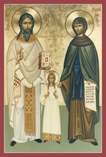 On the island of Mytilene (Lesbos) in the Aegean Sea,
there was an ancient monastery in the fifteenth century. Its archimandrite was Father Raphael,
and there also lived there the Hierodeacon Nicholas and other monks. During their lifetime, the
city of Constantinople fell to the Turks (in 1453), and the Muslims continued their incursions
into the surrounding areas, and soon they also wrested control of Mytilene away from the
Genovese. In 1463, on this island there was an uprising, and Turkish reprisals against the
Christian islanders were brutal. The mayor of the village of Thermi, Basil, together with his
wife and daughter, and also the teacher Theodore, ran up to the monastery to warn the fathers of
the danger, but were instantly arrested there by a company of Turks. It was Great Thursday, and
the Muslims subjected the inhabitants of the monastery to torments for several days. In order to
force the mayor to reveal the whereabouts of the other rebels, the Turks tortured his
twelve-year-old daughter, Irene, before her parents’ eyes; finally she was burned alive in a
large earthenware jar. Then they slaughtered her parents and beheaded the teacher. Finally, on
the evening of Bright Tuesday, they took Saint Raphael and, tying him to a tree by his hair,
severed his head from his body by cutting through his jaws with a saw. Saint Nicholas, who was
tied to a tree and forced to watch, died of a heart attack when he witnessed this horrific
execution of his beloved elder. The Turks threw the bodies of the saints into the spring, set
fire to the monastery, and left. After many centuries, the locals only had a vague memory of what
had happened at that ruined monastery. But God, Who never forgets the exploits of His saints,
deigned to reveal those holy martyrs in modern times, and when some builders happened to dig up
some of the sacred relics in 1959, the martyrs appeared to many different islanders in visions
for the next several years in order to reveal the location of their relics and tell the story of
what had happened to them. These miraculous revelations sent by the Church Triumphant are a great
consolation to the Orthodox faithful of the last times, manifesting a living connection between
the Faith we hold today and the Faith of those who have gone before.
FOR CONSIDERATION
It is said of Pericles that he was a man of almost perfect human form, except that his head was rather too long and narrow-like, so that he invited ironic smiles whenever he appeared bare-headed. To conceal this shortcoming of this great man of his people, Greek sculptors always portrayed him wearing a helmet. If pagans thus strove to conceal the shortcomings of their fellows, how much more should we Christians do so! ‘In honor preferring one another’ (Rom. 12:10), the apostle commands all who follow Christ. How can we say that we follow Him in meekness and purity if we poison the air every day with our talk of others’ sins and weaknesses? To conceal your own virtues and the shortcomings of others—in that lies the greatest spiritual wisdom.
Daily Scripture Readings taken from The Orthodox New Testament, translated and published by Holy Apostles Convent, Buena Vista, Colorado, copyright © 2000, used with permission, all rights reserved.
Daily Prologue Readings taken from The Prologue of Ochrid, by Bishop Nikolai Velimirovic, translated by Mother Maria, published by Lazarica Press, Birmingham, England, copyright © 1985, all rights reserved. Edited by Dormition Skete.