

Daily Devotional
Wednesday, April 9, 2031 (NS), March 27, 2031 (OS)
Fast Day. No Meat, Fish, Dairy, Eggs, Alcohol or Olive Oil Allowed.
Holy Week
| Holy and Great Wednesday |
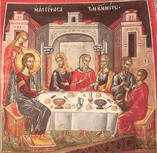
The commemoration of the holy Martyr Matrona of Thessalonica.
Scripture Readings
Paschalion — Movable Calendar
Holy and Great Wednesday
Epistle
There is no Epistle Reading this day because of Holy Week.
Gospel
In the Orthros
The Reading is from the Holy Gospel according to Saint John [§ mid 41]. At that time:
12 17The crowd that was with Jesus when He called Lazarus out of the grave and raised him from the dead bore witness. 18On this account the crowd also went to meet Him, because it heard that He had done this sign. 19The Pharisees therefore said among themselves, “Observe ye that ye profit nothing? Behold, the world hath gone away after Him.”
20And there were certain Greeks from among those going up that they might do reverence at the feast. 21Then these came to Philip, who was from Bethsaida of Galilee, and asked him, saying, “Sir, we wish to see Jesus.” 22Philip cometh and telleth Andrew, and again Andrew and Philip tell Jesus. 23But Jesus answered them, saying, “The hour hath come that the Son of Man should be glorified. 24“Verily, verily, I say to you, unless the grain of the wheat that falleth into the earth should die, it abideth alone; but if it should die, it beareth much fruit. 25“The one who loveth his life shall lose it; and the one who hateth his life in this world shall keep it to life eternal. 26“If anyone serve Me, let him keep on following Me; and where I am, there My servant shall be also. And if anyone serve Me, the Father shall honor him. 27“Now My soul hath been troubled; and what shall I say? ‘Father, save Me from this hour’; but on this account I came to this hour. 28“Father, glorify Thy name.” Then a voice came out of the heaven: “I both glorified it and will glorify it again.” 29The crowd then that stood by and heard it was saying that thunder had occurred; others were saying, “An angel hath spoken to Him.” 30Jesus answered and said, “This voice hath not occurred for My sake, but for your sakes. 31“Now is a judgment of this world; now the ruler of this world shall be cast out. 32“And I, if I be lifted up from the earth, will draw all to Myself.” 33But He was saying this, signifying by what manner of death He was about to die. 34The crowd answered Him, “We heard out of the law that the Christ abideth forever; and how sayest Thou, ‘The Son of Man must be lifted up’? Who is this Son of Man?” 35Then Jesus said to them, “Yet a little while is the light with you. Be walking while ye have the light, that darkness might not overtake you; and indeed the one who walketh in the darkness knoweth not where he goeth. 36“While ye have the light, keep on believing in the light, that ye might become sons of light.” Jesus spoke these things, and departed, and was hidden from them.
37But though He had done so many signs before them, yet they kept on not believing in Him, 38that the word of Esaias the prophet might be fulfilled, which he spoke, “Lord, who believed our report? And to whom was the arm of the Lord revealed [Is. 53:1]?” 39On this account they were not able to believe, because Esaias said again, 40“He hath blinded their eyes and hardened their heart, that they should not see with their eyes and understand with their heart and should be converted; and I shall heal them [cf. Is. 6:9, 10].” 41These things said Esaias when he saw His glory and spoke concerning Him. 42Yet, nevertheless, from among the rulers also many believed in Him, but because of the Pharisees they were not confessing Him, lest they should be expelled from the synagogue; 43for they loved the glory of men more than the glory of God. 44But Jesus cried and said, “The one who believeth in Me, believeth not in Me, but in the One Who sent Me; 45“and the one who seeth Me, seeth the One Who sent Me. 46“I have come a light into the world, that everyone who believeth in Me should not abide in the darkness. 47“And if anyone hear My words and believe not, I judge him not; for I came not that I might judge the world, but that I might save the world. 48“The one who rejecteth Me and receiveth not My words, hath that which judgeth him—the word which I spoke, that shall judge him in the last day. 49“For I spoke not of Myself, but the Father Who sent Me, He Himself gave a commandment to Me, what I should say and what I should speak. 50“And I know that His commandment is life everlasting. Therefore, what things I speak, as the Father hath said to Me, so I speak.”
In the Liturgy of the Presanctified Gifts
The Reading is from the Holy Gospel according to Saint Matthew [§ 108]. At that time:
26 6When Jesus was in Bethany, in the house of Simon the leper, 7a woman came to Him having an alabaster flask of very costly perfumed ointment, and she poured it upon His head as He reclined at table. 8But His disciples, having seen it, became indignant, saying, “For what is this loss? 9“For it was possible for this perfumed ointment to have been sold for much and to have been given to the poor.” 10But Jesus, perceiving it, said to them, “Why do ye cause trouble to the woman? For she wrought a good work toward Me. 11“For ye have the poor among yourselves always, but Me ye have not always. 12“For in putting this perfumed ointment upon My body, she did it for My burial. 13“Verily I say to you, wheresoever this Gospel shall be proclaimed in all the world, also what she did shall be spoken of for a memorial of her.” 14Then one of the twelve, who was called Judas Iscariote, went to the chief priests, 15and said, “What are ye willing to give to me, and I will deliver Him up to you?” And they fixed by agreement with him for thirty pieces of silver. 16And from that time he sought an opportunity that he might deliver Him up.
Menaion — Fixed Calendar
The commemoration of the holy Martyr Matrona of Thessalonica.
No readings given.
Lives of the Saints (Prologue)
April 9th – Civil Calendar
March 27th – Church Calendar
1. The Holy Martyr Matrona.
She was an orphan, and a servant in the house of a Jew in Thessalonica. The wife of this Jew constantly derided Matrona for her faith in Christ, and urged her to cast Christ aside and go to the synagogue. But the humble Matrona went about her work conscientiously, not replying to her mistress and secretly praying to Christ our God. On one occasion the Jewess discovered that Matrona had gone to church unbeknown to her, and demanded, in a great rage, to know why she had gone to the church and not the synagogue. ‘Because God is alive in the Christian Church, but He has departed from the synagogues of the Jews,’ replied Matrona. Enraged by such a courageous answer, the Jewess thrashed her and locked her in a dark chamber, and in addition to that had her bound. But the next day she found her unbound by the power of God and kneeling in prayer, praising God. Then she locked her up again for the second time until she died of hunger. Then that wicked woman took the body of the holy maiden and threw it to the ground from the top of her house. Christians took the body of the martyr and buried it. The bishop, Alexander, when he had learned of the many miracles worked by the holy martyr, built a church over her grave. As for the evil Jewess, she soon received her just reward, when, standing on the same spot from which she had thrown Matrona’s body, she slipped and fell onto the cobbled pavement and was smashed to pieces.
2. Our Holy Father John the Clairvoyant.
He was a carpenter until the age of twenty-five, when, urged on by an unquenchable desire for constant prayer, he took himself off into the desert, where he lived until his death; that is, until the age of ninety. He lived in the body as one without a body. He could look into the heart of every person who came near him and could discover his name, and his thoughts and desires. He foretold the outcome of the Emperor Theodosios’ battles to him; prophesied to nobles, to monks, to anyone at all who was in need, to uncover what was hidden from them in the darkness of future days. A certain prince asked him to receive his wife, who wished to see him. The holy man was not willing to satisfy empty curiosity, so he appeared in a dream to the prince’s wife, and she saw him just as he was. And when the woman described her dream to her husband, he affirmed that such was the appearance of the holy man. He taught every visitor about humility, which is the basic virtue, and always drew his examples from life. He taught how pride makes war against a man of exalted character and brings him to dust and to terrible sins. He endured great assaults from evil spirits. Once Satan appeared to him with a great crowd of demons in the form of shining angels. They pressed him to bow down before Satan, lying to him and telling him that it was Christ. But he answered with great wisdom: ‘Every day I bow down to Jesus Christ my King; if it were He, it would not be necessary for me to bow down to Him at this particular moment.’ After these words, the evil forces disappeared like smoke. He died peacefully, kneeling in prayer, at the age of ninety.
3. Our Holy Father Paphnutios.
He was a disciple of St. Anthony the Great. The holiness of his life brought many sinners (for example, St. Thaïs, Oct 8th) back to the path of repentance, for he was more like a bodiless angel than a carnal man. He entered into rest towards the end of the fourth century.
FOR CONSIDERATION
‘He who thinks evil, in him is no cleanness,’ says St. Simeon the New Theologian, and adds: ‘For how can there be a clean heart in one who fouls it with unclean thoughts, as a mirror is darkened by dust?’ Do you see, then, the inaccessible height on which the Christian religion stands in relation to all other religions and worldly theories? He who contemplates evil has in some manner done evil, and is at fault before God and his own soul. It is an insult to God and a loss to self. To be Christian in the true sense means to make an enormous effort to cleanse our hearts and minds from evil thoughts. On what an effort it is, there is a vast amount of teaching (which in our day remains an almost entirely closed book, even to Christians) and a wealth of true experience on the part of holy men and women who have justified this teaching. To cleanse oneself from evil and impure thoughts, this root of all evil, was the goal of all the great ascetics, cave-dwellers and hesychasts.
Daily Scripture Readings taken from The Orthodox New Testament, translated and published by Holy Apostles Convent, Buena Vista, Colorado, copyright © 2000, used with permission, all rights reserved.
Daily Prologue Readings taken from The Prologue of Ochrid, by Bishop Nikolai Velimirovic, translated by Mother Maria, published by Lazarica Press, Birmingham, England, copyright © 1985, all rights reserved. Edited by Dormition Skete.