

Daily Devotional
Friday, January 17, 2031 (NS), January 4, 2031 (OS)
No Fasting.
Friday of the Thirty-First Week
The commemoration of the Forefeast of Theophany, and the Synaxis of the holy Seventy Apostles.
Scripture Readings
Paschalion — Movable Calendar
Friday of the Thirty-First Week
Epistle
The Reading is from the General Epistle of Saint Iakovos [§ 52]. Brethren:
2 1Cease having, with respect of persons, the faith of our Lord Jesus Christ, the Lord of the glory. 2For if a gold-ringed man in splendid apparel should enter into your congregation, and a poor man in dirty apparel should also enter, 3and ye have regard for him wearing the splendid apparel, and say to him, “Sit thou in this good place,” and say to the poor man, “Stand thou there,” or “Sit thou here down beside my footstool,” 4ye also made a distinction in yourselves, did ye not, and became judges with evil thoughts? 5Hearken, my beloved brethren: God chose for Himself, did He not, the poor of this world to be rich in faith and heirs of the kingdom which He promised to those who love Him? 6But ye dishonored the poor man. The rich oppress you and drag you to courts of judgment, do they not? 7They blaspheme the good name, the one having been invoked upon you, do they not? 8If ye indeed fulfill the royal law according to the Scripture, “Thou shalt love thy neighbor as thyself [Lev. 19:18],” ye do well; 9but if ye have respect of persons, ye work sin, being convicted by the law as transgressors. 10For whosoever shall keep the whole law, but shall stumble in one point, he hath become guilty of all. 11For the One Who said, “Do not commit adultery [cf. Ex. 20:13(14)],” also said, “Do not commit murder [cf. Ex. 20:15(13)].” Now if thou shalt not commit adultery, but shalt murder, thou hast become a transgressor of the law. 12In this manner be speaking and in this manner be doing, as those who are to be judged by the law of freedom. 13For the judgment shall be merciless to him who rendered no mercy. Mercy boasteth against judgment.
Gospel
The Reading is from the Holy Gospel according to Saint Mark [§ 58]. At that time:
13 1As Jesus went forth out of the temple, one of His disciples saith to Him, “Teacher, see what manner of stones and what manner of buildings!” 2And Jesus answered and said to him, “Seest thou these great buildings? By no means shall a stone be left upon a stone which surely shall not be put down.” 3And as He sat upon the Mount of Olives opposite the temple, Peter and Iakovos and John and Andrew were questioning Him privately, 4“Tell us, when shall these things be, and what shall be the sign when all these things are about to be completed?” 5And Jesus, answering them, began to say, “Be taking heed, lest anyone should lead you astray. 6“For many shall come in My name, saying, ‘I am the Christ,’ and they shall lead astray many. 7“But whenever ye hear of wars and reports of wars, cease being clamorous; for it must come to pass, but the end is not yet. 8“For nation shall be stirred up against nation, and kingdom against kingdom. And there shall be earthquakes in place after place, and there shall be famines and troubles. These are the beginnings of birth pangs.”
Menaion — Fixed Calendar
The commemoration of the Forefeast of Theophany, and the Synaxis of the holy Seventy Apostles.
Epistle
The Reading is from the First Epistle of Saint Paul to the Corinthians [§ 131]. Brethren:
4 9I think that God showed forth us the apostles last, as condemned to death; for we became a spectacle to the world, both to angels and to men. 10We are fools for Christ’s sake, but ye are wise in Christ. We are weak, but ye are strong. Ye are held in honor, but we are dishonored. 11Until the present hour, we both hunger and thirst, and are naked, and are being buffeted, and never at rest. 12And we toil working with our own hands. Being reviled, we bless; being persecuted, we bear up; 13being evilly spoken of, we beseech. We became as the filth of the world, the off-scouring of all until now. 14I do not write these things shaming you, but admonishing you as my beloved children. 15For if ye have myriads of tutors in Christ, yet ye have not many fathers; for in Christ Jesus I begot you through the Gospel. 16Therefore, I beseech you, keep on becoming imitators of me.
For Sl. usage, see [Rom. 8:8-14].
Gospel
The Reading is from the Holy Gospel according to Saint John [§ 2].
1 18No one hath seen God at any time. The only-begotten Son, Who is in the bosom of the Father, that One declareth Him.
19And this is the testimony of John, when the Jews sent forth priests and Levites from Jerusalem that they should ask him, “Who art thou?” 20He not only confessed and denied not, but also confessed, “I am not the Christ.” 21And they questioned him, “What then? Art thou Elias?” And he saith, “I am not.” “Art thou the Prophet?” And he answered, “No.” 22Then they said to him, “Who art thou, that we might give an answer to those who sent us? What sayest thou about thyself?” 23He said, “I am a voice crying in the wilderness, ‘Make straight the way of the Lord [Is. 40:3],’ even as the Prophet Esaias said.” 24And they who had been sent forth were from the Pharisees. 25And they asked him, and said to him, “Why baptizest thou then, if thou art not the Christ, nor Elias, nor the Prophet?” 26John answered them, saying, “I baptize in water, but there standeth One in your midst Whom ye know not. 27“He it is, the One Who cometh after me, Who hath come to be before me, of Whom I am not worthy that I should loose the thong of His sandal.” 28These things took place in Bethabara across the Jordan, where John was baptizing.
For Sl. usage, see [Lk. 10:1-21]
Lives of the Saints (Prologue)
January 17th – Civil Calendar
January 4th – Church Calendar
1. The Assembly of the Seventy Apostles.
In addition to the twelve great apostles, the Lord chose besides seventy other, lesser apostles, and sent them to preach to the Jews. He sent them out two by two before His face, to each town and place, saying: “Behold, I send you as sheep among wolves” (Lk. 10:1-5). But as Judas, one of the Twelve, fell away from the Lord, so some among these Seventy withdrew from Him, not with the intention of betraying Him but from human weakness and lack of faith (Jn. 6:66). And as Judas’ place was filled from among the other apostles, so the places of these were filled with others chosen. These apostles labored in the same way as the twelve great apostles; they were the assistants of the Twelve in the spreading and strengthening of the Church of God in the world. They suffered much torture and malice, from men and from demons, but their firm faith and burning love for the risen Lord made them conquerors of the world and heirs of the kingdom of heaven.
2. St. Evstathius (Jevstatije), Archbishop of Serbia.
Born in the diocese of Budim (Budimlje), of God-fearing parents, he became a monk as a young man in Zeta, then moved on to greater asceticism at Hilandar. In time he became abbot of Hilandar, was then chosen to be Bishop of Zeta, and after some time had elapsed, to be Archbishop of Serbia. He was a man of great virtue and led Christ’s flock with zeal and love. He entered peacefully into rest at a great age in 1279, exclaiming as death drew near: “Into Thy hands, O Lord, I commend my spirit.” His relics are preserved in the crypt of the church at Peć.
3. The Eunuch of Queen Candace.
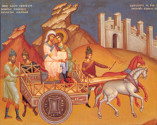 The
Apostle Philip baptized this negro eunuch (Acts 8:26-40). After his Baptism, the eunuch
returned home and began to teach about Christ. He was the first apostle of the Faith among
the negroes of Ethiopia. He died a martyr and was counted worthy of the kingdom of God. |
4. Our Holy Father, the Martyr Onuphrius of Hilandar.
He was possessed of great anger towards his parents in his youth, and declared to the Turks that he wished to become one of them. He immediately repented of these words, went to Hilandar and there became a monk. Tormented by his conscience, he determined on martyrdom. So, with the blessing of his spiritual father, he went to Trnovo and presented himself to the Turkish authorities, stating that he was a Christian and mocking Mohammed, as a result of which he was slain on January 4th, 1818, at the age of 32. The body of this spiritual hero was lost, as the Turks threw it into the sea.
FOR CONSIDERATION
How do we reply to those who say that there is no room in our logic for Christ the worker of miracles? Answer simply: Place yourself within His. In His logic are contained all eternity and all transient goodness, so you could, if you wished, find a place therein for yourself. If you cannot fit a barrel into a thimble, you can fit a thimble into a barrel. Clement of Alexandria says: ‘Philosophers are as children until they become mature in Christ...’ for the truth is never contained only in the processes of rational thought. Christ came to make men new, and so also to make new the logic of men. He is our Logos and our logic. Thus we must direct our minds in accordance with His, not He with ours. He is the corrective of our minds. The sun does not adjust itself to our clocks, but they to the sun.
Daily Scripture Readings taken from The Orthodox New Testament, translated and published by Holy Apostles Convent, Buena Vista, Colorado, copyright © 2000, used with permission, all rights reserved.
Daily Prologue Readings taken from The Prologue of Ochrid, by Bishop Nikolai Velimirovic, translated by Mother Maria, published by Lazarica Press, Birmingham, England, copyright © 1985, all rights reserved. Edited by Dormition Skete.