

Daily Devotional
Sunday, May 26, 2030 (NS), May 13, 2030 (OS)
No Fasting.
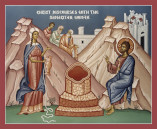
| Fifth Sunday of Pascha, or Sunday of the Samaritan Woman Mode Four — Seventh Eothinon |
The commemoration of the Virgin-martyr Glykeria at Heraclea.
Scripture Readings
Paschalion — Movable Calendar
Fifth Sunday of Pascha, or Sunday of the Samaritan Woman
Mode Four — Seventh Eothinon
Epistle
The Reading is from the Acts of the Apostles [§ 28]. In those days:
For Gk usage, see Acts 11:19-30; for Sl. usage. see Acts 11:19-26, 29, 30.
11 19The apostles, who were scattered because of the affliction that arose about Stephen, went abroad as far as Phœnicia and Cyprus and Antioch, speaking the word to no one except to Jews only. 20But some of them were men of Cyprus and Cyrene, who, after they came to Antioch, began speaking to the Hellenists, preaching as good tidings the Lord Jesus. 21And the hand of the Lord was with them, and a great number believed and turned to the Lord. 22Then the report concerning them was heard in the ears of the Church which was in Jerusalem. And they sent forth Barnabas to go through as far as Antioch, 23who, after he came and saw the grace of God, was glad and was exhorting all to keep on remaining near to the Lord with purpose of heart. 24For he was a good man, and full of the Holy Spirit and of faith; and a considerable crowd was added to the Lord. 25And Barnabas went forth to Tarsus to search for Saul. 26And having found him, he brought him to Antioch. And it came to pass that they were gathered together with the Church for a whole year, and taught a considerable crowd. And the disciples were called Christians first in Antioch.
27And in these days prophets came down from Jerusalem to Antioch. 28And one of them, by name Agavos, rose up, and signified by the Spirit that there was about to be a great famine over all the inhabited world, which also came to pass in the time of Claudius Cæsar. 29And according as any one of the disciples was prospered, each of them determined to send relief toward ministering to the brethren who dwelt in Judæa, 30which also they did, sending it off to the presbyters by the hand of Barnabas and Saul.
Gospel
The Reading is from the Holy Gospel according to Saint John [§ 12]. At that time:
4 5Jesus came to a city of Samaria called Sychar, near the place which Jacob gave to his son Joseph. 6And Jacob’s well was there. Jesus then, having grown weary from the journey, was sitting thus on the well. It was about the sixth hour. 7There cometh a woman of Samaria to draw water. Jesus saith to her, “Give Me to drink.” 8For His disciples had gone away into the city in order that they might buy provisions. 9Then the Samaritan woman saith to Him, “How is it that Thou, being a Jew, askest to drink from me, who am a Samaritan woman? For the Jews have no dealings with Samaritans.” 10Jesus answered and said to her, “If thou knewest the gift of God, and Who is the One Who saith to thee, ‘Give Me to drink,’ thou wouldest have asked Him, and He would have given to thee living water.” 11The woman saith to Him, “Lord, Thou hast no bucket for drawing water, and the well is deep. From what place then hast Thou the water, the living one? 12“Thou art not greater than our father Jacob, who gave us the well, and drank from it himself, and his sons, and his animals, art Thou?” 13Jesus answered and said to her, “Everyone who drinketh of this water shall thirst again; 14“but whosoever drinketh of the water which I shall give him in no wise shall ever thirst. But the water which I shall give him shall become in him a fountain of water springing into eternal life.” 15The woman saith to Him, “Lord, give me this water, that I may not be thirsting, nor keep on coming here to draw.” 16Jesus said to her, “Go, call thy husband, and come here.” 17The woman answered and said, “I have no husband.” Jesus said to her, “Well didst thou say, ‘I have no husband,’ 18“for thou hast had five husbands, and now he whom thou hast is not thy husband; this truly thou hast spoken.” 19The woman saith to Him, “Lord, I perceive that Thou art a prophet. 20“Our fathers do reverence in this mountain, and ye say that in Jerusalem is the place where it is needful to do reverence.” 21Jesus saith to her, “Woman, believe Me, that there is coming an hour when neither in this mountain, nor in Jerusalem, shall ye do reverence to the Father. 22“Ye do reverence what ye know not; we do reverence what we know, for salvation is of the Jews. 23“But there is coming an hour, and now is, when the true worshippers shall do reverence to the Father in spirit and truth; for also the Father seeketh such as those who revere Him. 24“God is Spirit, and it is needful for those who revere Him to do reverence in spirit and truth.” 25The woman said to Him, “I know that Messiah is coming, the One Who is called Christ. Whenever that One should come, He will announce to us all things.” 26Jesus saith to her, “I am, the One Who speaketh to thee.” 27And upon this came His disciples, and they wondered that He was speaking with a woman; nevertheless no one said, “What seekest Thou?” or “Why speakest Thou with her?” 28The woman then left her waterpot, and went away into the city, and saith to the people, 29“Come, see a Man Who told me all things whatsoever I did. This One is not the Christ, is He?” 30Then they went forth out of the city and were going toward Him.
31But in the meantime the disciples were entreating Him, saying, “Rabbi, eat.” 32But He said to them, “I have food to eat which ye know not.” 33Therefore the disciples were saying to one another, “No one brought Him anything to eat, did he?” 34Jesus saith to them, “My food is that I be doing the will of Him Who sent Me, and that I should finish His work. 35“Do ye not say, ‘It is yet a space of four months, and the harvest cometh’? Behold, I say to you, lift up your eyes and see the fields, for they are white already to harvest. 36“And the one who reapeth receiveth a reward, and gathereth fruit to life eternal, that both the one who soweth and the one who reapeth may rejoice together. 37“For in this the saying is true, ‘There is one who soweth and another who reapeth.’ 38“I sent you forth to reap on what ye have not labored; others have labored, and ye have entered into their labor.” 39And many of the Samaritans of that city believed in Him, because of the utterance of the woman testifying, “He told me all things whatsoever I did.” 40Therefore, when the Samaritans came to Him, they were asking Him to stay with them; and He stayed there two days. 41And many more believed because of His word. 42And to the woman they were saying, “We no longer believe because of thy talk; for we ourselves have heard, and we know that this One is truly the Savior of the world, the Christ.”
Menaion — Fixed Calendar
The commemoration of the Virgin-martyr Glykeria at Heraclea.
No readings given.
Lives of the Saints (Prologue)
May 26th – Civil Calendar
May 13th – Church Calendar
1. The Holy Martyr Glykeria.
The daughter of a governor of Rome, she became poor after her father’s death and went to live in Trajanopolis in Thrace. In the time of the wicked Emperor Antoninus, Glykeria was brought to offer sacrifice to the idol of Zeus. She traced the Cross on her forehead, and when the governor asked her where was her lamp (for they all carried lamps in their hands), Glykeria indicated the Cross on her forehead and said: ‘This is my lamp!’ At her prayers, the idol was struck by lightning and broken into pieces. The governor was furious with her and commanded that she be thrown into prison. He sealed the door of the prison, intending to starve the maiden to death, but an angel of God appeared to Glykeria and gave her heavenly food. After a certain time, when the governor reckoned that the maiden must have died of hunger, he opened the prison and was astounded to see her in good health, bright and merry. The warder, Laodicius, seeing this marvel, himself confessed Christ the Lord and was at once beheaded. After that, Glykeria was thrown into a burning furnace, but she remained untouched by the flames. Standing in the midst of the fire, she praised the Lord, commemorating the wonder with the Three Children in the burning fiery furnace in Babylon. Finally, she was thrown to the lions, and praying to God, this holy maiden gave her soul into the hands of the Lord for Whom she had heroically suffered much torture. She suffered with honor in the year 141. A healing myrrh flowed from her relics, which healed the sick of the gravest illnesses.
2. The Holy Martyr Alexander.
He was a Slav, an eighteen-year-old soldier in the army of the Emperor Maximian. He refused to obey the imperial order to offer sacrifice to the Roman idols, because of which it fell to Captain Tiberian to tell him either to deny Christ or be tortured and killed. As all this advice was in vain, Tiberian arrested him and took him through Macedonia to Constantinople, whither he himself had an errand. In every place, the young Alexander was harshly tortured, but in every place also, Christians came out to him, begging his blessing and encouraging him in his sufferings. His mother, Pimenia, followed him. In the course of this journey, Alexander was many times visited by an angel of God, who eased his pains and encouraged him. In one place called Carasura, the martyr worked a miracle by his prayers: when the soldiers who were escorting him were tormented by thirst, he made a spring of cold water come out of a dry place. On the bank of the River Ergina, Tiberian ordered that the executioner behead Alexander and throw his body into the river. When the executioner swung his axe above Alexander’s head, he saw angels of God around him, resplendent with light, and was afraid and stayed his hand. Alexander asked him why he had done this, and he said that he had seen some young men in a nimbus of light surrounding him. Desiring to die and so be united with the Lord, Alexander prayed to God to take the angels away, so that the executioner would not be afraid. And so the executioner completed his work, in 298. Pimenia retrieved the body of her son and gave it burial. There were many healings at the martyr’s grave. After his death, he appeared to his mother and gave her tidings of her own imminent departure to the other world.
3. Our Holy Fathers John, Evthymius, George and Gabriel of Iviron.
They were the founders of the famous Iviron (Georgian) Monastery on the Holy Mountain. St. John (Ioane) lived in asceticism first in the Lavra of Athanasius, and then founded his own monastery, Iviron. He entered into rest in 998. Evthymius (Ekvtime) and George (Giorgi) translated the holy Scriptures into Georgian. Evthymius died in 1028 and George in 1066. Gabriel was found worthy to receive the wonder-working Portaïtissa icon of the Mother of God which was brought to the monastery by the sea.
FOR CONSIDERATION
St. Athanasius writes thus on the power of the death of Christ and His Cross: ‘Whose death has ever driven away demons? And whose death has ever been the cause of fear to demons, as was the death of Christ? Wherever the name of the Savior is invoked, there the demons are driven out. What has tamed man’s spiritual passions to such an extent that prodigals become chaste and murderers are no longer servants of the sword, and the fearful become brave? Has not the Christian Faith? Has not the sign of the Cross? And what else has so convinced man of immortality as the Cross of Christ and His bodily Resurrection?’ The death of the Sinless One and the Cross of the Lover of mankind have brought a greater and more enduring victory than all the kings of the earth with their milliard soldiers. For when has an army ever overcome one single demon? Only the invocation of the name of the Crucified puts the armies of demons to flight. Oh, when will all Christians know what riches they have in the name of Christ, and what a weapon in His Cross?
Daily Scripture Readings taken from The Orthodox New Testament, translated and published by Holy Apostles Convent, Buena Vista, Colorado, copyright © 2000, used with permission, all rights reserved.
Daily Prologue Readings taken from The Prologue of Ochrid, by Bishop Nikolai Velimirovic, translated by Mother Maria, published by Lazarica Press, Birmingham, England, copyright © 1985, all rights reserved. Edited by Dormition Skete.