

Daily Devotional
Sunday, March 3, 2030 (NS), February 18, 2030 (OS)
No Fasting.
Meatfare Sunday
Last day for Meat until Pascha.
Sunday of the Meatfare or Sunday of the Last Judgment.
Grave Mode — Seventh Eothinon
The commemoration of our holy father among the saints, Leo, Pope of Rome.
Scripture Readings
Paschalion — Movable Calendar
Sunday of the Meatfare or Sunday of the Last Judgment.
Grave Mode — Seventh Eothinon
Epistle
The Reading is from the First Epistle of Saint Paul to the Corinthians [§ 140]. Brethren:
8 8Meat commendeth us not to God; for neither if we eat have we an advantage, nor if we eat not are we behind. 9But be taking heed, lest this license of yours should become a stumbling block to those who are weak. 10For if one should see thee who hast knowledge reclining at table in an idol’s temple, shall not the conscience of him who is weak be built up so as to eat the things sacrificed to idols? 11And on thy knowledge the brother who is weak shall destroy himself, for whom Christ died. 12But when ye sin thus against the brethren and wound their conscience which is weak, ye sin against Christ. 13On which very account, if meat causeth my brother to stumble, I will not at all eat flesh forever, lest I should cause my brother to stumble.
9 1I am an apostle, am I not? I am free, am I not? I have seen Jesus Christ our Lord, have I not? Ye are my work in the Lord, are ye not? 2If I am not an apostle to others, yet at least I am to you; for ye are the seal of mine apostleship in the Lord.
Gospel
The Reading is from the Holy Gospel according to Saint Matthew [§ 106]. The Lord said:
25 31“Whenever the Son of Man should come in His glory, and all the holy angels with Him, then shall He sit upon the throne of His glory. 32“And before Him shall be gathered all the nations; and He shall separate them from one another, even as the shepherd separateth the sheep from the young kids. 33“And indeed He shall set the sheep on His right, but the young kids on the left. 34“Then shall the King say to those on His right, ‘Come, ye who are blessed of My Father, inherit the kingdom which hath been prepared for you from the foundation of the world. 35“‘For I hungered and ye gave Me to eat; I thirsted and ye gave Me to drink; I was a stranger and ye brought Me in; 36“‘naked and ye clothed Me; I was sick and ye visited Me; I was in prison and ye came to Me.’ 37“Then shall the righteous answer Him, saying, ‘Lord, when did we see Thee hungering and fed Thee, or thirsting and gave Thee to drink? 38“‘And when did we see Thee a stranger and brought Thee in? Or naked and we clothed Thee? 39“‘And when did we see Thee sick, or in prison, and came to Thee?’ 40“And the King shall answer and say to them, ‘Verily I say to you, insofar as ye did it to one of the least of these My brethren, ye did it to Me.’ 41“Then shall He say also to those on the left, ‘Go from Me, ye who have been cursed, into the fire, the everlasting one, which hath been prepared for the devil and his angels: 42“‘For I hungered and ye did not give Me anything to eat; I thirsted and ye did not give Me anything to drink; 43“‘I was a stranger and ye did not bring Me in, naked and ye did not clothe Me, sick, and in prison, and ye did not visit Me.’ 44“Then shall they also answer Him, saying, ‘Lord, when did we see Thee hungering, or thirsting, or a stranger, or naked, or sick, or in prison, and we did not minister to Thee?’ 45“Then shall He answer them, saying, ‘Verily I say to you, insofar as ye did it not to one of the least of these, neither did ye do it to Me.’ 46“And these shall go away into everlasting punishment, but the righteous into life eternal.”
Menaion — Fixed Calendar
The commemoration of our holy father among the saints, Leo, Pope of Rome.
No readings given.
Synaxarion Readings
Meatfare Sunday
When Thou shalt sit to judge the world, O Judge of all, count me worthy of Thy summons to Thy right hand.
On this day we commemorate the inescapable second coming of Christ, ordained by the most divine fathers to be observed after the second parable of the prodigal, so that no one who has learned of the love of God for mankind from it will live in laziness, saying, “God loves mankind, and when I am separated from Him by sin, all is prepared for my restoration.” This fearsome day of judgment has been designated for commemoration at this point in time, that through fear of death and the expectation of future torment, those who live in laziness may be encouraged to the virtues, not trusting only in the love of God, but also realizing that He is the righteous Judge who will judge all men according to their deeds. In other words those souls who have passed over are obliged to undergo judgment. And this present feast is a type of symbol of this in that it is presented now as a final celebration just as it will be the last event after our death. For it behooves us to contemplate that as the beginning of the world and Adam’s fall from Paradise are commemorated on the following Sunday, so this day is the end of all days and of the world itself.
The commemoration is appointed for this day of Meatfare, that in awe of this event we should limit our intake of earthly food, not giving ourselves over to gluttony, and be encouraged to love our neighbor. In other words, since we were banished from Eden, cursed and condemned through eating of the fruit, so the present event has been ordained at this time, as next Sunday we will be banished through Adam, until Christ comes again to raise us up to Paradise. It is called the Second Coming, since Christ appeared to us at His first coming in the flesh and delivered the human race, and He will come again to judge whether that which He commanded us has been observed. And when will this Second Coming occur? No one knows; for although He mentioned several preceding signs, the Lord concealed it from His apostles. Before His coming the Antichrist will appear. He will live his life after the manner of Christ, performing miracles like those which Christ performed, and raising the dead. Yet all that he does will be an illusion. After this, suddenly like lightning from heaven the Lord will come, going before His holy Cross, and a river of boiling fire will go before Him, cleansing the earth of its defilement. The Antichrist will be seized immediately along with his servants and will be committed to eternal fire. And when the angels sound the trumpets, all the nations of mankind will gather from all places and from all the ends of the earth in Jerusalem, for it is the center of the earth. And there the thrones will be set for judgment. Then all souls will be reunited with their bodies and clothed in incorruptible beauty, transformed into one likeness. And with one word the Lord will separate the righteous from the sinners. Those who have done good will receive eternal life, and the sinners will be once more sent to eternal and everlasting torment. Let it be noted that Christ will not ask who fasted, or who was naked, or who performed miracles, for although these things are good, mercy and compassion are far better. He will question both the righteous and the sinners on six commandment-like virtues, of which everyone is capable: “For I was hungry, and ye gave Me to eat. I was thirsty, and ye gave Me drink. I was a stranger, and ye took Me in; naked, and ye clothed Me. I was sick, and ye visited Me. I was in prison, and ye came to Me. Inasmuch as ye have done it to one of the least of these My brethren, ye have done it to Me.” Then all will confess the Lord Jesus Christ in the glory of God the Father.
Now the torments, according to the Holy Gospel are weeping and the gnashing of teeth, where their worm dies not and the fire is not quenched, and he shall be cast into outer darkness. For all the Church of God will joyfully delight in attaining the kingdom of the heavens, being close to God in His holy place, and receiving everlasting glory and exaltation. But those who are separated from God through wasting the life of their souls in laziness and temporal nourishment will receive torment and darkness, and be eternally deprived of the divine radiance.
In Thine ineffable love for mankind, O Christ our God, make us worthy of Thy voice, which we long to hear, number us among those at Thy right hand, and have mercy on us. Amen.
Translated from Triodion, siest ‘Tripesnets: Triod’ Postnaya, Moscow, 1904, by Robert Parent.
Lives of the Saints (Prologue)
March 3rd – Civil Calendar: Non-Leap Year
March 2nd – Civil Calendar: Leap Year
February 18th – Church Calendar
1. St. Leo the Great, Pope of Rome.
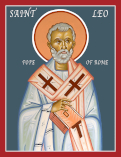 Born in Italy of devout parents, he was
first archdeacon with Pope Sixtus the Third, then elected against his own will to the papal
throne after Sixtus’ death. When Attila drew near to Rome with his Huns and prepared to
ravage and burn the city, Leo went out to him in his episcopal vestments, tamed the wrath of the
Hun leader and averted the fall of Rome. Attila was willing to be guided by Leo both because of
his holiness and because of a vision he had of the Apostles Peter and Paul, standing behind Leo
and threatening Attila with a flaming sword.
Leo not only saved Rome; he also contributed greatly to the safeguarding of Orthodoxy against the heresy of Eftyches and Dioscoros. This heresy consisted in the merging of the divine and human natures of Christ into one, and following from this, the denial of the existence of two wills in the Person of our Lord and Savior. This led to the summoning of the Fourth Ecumenical Council at Chalcedon, at which St. Leo’s Epistle was read—a letter which St. Leo, after writing it, had placed on the tomb of St. Peter, and which St. Peter had corrected. As death drew near, he spent forty days in fasting and prayer by the tomb of the Apostle Peter, begging him to tell him if his sins were forgiven. The apostle appeared to him and assured him that they were, except for his sins in the ordaining of priests (from which it is seen how grave a sin it is to ordain an unworthy man). The saint fell to prayer again, until he was told that these also were wiped out. Then he gave his soul to the Lord in peace. St. Leo entered into rest in the year 461.
FOR CONSIDERATION
Grass is the most important thing in a meadow, as are grain in a field and vegetables in a market-garden. No one would boast of the fence of a meadow rather than its hay, or of the hut in a field rather than its crop, or the ditch in a market garden rather than its vegetables. Why do people boast of their country, or of the highways in that country, or its frontier ditches or the towns in it—or about anything else that has just about as much value as the fence of a meadow or the hut in a field or the ditch in a market garden when weighed against the main crop; that is, people? People do not exist for the sake of the country, but the country for their sake. Christ came to save, not the country, but the people. A country is valued by the goodness of its citizens. But of what use is a great country to evil men? They fill the field with brambles.
Daily Scripture Readings taken from The Orthodox New Testament, translated and published by Holy Apostles Convent, Buena Vista, Colorado, copyright © 2000, used with permission, all rights reserved.
Daily Prologue Readings taken from The Prologue of Ochrid, by Bishop Nikolai Velimirovic, translated by Mother Maria, published by Lazarica Press, Birmingham, England, copyright © 1985, all rights reserved. Edited by Dormition Skete.