

Daily Devotional
Thursday, February 28, 2030 (NS), February 15, 2030 (OS)
No Fasting.
Thursday of the Thirty-Fifth Week
The commemoration of the holy Apostle Onesimos of the Seventy.
Scripture Readings
Paschalion — Movable Calendar
Thursday of the Thirty-Fifth Week
Epistle
The Reading is from the First General Epistle of Saint John [§ 74]. Beloved:
4 20If anyone should say, “I love God,” and be hating his brother, he is a liar; for the one not loving his brother whom he hath seen, how is he able to love God Whom he hath not seen? 21And this commandment have we from Him, that the one loving God, be loving his brother also.
5 1Everyone who believeth that Jesus is the Christ hath been born of God; and everyone who loveth Him Who begat loveth also him who hath been begotten of Him. 2In this we know that we love the children of God, whenever we love God and keep His commandments. 3For this is the love of God, that we be keeping His commandments. And His commandments are not heavy. 4For everything that hath been born of God overcometh the world. And this is the victory, the victory having overcome the world—our faith. 5Who is the one overcoming the world, if not the one believing that Jesus is the Son of God? 6This is the One Who came by water and blood, Jesus Christ; not in the water only, but in the water and the blood. And the Spirit is the One Who beareth witness, because the Spirit is the truth. 7For there are three bearing witness in the heaven: the Father, the Logos, and the Holy Spirit; and these Three are One. 8And there are three bearing witness in the earth: the Spirit, and the water, and the blood; and the three are for the one. 9If we receive the witness of man, the witness of God is greater; for this is the testimony of God which He hath testified concerning His Son. 10The one believing in the Son of God hath the witness in himself; the one not believing God hath made Him a liar, because he hath not believed in the testimony which God hath testified concerning His Son. 11And this is the testimony, that God gave us eternal life, and this life is in His Son. 12The one having the Son hath the life; the one not having the Son of God hath not the life.
13I am writing these things to you who believe in the name of the Son of God, that ye may know that ye have eternal life, and in order that ye may believe in the name of the Son of God. 14And this is the boldness which we have toward Him, that if we be asking anything for ourselves according to His will, He heareth us. 15And if we know that He hear us, whatsoever we may be asking for ourselves, we know that we have the requests which we have asked from Him. 16If anyone should see his brother sinning a sin not unto death, he shall ask, and He shall give life to him, for those that sin not unto death. There is a sin unto death; not concerning that do I say one should make request. 17All unrighteousness is sin; and there is a sin not unto death. 18We know that everyone who hath been born of God sinneth not, but the one who was born of God keepeth himself, and the evil one doth not take hold of him. 19We know that we are of God, and the whole world lieth in the evil one. 20But we know that the Son of God is come, and hath given us an understanding, in order that we may know Him Who is true; and we are in the true One, in His Son Jesus Christ. This is the true God and Life Eternal.
21Little children, guard yourselves from the idols. Amen.
Gospel
The Reading is from the Holy Gospel according to Saint Mark [§ 66]. At that time:
15 1The chief priests held a consultation with the elders and scribes and the whole sanhedrin, and bound Jesus, and carried Him away, and delivered Him up to Pilate. 2And Pilate questioned Him, “Thou art the King of the Jews?” And He answered and said to him, “Thou sayest.” 3And the chief priests were accusing Him of many things, but He answered nothing. 4And Pilate was questioning Him again, saying, “Answerest Thou nothing? Behold how many things they bear witness against Thee.” 5But Jesus answered nothing any more, so that Pilate marvelled. 6Now at the feast he used to release to them one prisoner, whomsoever they were asking for themselves. 7And there was one called Barabbas, who had been bound with fellow insurrectionists who had committed murder in the sedition. 8And the crowd, having cried out, began to ask him to do even as he always used to do for them. 9But Pilate answered them, saying, “Do ye wish that I release to you the King of the Jews?” 10For he was perceiving that the chief priests had delivered Him up by reason of envy. 11But the chief priests stirred up the crowd, in order that he should rather release Barabbas to them. 12And Pilate answered and said again to them, “What do ye wish then that I should do to Him Whom ye call King of the Jews?” 13And they cried out again, “Crucify Him.” 14But Pilate was saying to them, “Why, what evil did He do?” And they cried out more exceedingly, “Crucify Him.” 15And Pilate, willing to do that which was satisfactory to the crowd, released Barabbas to them; and he delivered up Jesus, after he scourged Him, in order that He might be crucified.
Menaion — Fixed Calendar
The commemoration of the holy Apostle Onesimos of the Seventy.
Epistle
The Reading is from the Epistle of Saint Paul to Saint Philemon [§ mid 302 B].
1Paul, a prisoner of Christ Jesus, and Timothy our brother, to Philemon the beloved and our fellow worker, 2and to Apfia the beloved, and to Archippos our fellow soldier, and to the church in thy house. 3Grace to you and peace from God our Father and the Lord Jesus Christ.
4I thank my God, making mention of thee always in the time of my prayers, 5hearing of thy love and the faith which thou hast toward the Lord Jesus and in regard to all the saints, 6that the communion of thy faith might become energized in full knowledge of every good which is in you in regard to Christ Jesus. 7For we have much joy and consolation over thy love, because the hearts of the saints have been refreshed through thee, brother. 8Wherefore, though I have much boldness in Christ to enjoin thee to that which is becoming, 9yet for the sake of love I rather beseech, being such a one as Paul, an elder, and now also a prisoner of Jesus Christ, 10I beseech thee concerning my child, Onesimos, whom I begot in my bonds— 11the one who was once useless to thee, but is now useful to thee and to me—whom I am sending back. 12Now receive thou him, that is, mine own heart, 13whom I was wishing to hold for myself, that he may minister to me in the bonds of the Gospel; 14but without thine opinion I wished to do nothing, that thy good may not be as according to necessity, but according to willingness. 15For perhaps on this account he was separated from thee for a season, in order that thou mayest receive him in full forever, 16no longer as a slave, but above a slave, a brother beloved, especially to me, and how much more to thee, both in the flesh and in the Lord! 17If then thou holdest me a partner, take him to thyself as thou wouldest me. 18But if he wronged thee in anything or oweth thee, be reckoning this to me; 19I, Paul, am writing it with mine own hand, I will repay it; not that I may mention that to me thou owest even thyself. 20Yes, brother, may I benefit from thee in the Lord; refresh thou my heart in the Lord.
21Having trusted to thine obedience, I am writing to thee, knowing that even beyond what I may say thou wilt do. 22And at the same time also, be preparing a lodging for me, for I hope that through your prayers I shall be graciously given to you. 23There greeteth thee Epaphras, my fellow captive in Christ Jesus, 24Mark, Aristarchos, Demas, Luke, my fellow workers.
25The grace of our Lord Jesus Christ be with your spirit. Amen.
Gospel
No reading given.
Lives of the Saints (Prologue)
February 28th – Civil Calendar
February 15th – Church Calendar
1. The Holy Apostle Onesimus.
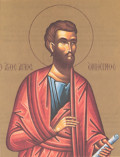 One of the Seventy, he was a slave of Philemon, a rich and
distinguished citizen of Colossae in Phrygia. He offended his master, Philemon, in some way and
fled to Rome, where he heard the Gospel from the Apostle Paul and was baptized. By this time,
Paul had also brought Philemon to the true Faith, and he reconciled the two of them, Philemon and
Onesimus, master and slave, writing a special epistle to Philemon—one of the most moving writings
to be found in the New Testament: ‘I beseech thee for my son Onesimus, whom I have begotten
in my bonds.... Perhaps he departed for a season, that thou shouldest receive him forever, not
now as a servant, but above a servant; a brother beloved.’ Deeply moved by this letter,
Philemon received Onesimus as a brother, indeed, and gave him his freedom. Onesimus was later
made bishop and received the see of Ephesus after the death of the Apostle Timothy. This is
recorded in the epistles of St. Ignatius the God-Bearer. At the time of the persecution under
Trajan, Onesimus, by then an old man, was arrested and taken to Rome. There he testified before
the judge, Tertylus, was imprisoned and finally slain. A wealthy woman took his body, placed it
in a silver coffin and buried it in the year 109.
2. Our Holy Father Evsevios.
A Syrian hermit, he lived at first under the guidance of holy men, but later went into the solitude of the desert. He fed himself entirely on vegetable foods, never even tasting fruit, and spent all his time in prayer in the open air, enduring all weathers. He lived to the age of 95 and entered into rest in the Lord in 440.
FOR CONSIDERATION
Peace of soul is precious to all men. With those who have acquired peace of soul, the body can be in constant motion, occupation or pain, but their souls, cleaving to God, remain always in unshakable peace. St. Seraphim of Sarov teaches: ‘We must endeavor by every means to keep peace of soul. Do not be troubled by the insults of men. It is necessary at all costs to restrain oneself from anger, and by watchfulness over oneself to keep the mind and heart from vain movement.... For the guarding of peace of soul, it is also necessary to flee from judging others. By non-judgement and silence, peace of soul is preserved. When a man attains to such a state, he receives divine revelation. For a man to be able to keep himself from judging others, he must be vigilant over himself; he must not dare to receive vain thoughts from another, and must be as one dead before all that is of this world. We must tirelessly keep our hearts from vain thoughts and impressions (Prov. 4:23). By constant watchfulness over the heart, a purity of heart is born in which God is seen, according to the words of eternal truth: “Blessed are the pure in heart; for they shall see God” (Matt. 5:8).’
Daily Scripture Readings taken from The Orthodox New Testament, translated and published by Holy Apostles Convent, Buena Vista, Colorado, copyright © 2000, used with permission, all rights reserved.
Daily Prologue Readings taken from The Prologue of Ochrid, by Bishop Nikolai Velimirovic, translated by Mother Maria, published by Lazarica Press, Birmingham, England, copyright © 1985, all rights reserved. Edited by Dormition Skete.