

Daily Devotional
Sunday, January 13, 2030 (NS), December 31, 2029 (OS)
No Fasting.
The Sunday After the Nativity of Christ: The commemoration of the holy and Righteous Joseph the Betrothed, David the King, and Iakovos the brother of the Lord.
Sunday of the Thirty-Third Week or Sunday of the Cananite Woman
Mode Plagal Four — Eleventh Eothinon
The commemoration of the Leave-taking of Nativity, and our venerable mother among the saints, Melanie the Younger, nun of Rome.
Scripture Readings
Special Commemorations
The Sunday After the Nativity of Christ: The commemoration of the holy and Righteous Joseph the Betrothed, David the King, and Iakovos the brother of the Lord.
Epistle
The Reading is from the Epistle of Saint Paul to the Galatians [§ 200].
1 11Brethren, I make known to you the Gospel which was preached as good tidings by me, that it is not according to man; 12for I neither received it from man, nor was I taught it, but by a revelation of Jesus Christ. 13For ye heard of my manner of life at one time in Judaism, that according to excess, I used to persecute the Church of God, and was ravaging her. 14And I kept on advancing in Judaism beyond many contemporaries in mine own race, being more exceedingly a zealot of the traditions of my fathers. 15But when it pleased God, Who separated me from my mother’s womb and called me by His grace, 16to reveal His Son in me, that I be preaching Him as good tidings among the nations, immediately I conferred not with flesh and blood, 17neither did I go up to Jerusalem to those who were apostles before me, but I went away into Arabia, and again returned to Damascus. 18Then after three years I went up to Jerusalem to visit Peter, and remained with him fifteen days; 19but of the other apostles I saw none, except Iakovos the brother of the Lord.
Gospel
The Reading is from the Holy Gospel according to Saint Matthew [§ 4].
2 13After the Magi departed, behold, an angel of the Lord appeareth to Joseph in a dream, saying, “Arise, and take the young Child and His Mother, and flee thou into Egypt, and be thou there until I should tell thee; for Herod is about to seek the young Child, to destroy Him.” 14And he arose and took the young Child and His Mother by night and departed into Egypt, 15and was there until the death of Herod, that it might be fulfilled that which was spoken by the Lord through the prophet, saying, “Out of Egypt I called My Son [cf. Hos. 11:1].” 16Then Herod, after he saw that he was mocked by the Magi, was angered exceedingly. And he sent forth and killed all the male children that were in Bethlehem and in all her borders, from two years old and under, according to the time which he inquired carefully from the Magi. 17Then was fulfilled that which was spoken by Jeremias the prophet, saying, 18“A voice in Rama was heard, lamentation and weeping and great mourning, Rachel weeping for her children, and would not be comforted, because they are not [cf. Jer. 38(31):15].” 19But after Herod died, behold, an angel of the Lord appeareth in a dream to Joseph in Egypt, 20saying, “Arise, and take the young Child and His Mother, and go into the land of Israel; for they who sought the soul of the young Child have died.” 21And he arose and took the young Child and His Mother, and came into the land of Israel. 22But after he heard that Archelaus reigned over Judæa instead of Herod his father, he was afraid to go there. And having been divinely warned in a dream, he withdrew into the parts of Galilee. 23And he came and dwelt in a city which is called Nazareth, in order that it might be fulfilled that which was spoken by the prophets, that He shall be called a Nazarene.
Paschalion — Movable Calendar
Sunday of the Thirty-Third Week or Sunday of the Cananite Woman
Mode Plagal Four — Eleventh Eothinon
Epistle
The Reading is from the Second Epistle of Saint Paul to Saint Timothy [§ 296]. Child Timothy:
3 10Thou hast closely followed my teaching, conduct, purpose, faith, long-suffering, love, patience, 11persecutions, sufferings, such as happened to me in Antioch, in Iconium, in Lystra—what persecutions I endured! And out of them all the Lord delivered me. 12Yes, and all those who wish to live piously in Christ Jesus shall be persecuted. 13But evil men and cheats shall advance to the worse, leading astray and being led astray. 14But thou, keep on abiding in what thou didst learn and wast assured of, knowing from whom thou didst learn, 15and that from a babe thou hast known the sacred writings, which are able to make thee wise in regard to salvation through faith which is in Christ Jesus.
Gospel
The Reading is from the Holy Gospel according to Saint Luke [§ 94]. At that time:
19 1Jesus was passing through Jericho. 2And behold, there was a man called by the name of Zacchæos, and he was a chief tax collector, and this man was rich. 3And he was seeking to see who Jesus was, but he was not able because of the crowd, for he was little of stature. 4And he ran in front and went up into a sycamore tree, in order that he might see Him, for He was about to pass through that way. 5And when Jesus came upon the place, He looked up and saw him, and said to him, “Zacchæos, make haste and come down, for today it is needful for Me to stay in thy house.” 6And he made haste and came down, and received Him rejoicing. 7But after they saw it, they all were murmuring, saying, “With a sinful man He doth enter to lodge.” 8And Zacchæos stood and said to the Lord, “Behold, the half of my possessions, Lord, I give to the poor; and if I extorted anything of anyone by false charges, I give back fourfold.” 9And Jesus said to him, “Today, to this house, salvation came to pass, inasmuch as he also is a son of Abraham. 10“For the Son of Man came to seek and to save that which hath been lost.”
Menaion — Fixed Calendar
The commemoration of the Leave-taking of Nativity, and our venerable mother among the saints, Melanie the Younger, nun of Rome.
No readings given.
Lives of the Saints (Prologue)
Special Commemorations
The Sunday After the Nativity of Christ: The commemoration of the holy and Righteous Joseph the Betrothed, David the King, and Iakovos the brother of the Lord.
Holy and Righteous Joseph, King David and Iakovos the Lord’s Brother.


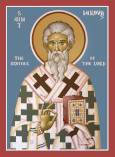 They
are commemorated on the Sunday after the Nativity of Christ. One can learn all about King David,
the son of Jesse, from the Book of Kings, and for holy Iakovos see October 23rd. Righteous Joseph
is so named in the Gospel (Matt. 1:19), and for this, God entrusted the most holy Virgin to his
protection and gave him great honor in the economy of human salvation. Although Joseph was of the
royal lineage of David, he himself was a simple carpenter in Nazareth. He took the most holy
Virgin from the temple into his home at the age of eighty, and entered into rest at the age of a
hundred and ten.
Menaion — Fixed Calendar
January 13th – Civil Calendar
December 31st – Church Calendar
1. Our Holy Mother Melanie the Roman.
Born in Rome of devout and very wealthy parents, she was forced by them to marry a young nobleman, Pinian. She was taken very seriously ill in giving birth to her second child, and told her husband that she would be healed only if he vowed before God to live with her in the future as brother and sister. Her husband agreed and Melanie, in her deep joy, was healed. When it pleased God to take both children to Himself, they agreed to sell all their possessions and give the proceeds to the destitute, the Church and the monasteries. They traveled through many lands and cities, everywhere doing good works. They visited famous spiritual guides in Upper and Lower Egypt, and received much instruction and inspiration from them. During all that time, Melanie lived in strict fasting, fervent prayer and the reading of the holy Scriptures. She followed the practice of reading the Scriptures right through, the Old and New Testaments, every three years, living with her husband as with a brother and fellow-ascetic. Going to Alexandria, they received the blessing of the patriarch, St. Cyril. After that, they went to Jerusalem and settled on the Mount of Olives. There Melanie became an anchoress, and gave herself completely to pondering, fasting and prayer. She lived thus for fourteen years, after which she came out, to help others to salvation, and founded monasteries for men and women. At the invitation of her kinsman, the senator Volusianus, a pagan, she went to Constantinople and brought him to the Christian Faith. She then returned to the Mount of Olives, where she went to God in 438, at the age of fifty-seven.
2. Our Holy Father, the Martyr Zoticus, Protector of the Poor.
He was eminent both of birth and rank. He moved to Constantinople, cast off all worldly things and received ordination to the priesthood, founding a home for the poor, containing a place for the treatment of infectious diseases, and ministering to those cared for in it. He was a close acquaintance of the Emperor Constantine the Great. In retaliation for the gold that Zoticus had had from him for his plague-victims, Constantine’s son, Constantius, tied him behind a wild ass, which was driven about until he died of his wounds. He suffered in the fourth century.
3. Blessed Theophylact, Archbishop of Ochrid.
Born on the island of Evia (Euboea), and educated in Constantinople by the most eminent teachers of his day, he became a priest in the Great Church. He was chosen as bishop, and sent, against his will, to Ochrid, where he spent about twenty-five years (from about 1082 to 1108). Chomatianus of Ochrid calls him ‘the wisest archbishop’. He was a man of enormous learning, both secular and theological, of refined Byzantine tastes, and was by nature melancholy and sensitive. Theophylact felt himself among the Slavs of Ochrid like an exile among barbarians. He wrote commentaries on the Four Gospels and on other books of the New Testament. These are the finest works of their sort after St. John Chrysostom, and are read to this day with great benefit. Of his other works, we know of his Letters, and a Life of St. Clement of Ochrid. In old age, Theophylact withdrew from Ochrid to Thessalonica, and finishing his earthly course, went to the blessedness of eternity.
FOR CONSIDERATION
How wisely holy men and women were able to handle their wealth! How skillfully they bought heavenly goods with their earthly riches! Oh, how low a value they set on earthly goods in themselves, treating them as dust and ashes! When St. Melanie visited the hermits in Egypt with the intention of giving them some financial help, she was astounded at their utter scorning of goods and wealth. Thus, she visited one hermit, Ephestion, and saw nothing in his cell but mats, a bowl for water, a little dry bread and a salt pot. Discovering in advance that the elder would not take money from her, she seized the opportunity to hide several gold pieces in the salt pot. But, as she was on the way back, she heard the elder running after her and calling her to stop. She stopped. The elder held the gold out to her on his palm, saying: ‘I don’t need this; take what’s yours.’ Melanie said to him: ‘If you don’t need it, give it to someone else.’ He replied: ‘No one around here would have any use for it.’ When Melanie would not take the gold back, the elder swung his arm and threw the gold into the river, and then returned to his cell.
During an outbreak of plague in Constantinople, the Emperor Constantius ordered that everyone affected be immediately thrown into the sea. St. Zoticus brought together those infected, and took them to his house to look after them there. When his money ran out, he went to the emperor and asked for money to buy precious pearls for him. The emperor gave him some money, and with this, he gathered further plague-victims and looked after them. One day, the emperor asked Zoticus for the promised pearls, and Zoticus took him and showed him the men in his house, saying: ‘These, O emperor, are living pearls, which I have acquired with toil and money for your salvation.’ The furious emperor condemned Zoticus to death. Zoticus entered into eternal life, and the emperor remained to expiate and repent of his sin.
Daily Scripture Readings taken from The Orthodox New Testament, translated and published by Holy Apostles Convent, Buena Vista, Colorado, copyright © 2000, used with permission, all rights reserved.
Daily Prologue Readings taken from The Prologue of Ochrid, by Bishop Nikolai Velimirovic, translated by Mother Maria, published by Lazarica Press, Birmingham, England, copyright © 1985, all rights reserved. Edited by Dormition Skete.