

Daily Devotional
Sunday, September 23, 2029 (NS), September 10, 2029 (OS)
No Fasting.
The Sunday Before the Exaltation of the Cross
Sunday of the Seventeenth Week or Sunday of the Cananite Woman
Mode Plagal Four — Sixth Eothinon
The commemoration of the Afterfeast of the Nativity, and the Martyrs Menodora, Metrodora, and Nymphodora.
Scripture Readings
Special Commemorations
The Sunday Before the Exaltation of the Cross
Epistle
The Reading is from the Epistle of Saint Paul to the Galatians [§ 215]. Brethren:
6 11See with what size letters I am writing to you with mine own hand. 12As many as wish to make a good show in the flesh, these constrain you to be circumcised, only that they may not be persecuted for the Cross of Christ. 13For not even they themselves who are circumcised keep the law, but they wish you to be circumcised, in order that they might boast in your flesh. 14But may it not be for me to boast, except in the Cross of our Lord Jesus Christ, through Whom the world hath been crucified to me, and I to the world. 15For in Christ Jesus neither circumcision hath any strength, nor uncircumcision, but a new creation. 16And as many as walk by this rule, peace be upon them and mercy, and upon the Israel of God.
17Henceforth, let no one be giving me troubles, for I bear in my body the marks of the Lord Jesus.
18The grace of our Lord Jesus Christ be with your spirit, brethren. Amen.
Gospel
The Reading is from the Holy Gospel according to Saint John [§ 9]. The Lord said:
3 13“No one hath gone up into the heavens, except the One Who came down from out of the heavens, the Son of Man, Who is in the heavens. 14“And even as Moses lifted up the serpent in the wilderness, thus it is needful for the Son of Man to be lifted up; 15“that everyone who believeth in Him should not perish, but may have everlasting life. 16“For God so loved the world that He gave His only-begotten Son, that everyone who believeth in Him should not perish, but may have everlasting life. 17“For God did not send forth His Son into the world in order that He might condemn the world, but that the world might be saved through Him.”
Paschalion — Movable Calendar
Sunday of the Seventeenth Week or Sunday of the Cananite Woman
Mode Plagal Four — Sixth Eothinon
Epistle
The Reading is from the Second Epistle of Saint Paul to the Corinthians [§ mid 182]. Brethren:
6 16Ye are a temple of the living God, even as God said, “I will dwell in them, and walk about in them; and I will be their God, and they shall be to Me a people [Cf. Lev. 26:11, 12; Jer. 38(31):33, 39(32):38; Ez. 37:27; Zach. 8:8].” 17Wherefore, “‘Come out from the midst of them, and be separated,’ saith the Lord, ‘and cease touching the unclean thing [Is. 52:11],’ and I will receive you, 18“‘and will be a Father to you, and ye shall be to Me for sons [cf. 2 Kgs. (2 Sam.) 7:14; 1 Chr. 17:13] and daughters [cf. Is. 43:6],’ saith the Lord Almighty.”
7 1Having, therefore, these promises, beloved, let us cleanse ourselves from all defilement of flesh and spirit, bringing to perfection holiness in the fear of God.
Gospel
The Reading is from the Holy Gospel according to Saint Matthew [§ 62]. At that time:
15 21Jesus withdrew into the parts of Tyre and Sidon. 22And behold, a Cananæan woman came out from those borders, and cried out to Him, saying, “Have mercy on me, O Lord, Son of David; my daughter is badly possessed by a demon.” 23But He answered her not a word. And His disciples came and were beseeching Him, saying, “Dismiss her, for she crieth aloud after us.” 24And He answered and said, “I was not sent except to the sheep, the lost of the house of Israel.” 25But she came and kept on making obeisance to Him, saying, “O Lord, help me.” 26And He answered and said, “It is not good to take the bread of the children, and to cast it to the little dogs.” 27But she said, “Yes, Lord, indeed even the little dogs eat from the little crumbs which fall from the table of their masters.” 28Then Jesus answered and said to her, “O woman, great is thy faith! Let it be to thee as thou wilt.” And her daughter was healed from that hour.
Menaion — Fixed Calendar
The commemoration of the Afterfeast of the Nativity, and the Martyrs Menodora, Metrodora, and Nymphodora.
No readings given.
Lives of the Saints (Prologue)
September 23rd – Civil Calendar
September 10th – Church Calendar
1. The Holy Martyrs Menodora, Metrodora and Nymphodora.
They were three sisters from some place in Asian Bithynia. Brought up in a Christian spirit, they withdrew from the city into the desert, desiring to lift up their minds to God and free themselves from the illusory world, and thus to live their lives with purity and virginity as true brides of Christ. They gave themselves to fasting, prayer and toil, and God adorned them with the gift of wonder-working. When people began to bring the sick to them for healing, they became known against their will. A certain governor, Fronton, heard of them and brought them to trial. Seeing them, the governor was amazed at their beauty, for, although they were nuns and their bodies were withered, their faces were radiant, illumined by an inner peace and the grace of God. The governor at first flattered them and promised to send them to the emperor, who would give them in marriage to his nobles, but when he realized that his flattery and promises were having no effect on these brides of Christ the Lord, he ordered that Menodora be put to torture and her sisters be thrown into prison. After harsh torture, the governor cried to Menodora, all wounded and covered in blood: ‘Offer sacrifice to the gods!’ To this the holy martyr replied: ‘Don’t you see that I am doing nothing but offering myself in sacrifice to my God?’ When she expired under torture, the governor brought out her two sisters and stood them beside Menodora’s dead body, and pointing to it, urged them to deny Christ. As they remained steadfast, he tortured them to death. At that, a thunderbolt fell from the sky and killed the soulless Fronton and his servants. Christians buried the bodies of these holy martyrs, who suffered some time between 305 and 311, in the time of Galerius, and entered into rest in the kingdom of Christ.
2. St. Pulcheria the Empress.
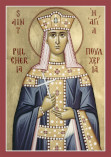 Daughter of the Emperor Arkadios, she vowed to remain in
perpetual virginity, and as an earnest of this vow, had a table of gold and precious stones
made for the cathedral. She reigned together with her brother Theodosios the Younger, and
was greatly zealous for the Orthodox Faith. It was at her instigation that the Third
Ecumenical Council in Ephesus was summoned, which condemned the Nestorian heresy. She built
the famous church of the Mother of God at Vlachernai in Constantinople. After
Theodosios’ death, she married Marcian, who was chosen as emperor, and lived with him
as a brother. It was she who found the relics of the Forty Martyrs of Sebaste. She entered
into rest in the Lord on September 10th, 453, at the age of fifty-five. Daughter of the Emperor Arkadios, she vowed to remain in
perpetual virginity, and as an earnest of this vow, had a table of gold and precious stones
made for the cathedral. She reigned together with her brother Theodosios the Younger, and
was greatly zealous for the Orthodox Faith. It was at her instigation that the Third
Ecumenical Council in Ephesus was summoned, which condemned the Nestorian heresy. She built
the famous church of the Mother of God at Vlachernai in Constantinople. After
Theodosios’ death, she married Marcian, who was chosen as emperor, and lived with him
as a brother. It was she who found the relics of the Forty Martyrs of Sebaste. She entered
into rest in the Lord on September 10th, 453, at the age of fifty-five.
|
3. Ss. Apollos, Lucius and Clement.
Apostles among the Seventy: Apollos (Acts 18:24-25) was bishop in Smyrna before St. Polycarp. St. Lucius (Rom. 16:21) was bishop in Laodicea and St. Clement was bishop in Sardis.
4. The Three Holy Women of Constantinople.
A noblewoman of Constantinople with her two handmaids, they scorned the vanity of the world and withdrew to solitude, where, after eleven years of asceticism, they entered into rest in the Lord.
FOR CONSIDERATION
The examples of courage and endurance that are given by the Christian martyrs—thousand upon thousand of them—shine with radiant glory through every page of the history of the Christian Church. But, as the examples of voluntary martyrs are given us to marvel at, so also (and no less) are the examples of the Christian ascetics, known and unknown, for asceticism is nothing other than a long-drawn-out martyrdom. Paul, Bishop of Monemvasia, has given to posterity the instructive example of a group of women ascetics. While he was still a layman and a tax-collector, he happened to stay in a monastery. Seeing ravens set about the fruit trees, stealing the fruit and carrying it off, he was curious, and together with the monks, set off after them to see where they were carrying the fruit. Going thus, they came to an impenetrable forest, into the depths of which the ravens disappeared, left their stolen fruit and quickly returned. Exploring, they found a cave, and in it, three nuns. The eldest of them told him of their life: how she had been a Constantinopolitan noblewoman whose husband had died and whom another noble had wanted to take by force as his wife. But she had decided, after her husband’s death, that she would spend the rest of her life in virginity, and had therefore given her goods away to the poor, and with her two handmaids, had fled to this remote spot. They had spent eleven years there in fasting and prayer, seeing no one and seen of no one but God. He, in His providence, had arranged for birds to bring them fruit to eat. They then begged the abbot to bring them holy Communion. When they had received Communion, three days later, all three holy women entered into rest, and the monks buried them.
Daily Scripture Readings taken from The Orthodox New Testament, translated and published by Holy Apostles Convent, Buena Vista, Colorado, copyright © 2000, used with permission, all rights reserved.
Daily Prologue Readings taken from The Prologue of Ochrid, by Bishop Nikolai Velimirovic, translated by Mother Maria, published by Lazarica Press, Birmingham, England, copyright © 1985, all rights reserved. Edited by Dormition Skete.