

Daily Devotional
Tuesday, September 18, 2029 (NS), September 5, 2029 (OS)
No Fasting.
Tuesday of the Seventeenth Week
The commemoration of the holy Prophet Zacharias and the holy and Righteous Elisabeth, the parents of the honorable Forerunner John the Baptist, and the martyred Monk Athanasios, Abbot of Brest.
Scripture Readings
Paschalion — Movable Calendar
Tuesday of the Seventeenth Week
Epistle
The Reading is from the Epistle of Saint Paul to the Ephesians [§ 222]. Brethren:
2 19Ye are no longer strangers and sojourners, but fellow citizens of the saints and of the household of God, 20who were built up on the foundation of the apostles and prophets, Jesus Christ Himself being the cornerstone, 21in Whom every building, being joined together, increaseth to a holy temple in the Lord, 22in Whom ye also are being built up together for a dwelling place of God in the Spirit.
3 1For this cause I, Paul, the prisoner of the Christ, Jesus, on behalf of you, the nations— 2if, indeed, ye heard of the dispensation of the grace of God which was given to me in regard to you, 3that by revelation He made known to me the mystery (even as I wrote before briefly, 4according to which reading ye are able to perceive my understanding in the mystery of the Christ), 5which in other generations was not made known to the sons of men, as now it was revealed to His holy apostles and prophets in the Spirit: 6the nations are to be joint-heirs, and fellow members of the body, and joint-partakers of His promise in the Christ, through the Gospel, 7of which I became a minister, according to the gift of the grace of God which was given to me according to the energy of His power.
Gospel
The Reading is from the Holy Gospel according to Saint Mark [§ 50]. At that time:
11 11Jesus entered into Jerusalem and into the temple. And after He looked about for Himself at all things, as it was already the evening hour, He went out to Bethany with the twelve.
12And on the morrow, after they came out from Bethany, He hungered. 13And having seen from afar a fig tree having leaves, He came, if perhaps He might find something on it. And after He came to it, He found nothing except leaves; for it was not the season of figs. 14And Jesus began to speak and said to it, “May no one any more eat fruit of thee forever.” And His disciples were listening. 15And they came to Jerusalem. And having entered into the temple, Jesus began to cast out those who sold and bought in the temple. And He overturned the tables of the money changers and the seats of those who sold the doves. 16And He did not permit that anyone should carry a vessel through the temple. 17And He was teaching, saying to them, “It hath been written, hath it not, that ‘My house shall be called a house of prayer for all the nations [Is. 56:7]’? But ye made it ‘a den of robbers [cf. Jer. 7:11].’” 18And the scribes and the Pharisees and the chief priests heard it, and they sought how they might destroy Him; for they were fearing Him, because all the crowd was astonished at His teaching. 19And when it came to be evening, He went forth out of the city. 20And in the morning, as they passed by, they saw the fig tree dried up from the roots. 21And Peter, having remembered, saith to Him, “Rabbi, behold, the fig tree which Thou cursedst hath been withered.” 22And Jesus answered, saying to them, “Be having faith in God. 23“For verily I say to you, that whosoever shall say to this mountain, ‘Be thou taken away and be thou cast into the sea,’ and doubt not in his heart, but shall believe that what he saith is coming to pass, it shall be to him whatsoever he shall say.”
Menaion — Fixed Calendar
The commemoration of the holy Prophet Zacharias and the holy and Righteous Elisabeth, the parents of the honorable Forerunner John the Baptist, and the martyred Monk Athanasios, Abbot of Brest.
Epistle
For the Righteous:
The Reading is from the Epistle of Saint Paul to the Hebrews [§ 314]. Brethren:
6 13God, having made a promise to Abraham, since He had no one greater to swear by, swore by Himself, 14saying, “Surely blessing I will bless thee, and multiplying I will multiply thee [cf. Gen. 22:17].” 15And thus, after he patiently endured, he attained the promise. 16For men indeed swear by the greater, and the oath for confirmation is to them an end of all contradiction. 17Wherein God, willing more abundantly to show to the heirs of the promise the immutability of His counsel, mediated by an oath, 18that by two immutable things, in which it was impossible for God to lie, we may have a strong consolation, who have fled for refuge to lay hold of the hope set before us, 19which we have as an anchor of the soul, both sure and firm, and which entereth into “the inner space behind the veil [Lev. 16:2, 12, 15],” 20where Jesus entered as a forerunner on our behalf, having become a high priest forever according to the order of Melchisedek.
For the venerable Martyr:
The Reading is from the Second Epistle of Saint Paul to Saint Timothy [§ 292]. Child Timothy:
2 1Be thou empowered in the grace that is in Christ Jesus; 2and the things which thou heardest from me in the midst of many witnesses, commit thou these things to faithful men who shall be competent also to teach others. 3Thou therefore suffer hardship as a good soldier of Jesus Christ. 4No one serving as a soldier is entangled with the affairs of life, in order that he might please the one who enlisted him. 5And if anyone also contend as an athlete in the games, he is not crowned unless he contend lawfully. 6The farmer who laboreth must be first to partake of the fruits. 7Be considering what I say; O may the Lord give thee understanding in all things! 8Be remembering Jesus Christ, of the seed of David, Who hath been raised from the dead, according to my Gospel, 9in which I suffer hardship even to bonds as a malefactor, but the word of God hath not been bound. 10On this account I endure all things for the sake of the elect, that they might also attain salvation that is in Christ Jesus with eternal glory.
Gospel
For the Righteous:
The Reading is from the Holy Gospel according to Saint Matthew [§ 96]. The Lord said to those Jews who had come to Him:
23 29“Woe to you, scribes and Pharisees, hypocrites! For ye build the tombs of the prophets and adorn the sepulchers of the righteous, 30“and say, ‘If we had been in the days of our fathers, we would not have been partakers with them in the blood of the prophets.’ 31“Therefore ye bear witness against yourselves that ye are sons of those who murdered the prophets. 32“Fill ye up also the measure of your fathers. 33“Serpents, offspring of vipers! How shall ye flee from the judgment of Gehenna? 34“On this account, behold, I send forth to you prophets, and wise ones, and scribes: and some of them shall ye kill and crucify; and some of them shall ye scourge in your synagogues and persecute from city to city, 35“that upon you should come all the righteous blood which is being poured out upon the earth, from the blood of Abel the righteous, unto the blood of Zacharias, son of Barachias, whom ye murdered between the temple and the altar. 36“Verily I say to you, all these things shall come upon this generation. 37“O Jerusalem, Jerusalem, the one that killeth the prophets and stoneth those who have been sent forth to her! How often would I have gathered together thy children, in the way a hen gathereth together her chicks under her wings, and ye would not. 38“Behold, your house is left to you desolate. 39“For I say to you, in no wise shall ye see Me henceforth, until ye shall say, ‘Blessed is He Who cometh in the name of the Lord [Ps. 117(118):25(26)].’”
For the venerable Martyr:
The Reading is from the Holy Gospel according to Saint Matthew [§ 38]. The Lord said to His disciples:
10 32“Everyone therefore who shall confess in Me before men, I also will confess in him before My Father Who is in the heavens. 33“But whosoever shall deny Me before men, him will I also deny before My Father Who is in the heavens. 34“Never think that I came to cast peace on the earth; I came not to cast peace, but a sword. 35“For I came to divide in two a man against his father, and a daughter against her mother, and a daughter-in-law against her mother-in-law; 36“and a man’s enemies shall be those of his own household. 37“The one who loveth father or mother more than Me is not worthy of Me; and the one who loveth son or daughter more than Me is not worthy of Me. 38“And whosoever taketh not his cross and followeth after Me is not worthy of Me.”
Lives of the Saints (Prologue)
September 18th – Civil Calendar
September 5th – Church Calendar
1. The Holy Prophet Zacharias.
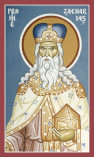 Father of St. John the Forerunner, he was the son of
Barachias, of the tribe of Aaron, a high priest in descent from Abia, and held the eighth degree
of service in the Temple in Jerusalem. His wife Elisabeth was sister to St. Anna, the mother of
the holy Mother of God. In the reign of King Herod, the child-slayer, Zacharias was serving one
day in his turn in the Temple in Jerusalem. An angel of God appeared to him in the altar, and
Zacharias was afraid. But the angel said to him: ‘Fear not, Zacharias’ (Luke 1), and
informed him that his wife Elisabeth would bear a son, for Zacharias and Elisabeth were both old.
When Zacharias doubted the words of the heavenly messenger, the angel told him: ‘I am
Gabriel, the one who standeth before the face of God,’ and Zacharias was made dumb from
that moment, and did not speak until his son was born and he had written on a tablet: ‘His
name is John.’ Then his mouth was opened, and he glorified God. Later, when the Lord Christ
was born and Herod began killing the children in Bethlehem, he sent men to find Zacharias’
son and kill him, for he had heard of all that had happened to Zacharias and how John was born.
Seeing the soldiers, Elisabeth took John in her arms—he was eighteen months old at that time—and
fled from the house with him to a rocky and desert region. When she saw where the soldiers had
driven them, she cried out to the mountain: ‘O mountain of God, receive a mother with her
child!’ and the rock opened and hid the mother and child inside itself. Herod, furious that
John had not been killed, ordered that Zacharias be cut down before the altar. Zacharias’
blood spilled over the marble and became as hard as stone, remaining thus as a witness to
Herod’s wickedness. At the place where Elisabeth hid with John, a cave opened and a spring
flowed forth, and a fruit-bearing palm grew up by God’s power. Forty days after
Zacharias’ death, blessed Elisabeth also entered into rest. The child John stayed in the
wilderness, fed by an angel and guarded by God’s providence, until that day when he
appeared by the Jordan.
Father of St. John the Forerunner, he was the son of
Barachias, of the tribe of Aaron, a high priest in descent from Abia, and held the eighth degree
of service in the Temple in Jerusalem. His wife Elisabeth was sister to St. Anna, the mother of
the holy Mother of God. In the reign of King Herod, the child-slayer, Zacharias was serving one
day in his turn in the Temple in Jerusalem. An angel of God appeared to him in the altar, and
Zacharias was afraid. But the angel said to him: ‘Fear not, Zacharias’ (Luke 1), and
informed him that his wife Elisabeth would bear a son, for Zacharias and Elisabeth were both old.
When Zacharias doubted the words of the heavenly messenger, the angel told him: ‘I am
Gabriel, the one who standeth before the face of God,’ and Zacharias was made dumb from
that moment, and did not speak until his son was born and he had written on a tablet: ‘His
name is John.’ Then his mouth was opened, and he glorified God. Later, when the Lord Christ
was born and Herod began killing the children in Bethlehem, he sent men to find Zacharias’
son and kill him, for he had heard of all that had happened to Zacharias and how John was born.
Seeing the soldiers, Elisabeth took John in her arms—he was eighteen months old at that time—and
fled from the house with him to a rocky and desert region. When she saw where the soldiers had
driven them, she cried out to the mountain: ‘O mountain of God, receive a mother with her
child!’ and the rock opened and hid the mother and child inside itself. Herod, furious that
John had not been killed, ordered that Zacharias be cut down before the altar. Zacharias’
blood spilled over the marble and became as hard as stone, remaining thus as a witness to
Herod’s wickedness. At the place where Elisabeth hid with John, a cave opened and a spring
flowed forth, and a fruit-bearing palm grew up by God’s power. Forty days after
Zacharias’ death, blessed Elisabeth also entered into rest. The child John stayed in the
wilderness, fed by an angel and guarded by God’s providence, until that day when he
appeared by the Jordan.
2. The Holy Martyrs Juventius and Maximus.
Little is known about the lives of these two holy men, but their suffering for Christ is known from a sermon in their praise by St. John Chrysostom. They were soldiers in the time of the Emperor Julian the Apostate. In conversation at an army festival, they condemned the emperor for his persecution of Christians. Someone told the emperor of this, and he had them thrown into prison. Some of the emperor’s men visited them, with the intention of turning them from the true Faith, telling them how many of their friends had denied Christ. To this, these great men replied: ‘We must therefore stand firm and with courage, and offer ourselves in sacrifice for their apostasy.’ They were beheaded with the sword under cover of darkness, but their relics were found and discovered to have wonder-working power.
3. The Seventy Holy Martyrs of Nikomedia.
Together with Urban, Theodore and Medimnus, these men were chosen by the Christians of Constantinople in the time of Valens’ persecution of Orthodoxy, to go as the most honored and eminent citizens of Constantinople to Nikomedia and beg the emperor (an Arian) to leave at least their lives to the Orthodox Christians. The emperor was furious and told them to go back home, but secretly ordered the sailors to set fire to the ship when they got out to sea, and save themselves in a small boat. The wicked servants of their yet more wicked master did this. The bodies of these glorious seventy were burned and drowned in the sea, but their souls swam off to the haven of eternal blessedness.
4. Our Holy Father Athanasius (Afanasy).
The holy New-martyr Athanasius was born in 1596 to a poor nobleman's family in the province of Minsk, Belarus. He became a monk and a zealous defender of the holy Orthodox Faith, struggling against the Latin Unia in the western reaches of Russia and Ukraine. Because of his strict monastic life he was ordained to the priesthood, eventually becoming the abbot of the St. Simeon Monastery of Brest-Litovsk. The faithful shepherd of the Lord's flock spent his time teaching and admonishing everyone in true Orthodox doctrine, writing and publishing educational materials and the writings of the holy fathers, and exposing the false union. The Polish Latins perpetrated despicable crimes against the Orthodox who lived within their territories, with the participation and encouragement of the Jesuits: tortures, burnings, brandings and other persecutions aimed at pressuring the Christians to deny their Faith. Only Roman Catholic heretics could engage in such violent behavior, since forced conversions are foreign to the Orthodox Faith. In 1645 Saint Athanasius was arrested and imprisoned for two years, as a new wave of persecution more brutal than previous ones broke out. Again, in 1648, the Latins apprehended Father Athanasius and tortured him both physically and psychologically. Transferring him to a Jesuit concentration camp, the authorities inflicted excruciatingly painful tortures on him, burning him with hot coals and branding him with iron rods. They flayed his flesh and burned him alive, though he somehow survived. At last he was dragged into a forest where he was shot twice and immediately surrendered his soul to God. The malicious Jesuits, unsatisfied with the death of the saint, continued to afflict his lifeless body, beheading him and then irreverently forcing his body into a narrow pit in the earth. Sometime later, a child miraculously found his body, and the local peasants unearthed his incorrupt relics with amazement, carrying the martyr’s body to the church of his own monastery, where many miracles have been performed at his sepulcher.
FOR CONSIDERATION
It is in vain that men try to find that which God deliberately hides from them. If God had not permitted it, men would never have found gold and silver under the earth, nor power made from steam nor a spark of electric light. In vain did Herod slay many children in Bethlehem in an effort to kill the One, for this One was hidden from the sight and sword of Herod. In vain did Herod seek John—and here is a mystery. The soldiers hastened after old Elisabeth, who fled with John in her arms, and could not catch her. Herod, in a rage, summoned Zacharias and shouted at him: ‘Give me your son John!’ But the old priest meekly replied to the king: ‘I am in the service of the Lord God of Israel. As for my son John, I do not know where he is.’ Maddened with rage, Herod ordered that Zacharias be murdered in place of John. The king’s servants went to the Temple and asked Zacharias: ‘Where have you hidden your son? Give him to us; the king demands this. If you do not give him to us, you will die yourself.’ Zacharias replied: ‘You may kill my body, but the Lord will receive my soul.’ Zacharias was slain, but Herod was not content with that. The wicked king had no peace day or night, being tormented with the foreboding that the newborn King proclaimed by the Magi must be none other than John. But he tried in vain to find him whom God deliberately concealed from him.
Daily Scripture Readings taken from The Orthodox New Testament, translated and published by Holy Apostles Convent, Buena Vista, Colorado, copyright © 2000, used with permission, all rights reserved.
Daily Prologue Readings taken from The Prologue of Ochrid, by Bishop Nikolai Velimirovic, translated by Mother Maria, published by Lazarica Press, Birmingham, England, copyright © 1985, all rights reserved. Edited by Dormition Skete.