

Daily Devotional
Monday, August 27, 2029 (NS), August 14, 2029 (OS)
Fast Day. No Meat, Fish, Dairy, Eggs, Alcohol or Olive Oil Allowed.
Monday of the Fourteenth Week
The commemoration of the Forefeast of the Dormition, the Prophet Micah, and the translation of the precious relics of our venerable Father Theodosios, Abbot of the Kiev Caves.
Scripture Readings
Paschalion — Movable Calendar
Monday of the Fourteenth Week
Epistle
The Reading is from the Second Epistle of Saint Paul to the Corinthians [§ 195]. Brethren:
12 10I am well pleased in weaknesses, in insults, in necessities, in persecutions, in straits, for Christ’s sake; for whenever I am weak, then I am strong.
11I have become foolish in boasting! Ye compelled me. For I ought to be commended by you; for I lacked nothing of the exceedingly super apostles, even though I am nothing. 12Indeed the signs of the apostle were wrought among you in all patience, in signs and wonders and works of power. 13For what is it in which ye were less than the rest of the churches, except that I myself did not burden you? Forgive me this wrong. 14Behold, I am ready to come to you a third time. And I will not burden you; for I seek not your things, but you. For the children ought not to lay up in store for the parents, but the parents for the children. 15Now I with the greatest pleasure will spend and will be expended utterly for your souls, even if loving you more abundantly, I am being loved the less. 16But let it be so, I did not burden you; but being crafty, I took you with guile. 17I did not take advantage of you through any of those whom I have sent forth to you, did I? 18I besought Titus, and with him I sent the brother. Titus did not take advantage of you in anything, did he? We walked in the same spirit, did we not? We walked in the same steps, did we not? 19Again, do ye think that we are making a defense to you? We speak before God in Christ; but we do all things, beloved, for your building up.
Gospel
The Reading is from the Holy Gospel according to Saint Mark [§ 16]. At that time:
4 10When Jesus was alone, those about Him with the twelve asked Him about the parable of the sower. 11And He began to say to them, “To you it hath been given to know the mystery of the kingdom of God; but to those who are outside, everything is done in parables, 12“that ‘seeing they see and perceive not, and hearing they hear and understand not, lest they should turn again and their sins be forgiven them [cf. Is. 6:9, 10].’” 13And He saith to them, “Know ye not this parable? And how will ye know all the parables? 14“The sower soweth the word. 15“And these are the ones by the wayside where the word is sown; and whenever they hear, Satan straightway cometh and taketh away the word which hath been sown in their hearts. 16“And these in like manner are the ones who are sown upon the rocky places who, whenever they hear the word, straightway, receive it with joy; 17“and they have no root in themselves, but are temporary. Then after affliction or persecution ariseth on account of the word, straightway they are made to stumble. 18“And these are the ones who are sown in the midst of thorns; such as hear the word, 19“and the cares of this age, and the deceit of wealth, and the desires concerning the rest entering in choke the word, and it becometh unfruitful. 20“And these are the ones who were sown on the good ground, such as hear the word, and receive it, and bring forth fruit: one thirty, and one sixty, and one a hundred.” 21And He was saying to them, “The lamp doth not come, in order that it might be put under the bushel or under the couch, doth it? It is in order that it might be placed upon the lampstand, is it not? 22“For nothing is hidden, except that it should be made manifest; nor did a secret thing take place, but that it should come to light. 23“If anyone hath ears to hear, let him hear.”
Menaion — Fixed Calendar
The commemoration of the Forefeast of the Dormition, the Prophet Micah, and the translation of the precious relics of our venerable Father Theodosios, Abbot of the Kiev Caves.
Epistle
For the venerable Father:
The Reading is from the Epistle of Saint Paul to the Galatians [§ 213]. Brethren:
5 22The fruit of the Spirit is love, joy, peace, long-suffering, kindness, goodness, faith, 23meekness, self-control; against such things there is no law. 24But they who are of the Christ crucified the flesh with the passions and the lusts. 25If we live by the Spirit, let us also be walking by the Spirit. 26Let us not become vainglorious, provoking one another, envying one another.
6 1Brethren, even if a man should be overtaken in some transgression, ye, the spiritual ones, be restoring such a one in the spirit of meekness, looking out for thyself, lest thou also be tempted. 2Keep on bearing one another’s burdens, and thus fill up the law of the Christ.
or
The Reading is from the Second Epistle of Saint Paul to the Corinthians [§§ 176, 177]. Brethren:
4 6It is God Who said, “Let there be light [cf. Gen. 1:3]” to shine out of darkness, Who shined in our hearts, for the illumination of the knowledge of the glory of God in the face of Jesus Christ.
7But we have this treasure in earthen vessels, that the preeminence of the power may be of God, and not from us. 8In every way we are afflicted, but not straitened; we are at a loss, but not utterly at a loss; 9persecuted, but not abandoned; cast down, but not destroyed— 10always bearing about in the body the dying of the Lord Jesus, that the life also of Jesus might be made manifest in our body. 11For we, the living, are always being delivered to death on account of Jesus, that also the life of Jesus might be made manifest in our mortal flesh. 12So that indeed death energizeth itself in us, but life in you. 13But having the same spirit of faith, according to that which hath been written: “I believed, wherefore I spoke [Ps. 115(116):1(10)],” we also believe, and therefore speak, 14knowing that the One Who raised up the Lord Jesus shall raise up us also through Jesus, and shall present us with you. 15For all things are for your sakes, that the grace, which abounded through the majority, might cause the giving of thanks to abound more to the glory of God.
Gospel
The Reading is from the Holy Gospel according to Saint Matthew [§ 43]. The Lord said to His disciples:
11 27“All things were delivered to Me by My Father. And no one doth fully know the Son, except the Father; nor doth anyone fully know the Father, except the Son, and he to whomsoever the Son is willing to reveal Him. 28“Come to Me, all ye who labor and are burdened, and I will give you rest. 29“Take up My yoke upon you and learn from Me, for I am meek and humble in heart; and ye shall find rest to your souls. 30“For My yoke is good and My burden is light.”
Lives of the Saints (Prologue)
August 27th – Civil Calendar
August 14th – Church Calendar
1. The Holy Prophet Micah the Second.
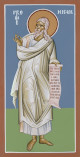 Of the tribe of Judah and from the village of Morasth, from which
he took the name ‘the Morasthite,’ he was a contemporary of the prophets Isaias, Amos
and Hosea, and the Judean kings Jotham, Ahaz and Hezekiah. He denounced the vices of his people
and denounced also the prophets who prophesied ‘of wine and strong drink’. He
foretold the fall of Samaria, which would come about because the city’s elders take a bribe
and the priests teach for hire, and prophets divine for money. ‘Therefore shall Sion for
your sake be plowed as a field, and Jerusalem shall become heaps’. But, of all his
prophecies, the most important are those of the Messiah, and especially of the place of His
birth. He named Bethlehem as the birthplace of the Messiah, ‘whose goings-forth have been
from of old, from everlasting’ (5:2). It is not known certainly whether this prophet was
killed by the Jews or died peacefully (see Jer. 26:18-19), but it is known that he was buried in
his village, and that his relics were found, together with the relics of the Prophet Abbakum, in
the time of the Emperor Theodosios the Great, by a mysterious revelation received by the Bishop
of Eleftheropolis.
Of the tribe of Judah and from the village of Morasth, from which
he took the name ‘the Morasthite,’ he was a contemporary of the prophets Isaias, Amos
and Hosea, and the Judean kings Jotham, Ahaz and Hezekiah. He denounced the vices of his people
and denounced also the prophets who prophesied ‘of wine and strong drink’. He
foretold the fall of Samaria, which would come about because the city’s elders take a bribe
and the priests teach for hire, and prophets divine for money. ‘Therefore shall Sion for
your sake be plowed as a field, and Jerusalem shall become heaps’. But, of all his
prophecies, the most important are those of the Messiah, and especially of the place of His
birth. He named Bethlehem as the birthplace of the Messiah, ‘whose goings-forth have been
from of old, from everlasting’ (5:2). It is not known certainly whether this prophet was
killed by the Jews or died peacefully (see Jer. 26:18-19), but it is known that he was buried in
his village, and that his relics were found, together with the relics of the Prophet Abbakum, in
the time of the Emperor Theodosios the Great, by a mysterious revelation received by the Bishop
of Eleftheropolis.
2. The Hieromartyr Markellos, Bishop of Apameia.
Born in Cyprus of rich and eminent parents, he was well-educated, and married and had children. After coming to an agreement with his wife and children, now grown, he withdrew to follow the monastic life in Syria. He became known for his compassion, meekness and spiritual learning, because of which the people of Apameia chose him as their bishop. As a bishop, he labored with zeal to bring pagans to the Christian Faith. When an idolatrous temple was burned down, the idolaters seized Markellos, and on the pretext of his having caused it, threw him into the fire, in about 389. We find in St. Markellos’ ‘Life’ that the blessing of water is mentioned, and its use.
FOR CONSIDERATION
Keep yourself from a parental curse, for it is a terrible thing. Value and seek your parents’ blessing, for it will accompany you throughout your life. The wise Sirach says: ‘The blessing of the father establisheth the houses of the children; but the curse of the mother rooteth out foundations’ (Sirach 3:9). The curse with which Noah cursed the descendants of Ham has stayed with them to this day, but the sons of Jacob have had fortune in life, according to their father’s blessing. St. Sergius, as a young man, asked his parents’ blessing to become a monk. His aged parents begged their son to wait and stay with them till their death, and then become a monk. Bishop Hermogenes speaks of an occasion when a son ill-treated his wife. When his mother, in tears, began to chide him for this, the son set on his mother, beat her and cracked her head against the wall. The despairing mother cried out: ‘Lord, let my son be accursed, and receive no blessing from Thee or from me!’ That same day, he began to tremble all over his body, and lived in this state for thirteen whole years, unable even to lift a spoon to his mouth. After thirteen years, he confessed and received Communion, and after that became a little eased and very soon died.
Daily Scripture Readings taken from The Orthodox New Testament, translated and published by Holy Apostles Convent, Buena Vista, Colorado, copyright © 2000, used with permission, all rights reserved.
Daily Prologue Readings taken from The Prologue of Ochrid, by Bishop Nikolai Velimirovic, translated by Mother Maria, published by Lazarica Press, Birmingham, England, copyright © 1985, all rights reserved. Edited by Dormition Skete.