

Daily Devotional
Sunday, August 19, 2029 (NS), August 6, 2029 (OS)
Fast Day, but Fish, Wine and Olive Oil Allowed.
Sunday of the Twelfth Week
Mode Three — First Eothinon
| The commemoration of the holy Transfiguration of our Lord, God, and Savior Jesus Christ. |
Scripture Readings
Paschalion — Movable Calendar
Sunday of the Twelfth Week
Mode Three — First Eothinon
Epistle
The Reading is from the First Epistle of Saint Paul to the Corinthians [§ 158].
15 1Brethren, I make known to you the Gospel which I preached as good tidings to you, which also ye received, and in which also ye stand, 2by which also ye are being saved, in what word I myself preached as good tidings to you, if ye hold fast, unless ye believed in vain. 3For I delivered to you in the first place what I also received, that Christ died for our sins according to the Scriptures, 4and that He was buried, and that He hath been raised the third day according to the Scriptures, 5and that He appeared to Kephas, then to the twelve. 6Afterward He appeared to over five hundred brethren at once, of whom the majority remain until now, but some also fell asleep. 7Then He appeared to Iakovos, then to all the apostles. 8And last of all He appeared to me also, as it were one untimely born. 9For I am the least of the apostles, who am not fit to be called an apostle, because I persecuted the Church of God. 10But by the grace of God I am what I am, and His grace which was toward me did not become void; but I toiled more abundantly than all of them, yet not I, but the grace of God which was with me. 11Therefore, whether it were I or they, so we preach and so ye believed.
Gospel
The Reading is from the Holy Gospel according to Saint Matthew [§ 79]. At that time:
19 16A certain young man came to Jesus, and knelt down to Him, and said, “Good Teacher, what good thing shall I do that I may have eternal life?” 17And He said to him, “Why callest thou Me good? No one is good, except One: God. But if thou art willing to enter into life, keep the commandments.” 18He saith to Him, “Which?” And Jesus said, “‘Thou shalt not murder; thou shalt not commit adultery; thou shalt not steal; thou shalt not bear false witness [Ex. 20:15, 13, 14, 16]; 19“‘be honoring thy father and thy mother [Ex. 20:12]’; and, ‘thou shalt love thy neighbor as thyself [Lev. 19:18].’” 20The young man saith to Him, “All these I kept for myself from my youth; what lack I yet?” 21Jesus said to him, “If thou art willing to be perfect, go and sell thy possessions, and give to the poor, and thou shalt have treasure in heaven; and come and keep on following Me.” 22But after the young man heard the saying, he went away being grieved; for he had many possessions. 23And Jesus said to His disciples, “Verily I say to you, that a rich man, with difficulty, shall enter into the kingdom of the heavens. 24“And again, I say to you, it is easier for a camel to pass through a needle’s eye than for a rich man to enter into the kingdom of God.” 25And after His disciples heard this, they were exceedingly amazed, saying, “Who then is able to be saved?” 26But Jesus looked at them and said to them, “With men this is impossible, but with God all things are possible.”
Menaion — Fixed Calendar
The commemoration of the holy Transfiguration of our Lord, God, and Savior Jesus Christ.
Epistle
The Reading is from the Second General Epistle of Saint Peter [§ 65].
1 10Brethren, give the more diligence to make sure for yourselves your calling and election; for if ye do these things, in no wise shall ye ever stumble. 11For thus shall there be richly supplied to you the entrance into the eternal kingdom of our Lord and Savior Jesus Christ.
12Wherefore I will not neglect to be reminding you always concerning these things, although ye know them and have been firmly set in the present truth. 13But I deem it right, as long as I am in this tabernacle, to stir you up by way of reminding you, 14knowing that the putting off of my tabernacle is soon, even as our Lord Jesus Christ also declared to me. 15But I will also endeavor for you to have after my decease these things always, so that ye may be able to put yourselves in remembrance. 16For we did not follow fables which have been cleverly devised, but we became eyewitnesses of that One’s majesty and made known to you the power and coming of our Lord Jesus Christ. 17For having received from God the Father honor and glory, there was borne along by the magnificent glory such a voice to Him, “This is My Son, the Beloved, in Whom I am well pleased.” 18And we heard this voice which was borne along from out of heaven, when we were with Him in the mount, the holy one. 19And we have the prophetic word made more sure, to which ye do well to take heed, as to a lamp shining in a squalid place, until the day should dawn and the morning star should arise in your hearts.
Gospel
In the Orthros
The Reading is from the Holy Gospel according to Saint Luke [§ 45]. At that time:
9 28Jesus took along Peter and John and Iakovos, and went up into the mountain to pray. 29And it came to pass, as He was praying, the appearance of His countenance was different, and His clothing became white, flashing as with lightning. 30And behold, two men were talking with Him, who were Moses and Elias, 31who appeared in glory and were speaking of His decease which He was about to fulfill in Jerusalem. 32But Peter and those with him were weighed down with sleep; and after they fully awoke, they saw His glory and the two men who stood with Him. 33And it came to pass, as they were parting from Him, Peter said to Jesus, “Master, it is good for us to be here; and let us make three tabernacles: one for Thee, and one for Moses, and one for Elias,” not knowing what he was saying. 34And while he was saying these things, a cloud came to be and began to overshadow them; and they were afraid as they were entering into the cloud. 35And there came to be a voice out of the cloud, saying, “This is My Son, the Beloved; be hearing Him.” 36And while the voice came to be, Jesus was found alone. And they kept silent, and related to no one in those days anything of what they had seen.
In the Liturgy
The Reading is from the Holy Gospel according to Saint Matthew [§ 70]. At that time:
17 1Jesus taketh along Peter and Iakovos and John his brother, and bringeth them up into a high mountain in private; 2and He was transfigured before them. And His face did shine as the sun, and His garments became white as the light. 3And behold, Moses and Elias appeared to them, talking together with Him. 4And Peter answered and said to Jesus, “Lord, it is good for us to be here; if Thou wilt, let us make here three tabernacles: one for Thee, and one for Moses, and one for Elias.” 5While he yet spoke, behold, a bright cloud overshadowed them. And behold, there came to be a voice out of the cloud, saying, “This is My Son, the Beloved, in Whom I am well pleased; be hearing Him.” 6And after the disciples heard it, they fell on their face, and were exceedingly afraid. 7And having come to them, Jesus touched them and said, “Arise, and cease being afraid.” 8And after they lifted up their eyes, they saw no one except Jesus alone. 9And as they came down from the mountain, Jesus enjoined them, saying, “Tell the vision to no one, until the Son of Man is raised from the dead.”
Lives of the Saints (Prologue)
August 19th – Civil Calendar
August 6th – Church Calendar
1. The Transfiguration of our Lord and God and Savior Jesus Christ.
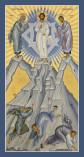 In the third year of His
ministry, the Lord Jesus spoke more frequently to His disciples of His coming Passion, but linked
it always with His glory after His suffering on the Cross. That His coming suffering should not
utterly shatter His disciples, so that they fall away from Him, He, the all-wise, decided to show
them, before His Passion, something of His divine glory. He therefore, taking with Him Peter,
Iakovos and John, went up onto Mount Tabor and was there transfigured before them. ‘And His
face shone as the sun, and His raiment became white as snow,’ and there appeared beside Him
Moses and Elias, the great prophets of the Old Testament. And the disciples saw and were amazed,
and Peter said: ‘Lord, it is good for us to be here; if Thou wilt, let us make here three
tabernacles: one for Thee, one for Moses and one for Elias.’ While Peter was still
speaking, Moses and Elias disappeared and a bright cloud came and overshadowed the Lord and the
disciples, and a voice came out of the cloud: ‘This is My Son, the Beloved, in Whom I am
well pleased; be hearing Him.’ Hearing this voice, the disciples fell prostrate on the
ground as though dead, and remained thus lying in fear until the Lord came to them and said:
‘Arise, and cease being afraid’ (Matt. 17). Why did the Lord take only three
disciples with Him onto Tabor, and not all of them? Because Judas was not worthy to behold the
divine glory of the Master Whom he was to betray, and the Lord did not want to leave him alone at
the foot of the mountain, that the betrayer should not thus work his betrayal. Why did Moses and
Elias appear? To shatter the Jewish fallacy that Christ was one of the prophets—Elias, Jeremias
or one of the others. This was why He revealed Himself as King over the prophets, and why Moses
and Elias appeared as His servants. Up to this moment, the Lord had many times shown His divine
power to His disciples, but on Tabor He showed them the glory of His divine nature. This vision
of His divine energies and the hearing of the heavenly witness to Him as the Son of God must have
been of support to the disciples in the days of the Lord’s suffering, for the strengthening
of a steadfast faith in Him and His final victory.
In the third year of His
ministry, the Lord Jesus spoke more frequently to His disciples of His coming Passion, but linked
it always with His glory after His suffering on the Cross. That His coming suffering should not
utterly shatter His disciples, so that they fall away from Him, He, the all-wise, decided to show
them, before His Passion, something of His divine glory. He therefore, taking with Him Peter,
Iakovos and John, went up onto Mount Tabor and was there transfigured before them. ‘And His
face shone as the sun, and His raiment became white as snow,’ and there appeared beside Him
Moses and Elias, the great prophets of the Old Testament. And the disciples saw and were amazed,
and Peter said: ‘Lord, it is good for us to be here; if Thou wilt, let us make here three
tabernacles: one for Thee, one for Moses and one for Elias.’ While Peter was still
speaking, Moses and Elias disappeared and a bright cloud came and overshadowed the Lord and the
disciples, and a voice came out of the cloud: ‘This is My Son, the Beloved, in Whom I am
well pleased; be hearing Him.’ Hearing this voice, the disciples fell prostrate on the
ground as though dead, and remained thus lying in fear until the Lord came to them and said:
‘Arise, and cease being afraid’ (Matt. 17). Why did the Lord take only three
disciples with Him onto Tabor, and not all of them? Because Judas was not worthy to behold the
divine glory of the Master Whom he was to betray, and the Lord did not want to leave him alone at
the foot of the mountain, that the betrayer should not thus work his betrayal. Why did Moses and
Elias appear? To shatter the Jewish fallacy that Christ was one of the prophets—Elias, Jeremias
or one of the others. This was why He revealed Himself as King over the prophets, and why Moses
and Elias appeared as His servants. Up to this moment, the Lord had many times shown His divine
power to His disciples, but on Tabor He showed them the glory of His divine nature. This vision
of His divine energies and the hearing of the heavenly witness to Him as the Son of God must have
been of support to the disciples in the days of the Lord’s suffering, for the strengthening
of a steadfast faith in Him and His final victory.
FOR CONSIDERATION
Why did the Lord not reveal His divine glory on Tabor before all the disciples, but only before the three? First, because He Himself had given the law through Moses: ‘At the mouth of two witnesses or...of three, shall the matter be established’ (Deut. 19:15). Three witnesses were, then, enough. There was, though, a special reason for choosing these three disciples. The three of them represented the three chief virtues: Peter—faith, for he was the first to proclaim his faith in Christ as the Son of God, Iakovos—hope, for it was with hope in the promise of Christ that he was the first to lay down his life for the Lord, being the first killed by the Jews; John—love, for he lay on the Lord’s breast and stayed beneath the Lord’s Cross till the end. God is not the God of the many but the God of the chosen: ‘I am the God of Abraham, of Isaac and of Jacob’. God has often valued one faithful man more highly than a whole people. On several occasions, He intended to exterminate the Jewish people, but at the prayers of righteous Moses, He left the people alive. God hearkened to Elias more than to all the royalty of the faithless Ahab. At the prayers of one man, God often saved both towns and men. Thus the sinful town of Ustiug would have been destroyed by fire and hail if the one righteous man in it, St. Procopius the Fool for Christ (see July 8th), had not saved it by his prayers.
Daily Scripture Readings taken from The Orthodox New Testament, translated and published by Holy Apostles Convent, Buena Vista, Colorado, copyright © 2000, used with permission, all rights reserved.
Daily Prologue Readings taken from The Prologue of Ochrid, by Bishop Nikolai Velimirovic, translated by Mother Maria, published by Lazarica Press, Birmingham, England, copyright © 1985, all rights reserved. Edited by Dormition Skete.