

Daily Devotional
Sunday, July 29, 2029 (NS), July 16, 2029 (OS)
No Fasting.
13-19. The Sunday of the Holy Fathers.
According to the Typikon of the Great Church, if the 13th is a Sunday, we commemorate the holy and God-bearing Fathers of the Fourth Œcumenical Synod at Chalcedon. If the 13th is not a Sunday, the service is celebrated on the first Sunday following the 13th, but not later than the 19th of July.
According to the Typikon of St. Savvas, when it is the 16th of July, if it should fall on Wednesday or earlier, we celebrate the service to the holy and God-bearing Fathers of the first Six Œcumenical Synods on the preceding Sunday. If the 16th falls on a Thursday or later, the service is commemorated on the following Sunday.
Sunday of the Ninth Week
Mode Plagal Four — Ninth Eothinon
The commemoration of Hieromartyr Athenogenes, Bishop of Pedachtoe, and his ten disciples.
Scripture Readings
Special Commemorations
13-19. The Sunday of the Holy Fathers.
According to the Typikon of the Great Church, if the 13th is a Sunday, we commemorate the holy and God-bearing Fathers of the Fourth Œcumenical Synod at Chalcedon. If the 13th is not a Sunday, the service is celebrated on the first Sunday following the 13th, but not later than the 19th of July.
According to the Typikon of St. Savvas, when it is the 16th of July, if it should fall on Wednesday or earlier, we celebrate the service to the holy and God-bearing Fathers of the first Six Œcumenical Synods on the preceding Sunday. If the 16th falls on a Thursday or later, the service is commemorated on the following Sunday.
Epistle
The Reading is from the Epistle of Saint Paul to Saint Titus [§ mid 302 A]: Child Titus:
3 8Faithful is the word. And concerning these things I desire thee to be affirming, in order that they who have believed God may give heed to set before themselves good works. These things are good and profitable to men. 9But be shunning foolish inquiries, and genealogies, and strifes, and contentions relating to points of the law; for they are unprofitable and vain. 10A heretical man, after a first and second admonition, be rejecting, 11knowing that such a one hath been perverted, and sinneth, being self-condemned.
12Whenever I should send Artemas to thee, or Tychikos, hasten to come to me in Nicopolis, for I have decided to winter there. 13Send forth with haste Zenas the lawyer and Apollos, in order that nothing may be lacking to them. 14And let ours also be learning to set before themselves good works for necessary uses, that they may not be unfruitful.
15All those with me salute thee. Greet those who love us in faith.
Grace be with you all. Amen.
for Sl. usage, see [Heb. 13:7-16].
Gospel
The Reading is from the Holy Gospel according to Saint Matthew [§ 11]. The Lord said to His disciples:
5 14“Ye are the light of the world. A city situated on the top of a mountain cannot be hid. 15“Nor do they light a lamp and put it under the bushel, but upon the lampstand, and it giveth light to all those in the house. 16“Thus, let your light shine before men, that they might see your good works, and might glorify your Father Who is in the heavens.
17“Do not begin to think that I came to abolish the law or the prophets; I came not to abolish, but to fulfill. 18“For verily I say to you, until the heaven and the earth shall have passed away, one iota or one tittle in no wise shall pass away from the law, until all shall have taken place. 19“Whosoever then shall break one of the least of these commandments, and shall teach men so, he shall be called least in the kingdom of the heavens; but whosoever shall do and teach them, this one shall be called great in the kingdom of the heavens.”
for Sl. usage, see [Jn. 17:1-13].
Paschalion — Movable Calendar
Sunday of the Ninth Week
Mode Plagal Four — Ninth Eothinon
Epistle
The Reading is from the First Epistle of Saint Paul to the Corinthians [§ 128]. Brethren:
3 9We are God’s co-laborers; ye are God’s cultivation, ye are God’s building. 10According to the grace of God which was given to me, as a wise architect, I have laid a foundation and another buildeth upon it. But let each one be taking heed how he buildeth up; 11for no one is able to lay any other foundation beside the One being laid, Who is Jesus Christ. 12Now if anyone build upon this foundation gold, silver, precious stones, wood, grass, straw, 13the work of each shall become manifest; for the day shall declare it, because it is being revealed in fire; and the fire shall put to the test the work of each, of what sort it is. 14If the work of anyone abide which he built upon, he shall receive a reward. 15If the work of anyone shall be burned, he shall suffer loss, but he himself shall be saved, but so as in the midst of fire. 16Know ye not that ye are God’s temple, and that the Spirit of God dwelleth in you? 17If anyone corrupt the temple of God, God shall bring this same one to corruption; for the temple of God is holy, which ye are.
Gospel
The Reading is from the Holy Gospel according to Saint Matthew [§ 59]. At that time:
14 22Jesus constrained His disciples to embark into the ship and to go before Him to the other side, until He should dismiss the crowds. 23And after He dismissed the crowds, He went up into the mountain apart to pray. And evening having come to pass, He was there alone. 24But the ship was already in the midst of the sea, being tossed by the waves, for the wind was contrary. 25But in the fourth watch of the night Jesus went toward them, walking on the sea. 26And after the disciples saw Him walking on the sea, they were troubled, saying, “It is a phantom”; and they cried out from fear. 27But straightway Jesus spoke to them, saying, “Be of good courage, I am; cease being afraid.” 28And Peter answered Him and said, “Lord, if it be Thou, command me to come to Thee on the water.” 29And He said, “Come.” And after Peter came down from the ship, he walked on the water to go to Jesus. 30But when he saw the strong wind, he was afraid; and beginning to sink, he cried out, saying, “Lord, save me.” 31And straightway Jesus stretched forth His hand and laid hold of him, and said to him, “O thou of little faith! Why didst thou doubt?” 32And after they stepped into the boat, the wind abated. 33And those in the ship came and made obeisance to Him, saying, “Truly, Thou art God’s Son.” 34And after they went across, they came into the land of Gennesaret.
Menaion — Fixed Calendar
The commemoration of Hieromartyr Athenogenes, Bishop of Pedachtoe, and his ten disciples.
No readings given.
Lives of the Saints (Prologue)
Special Commemorations
13-19. The Sunday of the Holy Fathers.
According to the Typikon of the Great Church, if the 13th is a Sunday, we commemorate the holy and God-bearing Fathers of the Fourth Œcumenical Synod at Chalcedon. If the 13th is not a Sunday, the service is celebrated on the first Sunday following the 13th, but not later than the 19th of July.
According to the Typikon of St. Savvas, when it is the 16th of July, if it should fall on Wednesday or earlier, we celebrate the service to the holy and God-bearing Fathers of the first Six Œcumenical Synods on the preceding Sunday. If the 16th falls on a Thursday or later, the service is commemorated on the following Sunday.
Commemoration of the First Six Ecumenical Councils.
The ecumenical councils (synods) are the greatest duels between Orthodoxy and the heretics. Today, the Church commemorates the first six councils together:
The First Ecumenical Council in Nicaea in 325, at which 318 fathers were present. It is commemorated on May 29th and on the 7th Sunday after Pascha. This council refuted the Arian heresy against God the Son.
The Second Council in Constantinople in 381, was attended by 150 fathers. It is commemorated on May 22nd. This council refuted the heresy of Macedonius against God the Holy Spirit.
The Third Council was in Ephesus in 431, with 200 fathers. It is commemorated on September 9th. This council refuted the Nestorian heresy against the Mother of God.
The Fourth Council was in Chalcedon in 451, with 630 fathers present. It is commemorated on July 16th. This council refuted the Monophysite heresy.
The Fifth Council was in Constantinople in 553, with 160 fathers, and is commemorated on July 25th. This council refuted the heresy of Origen.
The Sixth Council was in Constantinople in 691, with 170 fathers. It is commemorated on January 23rd. This council refuted the Monothelite heresy.
The Seventh Ecumenical Council, held in 787 with 367 fathers present, is not commemorated on this occasion, but on its own on October 11th. This council refuted the iconoclast heresy.
At these councils, by the guidance of the Holy Spirit, all heresies were condemned and the Orthodox Faith defined and confirmed for all time.
Menaion — Fixed Calendar
July 29th – Civil Calendar
July 16th – Church Calendar
1. The Hieromartyr Athenogenes, Bishop of Sebaste in Armenia.
He lived in a monastery near the town with ten of his disciples. In the time of Diocletian, a fierce persecutor of Christians called Philomarchus came to Sebaste. He arrested and killed many of the Christians in the town. When he saw Athenogenes and his disciples, he told the elder to sacrifice to idols, that they should not perish as had the other Christians. Athenogenes replied: ‘O torturer, those whom you describe as having perished have not perished, but are in heaven and make merry with the angels!’ There was a touching moment when a deer, which had been hand-fed by the compassionate Athenogenes, ran up to him, and seeing him in such straits, shed tears. Wild animals of the hills had more pity on the martyrs than did the pagans! After harsh torture, during which an angel of God comforted them, they were all beheaded, first the priests and fellow-workers of Athenogenes and then Athenogenes himself, and went to their heavenly home in the year 311.
2. The Holy Martyr Julia the Virgin.
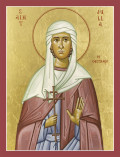 She was born in Carthage of noble parents. When the
Persians overran Carthage, many of the people were taken into slavery. St. Julia was one of
these, and was given to a Syrian merchant, who was a pagan. Seeing that Julia was a Christian, he
urged her many times to deny Christ and become of one faith with him, but Julia steadfastly
refused. As Julia was faithful and reliable in her work, the merchant left her in peace and spoke
no more about faith. One day, the merchant loaded his ship with goods, took Julia with him and
set off across the sea to a distant land to ply his trade. When they arrived at Corsica, there
was a pagan festival in progress, and the merchant took part in the foul idolatry while Julia
remained in the ship, weeping that so many people lived in foolish error, not knowing the truth.
The pagans somehow came to know about her, dragged her off the ship in spite of her owner’s
efforts to prevent them, and began to torture her in terrible ways. They cut off her breasts and
threw her onto the rock, then crucified her, at which Julia gave her soul to God. Her death was
revealed to some monks on the nearby island of Margarita (or Gorgona), and they went and buried
the martyr’s body. Many miracles were worked over St. Julia’s grave through the ages,
and she herself appeared to various people from the other world. She suffered with honor and went
to the kingdom of God in the sixth century.
She was born in Carthage of noble parents. When the
Persians overran Carthage, many of the people were taken into slavery. St. Julia was one of
these, and was given to a Syrian merchant, who was a pagan. Seeing that Julia was a Christian, he
urged her many times to deny Christ and become of one faith with him, but Julia steadfastly
refused. As Julia was faithful and reliable in her work, the merchant left her in peace and spoke
no more about faith. One day, the merchant loaded his ship with goods, took Julia with him and
set off across the sea to a distant land to ply his trade. When they arrived at Corsica, there
was a pagan festival in progress, and the merchant took part in the foul idolatry while Julia
remained in the ship, weeping that so many people lived in foolish error, not knowing the truth.
The pagans somehow came to know about her, dragged her off the ship in spite of her owner’s
efforts to prevent them, and began to torture her in terrible ways. They cut off her breasts and
threw her onto the rock, then crucified her, at which Julia gave her soul to God. Her death was
revealed to some monks on the nearby island of Margarita (or Gorgona), and they went and buried
the martyr’s body. Many miracles were worked over St. Julia’s grave through the ages,
and she herself appeared to various people from the other world. She suffered with honor and went
to the kingdom of God in the sixth century.
After many years had passed, the faithful wanted to build a new church in honor of St. Julia in another place, because the old church was small and dilapidated. They prepared the materials: the stone, bricks, sand and everything else that was needed, on the new site. But it happened that, at night, on the night before the day on which the foundations were to be laid, that the materials were carried by invisible hands back to the old church. In great perplexity, the people carried them to the new site again, but again the same thing happened: the materials were taken to the old site and left beside the church. The night watchman saw a maiden bathed in light, using white oxen to carry the materials to the old church. By this, they understood that St. Julia did not wish her church to be built in another place, so they pulled down the old church and built the new one on the same spot.
3. The Fifteen Thousand Holy Martyrs of Persia.
They were beheaded for the Christian Faith in Persia.
4. The Holy Martyr Athenogenes.
The composer of the Vespers hymn ‘O Joyous Light,’ he perished for Christ in the flames and was made worthy of eternal glory in the kingdom of God.
Daily Scripture Readings taken from The Orthodox New Testament, translated and published by Holy Apostles Convent, Buena Vista, Colorado, copyright © 2000, used with permission, all rights reserved.
Daily Prologue Readings taken from The Prologue of Ochrid, by Bishop Nikolai Velimirovic, translated by Mother Maria, published by Lazarica Press, Birmingham, England, copyright © 1985, all rights reserved. Edited by Dormition Skete.