

Daily Devotional
Sunday, May 27, 2029 (NS), May 14, 2029 (OS)
No Fasting.
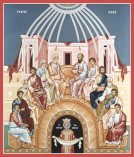
| Eighth Sunday, or the Sunday of Holy Pentecost |
The commemoration of the Martyr Isidore at Chios.
Scripture Readings
Paschalion — Movable Calendar
Eighth Sunday, or the Sunday of Holy Pentecost
Epistle
The Reading is from the Acts of the Apostles [§ 3].
2 1While the day of Pentecost was being fulfilled, they were all with one accord in the same place. 2And suddenly there came to be a sound out of the heaven, like as of a violent wind borne along, and it filled the whole house where they were sitting. 3And there appeared to them tongues, as if of fire, being distributed; and it sat upon each one of them. 4And they were all filled with the Holy Spirit, and began to speak in other tongues, even as the Spirit was giving them to utter. 5And there were Jews abiding in Jerusalem, pious men, from every nation of those under the heaven. 6And the report of this having arisen, the multitude came together and was confounded, because they were hearing, each one of them, speaking in his own dialect. 7And they were all amazed and wondering, saying to one another, “Behold, all these who are speaking are Galilæans, are they not? 8“And how do we each hear in our own dialect in which we were born? 9“Parthians and Medes and Elamites and those who dwell in Mesopotamia, also Judæa and Cappadocia, Pontos and Asia, 10“also Phrygia and Pamphylia, Egypt and the parts of Libya which are in the region of Cyrene, and the Romans, both Jews and proselytes, who sojourn here, 11“Cretans and Arabians—we hear them speaking in our own tongues the magnificent works of God.”
Gospel
In the Orthros
The Reading is from the Holy Gospel according to Saint John [§ 65].
20 19When it was evening on that day, the first of the week—and the doors were closed where the disciples were gathered together for fear of the Jews—Jesus came and stood in the midst, and saith to them, “Peace be to you.” 20And after He said this, He showed them His hands and His side. Then were the disciples glad, after they saw the Lord. 21Then Jesus said to them again, “Peace be to you; even as the Father hath sent Me forth, I also send you.” 22And after He said this, He breathed on them, and saith to them, “Receive ye the Holy Spirit: 23“if ye forgive the sins of any, they are forgiven to them; if ye retain the sins of any, they are retained.”
In the Liturgy
The Reading is from the Holy Gospel according to Saint John [§ 27].
7 37In the last day, that great day of the feast, Jesus was standing and cried out, saying, “If anyone thirst, let him come to Me and drink. 38“The one who believeth in Me, even as the Scripture said—rivers of living water shall flow out of his belly.” 39But this He said concerning the Spirit, Whom those who believe in Him were about to receive; for the Holy Spirit was not yet given, because Jesus was not yet glorified. 40Many therefore of the crowd, having heard the utterance, were saying, “This is truly the Prophet.” 41Others were saying, “This is the Christ.” But others were saying, “The Christ is not coming out of Galilee, is He? 42“Hath not the Scripture said that of the seed of David and from the village of Bethlehem, where David was, the Christ is coming?” 43Therefore a division occurred in the crowd on account of Him. 44And some of them were wishing to lay hold of Him, but no one laid hands on Him. 45Then came the officers to the chief priests and Pharisees, and they said to them, “Why did ye not bring Him?” 46The officers answered, “Never did a man so speak as this Man.” 47Then the Pharisees answered them, “Ye have not also been deceived, have ye? 48“Not one of the rulers believe in Him or of the Pharisees, doth he? 49“But this people who knoweth not the law are accursed!” 50Nicodemos (the one who came by night to Him, being one of them) saith to them, 51“Our law doth not judge the man, unless it should first hear him, and know from the man himself what he doeth, doth it?” 52They answered and said to him, “Thou art not also of Galilee, art thou? Search and look, for a prophet hath not been raised out of Galilee.”...
8 12Then Jesus spoke again to them, saying, “I am the light of the world; the one who followeth Me in no wise shall walk in the darkness, but shall have the light of the life.”
Menaion — Fixed Calendar
The commemoration of the Martyr Isidore at Chios.
No readings given.
Lives of the Saints (Prologue)
May 27th – Civil Calendar
May 14th – Church Calendar
1. The Holy Martyr Isidore.
In the reign of the Emperor Decius, this Isidore was taken by force by soldiers from the island of Chios. He had held the Christian Faith from his youth, and had spent his life in fasting, prayer and good works. So when, in the army, he declared himself to be a Christian, the commander took him to task for it, and urged him to deny Christ and offer sacrifice to idols. The saint replied: ‘Even if you kill my body, you have no power over my soul. I have the true and living God, Jesus Christ, Who lives in me and will be with me at my death; and I am in Him and shall remain in Him, and will not cease to confess His holy name while the spirit is in my body.’ The commander ordered that they first beat him with iron flails and then cut out his tongue. But, even without his tongue, Isidore was able to speak, and confessed the name of Christ by the Spirit of God. Meanwhile the punishment of God struck the commander, and he suddenly became mute. The mute commander finally gave the signal to behead Isidore. Isidore rejoiced at this sentence, and praising God, went out to the scaffold, where his head was cut off in the year 251. His friend, Ammon, buried his body, and after that, himself suffered and received the wreath of martyrdom.
2. Our Holy Father Serapion the Sindonite.
‘Sindon’ means ‘linen cloth,’ and this saint was called ‘the Sindonite’ because he covered his naked body only with a linen cloth. He carried the Gospels in his hand. Serapion lived like the birds, with no roof and no cares, moving from one place to another. He gave his linen cloth to a poor wretch who was shivering with cold, and himself remained completely naked. When someone asked him: ‘Serapion, who made you naked?’ he indicated the Gospels and said: ‘This!’ But, after that, he gave away the Gospels also for the money needed by a man who was being hounded to prison by a creditor for a debt. At one time in Athens, he did not eat for four days, having nothing, and began to cry out with hunger. When the Athenian philosophers asked him what he was shouting about, he replied: ‘There were three to whom I was in debt: two have quieted down, but the third is still tormenting me.’ The crowd was roused to aid him. They asked him who these were who were tormenting him. He replied: ‘The first creditor is carnal lust, which has tormented me from my youth; the second is love of money, and the third is the stomach. The first two have left me alone, but the third one still torments me.’ The philosophers gave him some gold to buy bread. He went to a baker, bought a single loaf, put down all the gold and went out. He went peacefully to the Lord in old age, in the 5th century.
3. Blessed Isidore the Fool for Christ.
He was of German birth. Going to Rostov from an attraction to the Orthodox Faith, he not only became a member of the Orthodox Church but took on himself the strict asceticism of folly for Christ. He lived in rags, spending the day pretending madness, and through this madness, teaching men; and spending the nights in prayer. He spent these nights in a hut outside the town, built in a lonely swamp. Great and mighty wonders were performed by this saint, both during his lifetime and after his death. He appeared to a merchant who had been thrown out of his ship and was drowning. Isidore came to him through the water and led him to the shore. He caused the wine in all the containers to dry up one day, when the servants had driven him from the door of the Prince of Rostov without giving him a single cup of water. When he died in his hut on May 24th, 1484, the whole of Rostov was aware of a fragrant aroma. The merchant who had been saved from the sea built a church in the place where the hut had stood.
FOR CONSIDERATION
A sin that is a cause of scandal to others is a twofold sin. A wise man tries to ensure that he gives scandal to no one by his sinful example and leads another into sin. St. Ambrose applauds such wisdom in the Emperor Valentinian, who died young, in this example from his life: ‘The emperor, hearing that he was being talked of all over Rome as a passionate hunter of wild beasts—which he, in fact, was not—and that this passion was taking the emperor away from his duties of state, immediately commanded that all the wild beasts in his forests be destroyed. Hearing, on another occasion, that some malicious person was spreading word that he lunched early (wanting by this to make him out to be a glutton), he took on himself a very strict fast, both publicly and privately. At public meals, he was rarely seen to put a morsel of food into his mouth. When, again, his sisters were in dispute with a man over some land, the emperor, although he had the right to try the case himself, submitted it to trial in open court, so that he could not be accused of partiality.’ Truly this devout emperor kept with godly fear to the words of the Lord: ‘Woe to him that causes offence to one of these little ones.’
Daily Scripture Readings taken from The Orthodox New Testament, translated and published by Holy Apostles Convent, Buena Vista, Colorado, copyright © 2000, used with permission, all rights reserved.
Daily Prologue Readings taken from The Prologue of Ochrid, by Bishop Nikolai Velimirovic, translated by Mother Maria, published by Lazarica Press, Birmingham, England, copyright © 1985, all rights reserved. Edited by Dormition Skete.