

Daily Devotional
Thursday, May 17, 2029 (NS), May 4, 2029 (OS)
No Fasting.
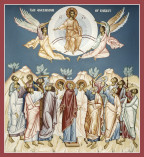
| The Thursday of the Ascension |
The commemoration of the Virgin-martyr Pelagia of Tarsus.
Scripture Readings
Paschalion — Movable Calendar
The Thursday of the Ascension
Epistle
The Reading is from the Acts of the Apostles [§ 1].
1 1The first account indeed I made for myself concerning all which, O Theophilos, Jesus began both to do and teach, 2until the day in which He was taken up, after He gave command to the apostles whom He chose for Himself through the Holy Spirit, 3to whom also He presented Himself alive after He had suffered by many proofs, being seen by them during forty days and speaking the things concerning the kingdom of God. 4And being assembled together with them, He ordered them not to depart from Jerusalem, but to wait for the promise of the Father, “which,” He said, “ye heard of Me; 5“for John indeed baptized with water, but ye shall be baptized in the Holy Spirit not many days after these.” 6Indeed therefore, after they came together, they kept on questioning, saying, “Lord, dost Thou at this time restore the kingdom to Israel?” 7And He said to them, “It is not yours to know times or seasons which the Father Himself put in His own authority. 8“But ye shall receive power, after the Holy Spirit is come upon you; and ye shall be witnesses to Me both in Jerusalem, and in all Judæa and Samaria, and unto the ends of the earth.” 9And having said these things, while they looked, He was taken up; and from before their eyes, a cloud took Him up from under. 10And while they were gazing intently into the heaven as He went, then behold, two men stood by them in white raiment, 11who also said, “Men, Galilæans, why do ye stand looking into the heaven? This Jesus, the One Who was taken up from you into the heaven, so shall He come in the manner ye beheld Him going into the heaven.” 12Then they returned to Jerusalem from the mount which is called the Mount of Olives, which is near Jerusalem, being a sabbath’s day journey.
Gospel
In the Orthros
The Reading is from the Holy Gospel According to Saint Mark. [§ 71]. At that time:
16 9After Jesus rose early the first day of the week, He appeared first to Mary Magdalene, from whom He had cast out seven demons. 10She went and brought tidings to those who had been with Him, who were mourning and weeping. 11And they, having heard that He liveth and was seen by her, disbelieved. 12And after these things He was made manifest in a different form to two of them as they were walking and went into the country. 13And they went and brought tidings to the rest; neither did they believe them. 14Afterwards He was made manifest to the eleven themselves as they reclined at table; and He reproached their unbelief and hardness of heart, because they believed not those who saw Him after He was raised. 15And He said to them, “Go into all the world and proclaim the Gospel to the whole creation. 16“The one who believeth and is baptized shall be saved; but the one who believeth not shall be condemned. 17“And these signs shall accompany those who believe: In My name they shall cast out demons; they shall speak in new tongues; 18“they shall take up serpents; and if they should drink anything deadly, in no wise shall it harm them; they shall lay hands on the sick, and they shall be well.”
19Then indeed, after speaking to them, the Lord was taken up into the heaven, and sat on the right of God. 20And they went forth and preached everywhere, the Lord working with them, and confirming the word by the accompanying signs. Amen.
In the Liturgy
The Reading is from the Holy Gospel according to Saint Luke [§ 114]. At that time:
24 36After Jesus rose from the dead, He stood in the midst of His disciples, and saith to them, “Peace be to you.” 37But they were terrified and affrighted, and kept on thinking that they saw a spirit. 38And He said to them, “Why are ye troubled? And why do reasonings come up in your hearts? 39“Behold My hands and My feet, that I am He. Touch Me and see, for a spirit hath not flesh and bones, even as ye see Me having.” 40And having said this, He showed them His hands and His feet. 41And while they yet disbelieved from the joy, and wondered, He said to them, “Have ye anything to eat here?” 42And they gave Him a portion of a broiled fish and of a honeycomb. 43And He took these and ate in their presence. 44And He said to them, “These are the words which I spoke to you while I was yet with you, that it is needful for all the things to be fulfilled, which were written in the law of Moses, and in the prophets, and in the psalms concerning Me.” 45Then He thoroughly opened their mind to understand the Scriptures, 46and said to them, “Thus it hath been written, and thus it was needful for the Christ to have suffered, and to have risen from the dead the third day, 47“and repentance and forgiveness of sins to have been preached in His name to all the nations, beginning from Jerusalem. 48“And ye are witnesses of these things. 49“And behold, I send forth the promise of My Father upon you; but sojourn in the city of Jerusalem, until ye are clothed with power from on high.”
50And He led them out as far as to Bethany. And having lifted up His hands, He blessed them. 51And it came to pass, as He was blessing them, He stood apart from them and was carried up into the heaven. 52And they made obeisance to Him, and returned to Jerusalem with great joy. 53And they were continually in the temple, praising and blessing God. Amen.
Menaion — Fixed Calendar
The commemoration of the Virgin-martyr Pelagia of Tarsus.
No readings given.
Lives of the Saints (Prologue)
May 17th – Civil Calendar
May 4th – Church Calendar
1. The Holy Martyr Pelagia of Tarsus.
Born in the town of Tarsus of pagan but noble and wealthy parents, she heard about Christ and the salvation of the soul from Christians, became inflamed with love for the Savior and was a Christian in her soul. There was at that time a terrible persecution of Christians. It happened that the Emperor Diocletian himself stopped in Tarsus and that, during the time of his stay in the town, his son, the heir, fell deeply in love with Pelagia and wanted to make her his wife. Pelagia replied through her mother—a wicked woman—that she was already promised to her betrothed husband, Christ the Lord. Fleeing from the foul heir and her wicked mother, Pelagia sought and found Bishop Linus, a man renowned for his holiness. He instructed her in the Faith and baptized her. Then Pelagia gave away her luxurious clothing and great wealth, returned home and confessed to her mother that she was already baptized. Hearing of this, the emperor’s son, losing all hope of getting this holy maiden as his wife, ran himself through with a sword and died. Then the wicked mother denounced her daughter to the emperor and she was taken for trial. The emperor marveled at the girl’s beauty, and forgetting his son, burned with an impure passion for her. But when Pelagia remained unfaltering in her faith, the emperor condemned her to be burned in a metal ox heated by fire. She entered the ox with prayers of thanksgiving to God on her lips, and received a crown of martyrdom. She suffered with honor in 287. Diocletian bid that her remains be cast out of the city for wild beasts to devour, but God preserved her relics intact. Bishop Linus took her relics and buried them honorably. In the time of the Emperor Constantine Kopronymos (741-775), a beautiful church was built on that site in honor of this holy virgin and martyr Pelagia, who was sacrificed for Christ to reign eternally with Him.
2. The Hieromartyr Silvanos, Bishop of Gaza.
He was at first in military service, but later, urged by the strength of his faith, he transferred to spiritual service. Accused of bringing many pagans to Christianity, he was at first brutally tortured then beheaded with forty other soldiers in 311, and thus became a citizen of heaven.
3. Our Holy Father Nikephoros the Hesychast.
He was at first a Roman Catholic, but then became Orthodox. He lived in asceticism on the Holy Mountain as a monk, with the wise Theoleptos. He was a teacher of St. Gregory Palamas and wrote a work on mental prayer. He went peacefully to the Lord in the 14th century. He taught: ‘Gather your mind and compel it to enter into your heart and remain there. When your mind is firmly in your heart, it must not remain empty, but must incessantly make the prayer: “Lord Jesus Christ, Son of God, have mercy on me!” And it must never fall silent. Through this the whole string of the virtues: love, joy, peace and the others, will make their abode in you, by which, then, every request of yours to God will be fulfilled.’
FOR CONSIDERATION
A young man, inexperienced in the spiritual struggle, makes a show to everyone of his good works with self-congratulation. But a soldier experienced in skirmishes with the passions and with demons belittles each work of his and intensifies his prayer for the help of God. Abba Matoes said: ‘The closer a man is to God, the more clearly he knows himself a sinner.’ And, again, he said: ‘When I was young, I thought that I might be able to do some good thing; but now that I am old, I see that I have not done a single good work.’ Did not the Lord say: ‘None is good, but the one God’? If, then, the one God alone is good and the fount of all good, how can a good work be done that is not of God? And how can anyone who performs a good work attribute it to himself and not to God? And, if this is so, by what can a dead man be praised? By nothing but God and the goodness of God.
Daily Scripture Readings taken from The Orthodox New Testament, translated and published by Holy Apostles Convent, Buena Vista, Colorado, copyright © 2000, used with permission, all rights reserved.
Daily Prologue Readings taken from The Prologue of Ochrid, by Bishop Nikolai Velimirovic, translated by Mother Maria, published by Lazarica Press, Birmingham, England, copyright © 1985, all rights reserved. Edited by Dormition Skete.