

Daily Devotional
Friday, May 11, 2029 (NS), April 28, 2029 (OS)
Fast Day, but Wine and Olive Oil Allowed.
Friday of the Fifth Week
The commemoration of the holy Nine Martyrs of Kyzicus, Theognis, Rufus, Antipater, Theostichos, Artemas, Magnos, Theodotos, Thavmasios, and Philemon (commemorated on Sl. calendar on the 29th of April). The commemoration of the holy Apostles of the Seventy, Jason and Sosipater, and their companions (commemorated on Gk. calendar on the 29th of April). The commemoration of the holy Martyrs Maximos, Quintillian, and Dada at Dorostolum (commemorated on Gk. calendar on the 13th of April).
Scripture Readings
Paschalion — Movable Calendar
Friday of the Fifth Week
Epistle
The Reading is from the Acts of the Apostles [§ 36]. In those days:
15 5There rose up certain of those from the sect of the Pharisees who believed, saying, “It is necessary to circumcise them, and to command them to keep the law of Moses.”
6And the apostles and the presbyters were gathered together to see about this matter. 7And after much discussion took place, Peter rose up and said to them, “Men, brethren, ye know that from former days God Himself chose among us for the nations to hear by my mouth the word of the Gospel, and to believe. 8“And God, the Knower of hearts, bore witness to them, giving them the Holy Spirit, even as also to us; 9“and He made no distinction between both us and them, having purified their hearts by faith. 10“Now then why tempt ye God by putting a yoke upon the neck of the disciples which neither our fathers nor we were able to bear? 11“But through the grace of the Lord Jesus Christ, we believe we are to be saved in like manner as they.” 12And all the multitude became silent, and were listening to Barnabas and Paul relating how many signs and wonders God wrought among the nations through them. 13And after they became silent, Iakovos answered, saying, “Men, brethren, hear me. 14“Symeon related how God first visited to take from the nations a people for His name. 15“And to this agree the words of the prophets, even as it hath been written: 16“‘“After these things I will return, and will build again the tabernacle of David which is fallen, and I will build again the things which have been dug down, and I will set it up [cf. Amos 9:11], 17“‘“so that the residue of men might seek after the Lord, even all the nations upon whom My name hath been called upon them,” saith the Lord Who doeth all these things [cf. Amos 9:12].’ 18“Known to God are all His works from eternity. 19“Wherefore I judge that we are not to trouble those who from the nations are turning to God, 20“but that we write to them to abstain from the pollutions of the idols, and from fornication, and from what is strangled, and from blood. 21“For Moses from generations of old hath in every city those proclaiming him, since he is read every sabbath day.” 22Then it seemed good to the apostles and to the presbyters, with the whole Church, to send chosen men from among them to Antioch with Paul and Barnabas, namely, Judas surnamed Barsavas, and Silas, leading men among the brethren, 23having written by their hand thus: “The apostles and the presbyters and the brethren to those brethren who are of the nations in Antioch and Syria and Cilicia: Greetings. 24“Whereas we have heard that certain from among us who went out troubled you with words, upsetting your souls, saying, ‘Be circumcised and keep the law’—to whom we gave no such command— 25“it seemed good to us, having come to be of one accord, to send chosen men to you with our beloved Barnabas and Paul, 26“men who have handed over their lives for the name of our Lord Jesus Christ. 27“We have sent forth therefore Judas and Silas, who shall themselves also relate verbally the same things. 28“For it seemed good to the Holy Spirit, and to us, to lay upon you no further burden than these necessary things: 29“that ye abstain from sacrifices to idols, and from blood, and from what is strangled, and from fornication; from which, if ye keep yourselves, ye shall do well. Fare-well.”
30So when they were dismissed, they went to Antioch; and after they gathered together the multitude, they delivered the epistle. 31And having read it, they rejoiced for the consolation. 32Both Judas and Silas, being themselves also prophets, by much discourse exhorted the brethren and confirmed them. 33And after they continued for a time, they were sent forth in peace from the brethren to the apostles. 34But it seemed good to Silas to abide there.
Gospel
The Reading is from the Holy Gospel according to Saint John [§ 37]. The Lord said to those Jews who had come to Him:
10 17“On this account My Father loveth Me, because I lay down My soul, that I might take it again. 18“No one taketh it from Me, but I lay it down of Myself. I have authority to lay it down, and I have authority to take it again. This commandment I received from My Father.” 19A division therefore again arose among the Jews on account of these words. 20And many of them were saying, “He hath a demon and is mad; why hear ye Him?” 21Others were saying, “These are not the words of one who is possessed by a demon. A demon is not able to open the eyes of the blind, is he?”
22And it came to be the feast of the dedication in Jerusalem, and it was winter. 23And Jesus was walking about in the temple in Solomon’s porch. 24Then the Jews came round about Him and were saying to Him, “Until when dost Thou lift up our soul? If Thou art the Christ, tell us openly.” 25Jesus answered them, “I told you, and ye believe not. The works which I do in the name of My Father, these bear witness concerning Me. 26“But ye believe not; for ye are not of My sheep, even as I said to you. 27“The sheep, those that are Mine, hear My voice, and I know them, and they follow Me. 28“And I give them eternal life.”
Menaion — Fixed Calendar
The commemoration of the holy Nine Martyrs of Kyzicus, Theognis, Rufus, Antipater, Theostichos, Artemas, Magnos, Theodotos, Thavmasios, and Philemon (commemorated on Sl. calendar on the 29th of April). The commemoration of the holy Apostles of the Seventy, Jason and Sosipater, and their companions (commemorated on Gk. calendar on the 29th of April). The commemoration of the holy Martyrs Maximos, Quintillian, and Dada at Dorostolum (commemorated on Gk. calendar on the 13th of April).
No readings given.
Lives of the Saints (Prologue)
May 11th – Civil Calendar
April 28th – Church Calendar
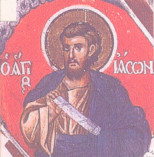
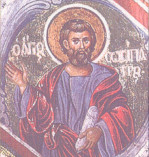
1. The Holy Apostles Jason and Sosipater, and the Virgin Kerkyra.
|
The first two were among the Seventy Apostles, and the last was the daughter of the king of the island of Corfu. The Apostle Paul mentions Jason and Sosipater (Rom. 16:21), and calls them his kinsmen. Jason was born in Tarsus, as was the Apostle Paul himself, and Sosipater in Achaea. The first was nominated by the apostles as Bishop of Tarsus and the second as Bishop of Iconium. Travelling and preaching the Gospel, these two apostles came to the island of Corfu, where they succeeded in building a church dedicated to St. Stephen the Protomartyr and in bringing some unbelievers to the Church. The king of the island threw them into prison, where there were seven robbers already imprisoned: Satorninus, Jakischolus, Faustian, Januarius, Marsalus, Evphrasius and Mamminus. The apostles brought all seven of them to the Christian Faith, making wolves into lambs. The king commanded that these seven be put to death in boiling pitch, and they thus received the wreath of martyrdom. Seeking to disgrace Jason and Sosipater, the king had them dragged through the streets by a horse at a speed calculated to be slow enough to bruise them without killing them. When the king’s daughter, Kerkyra, saw this, she looked upon the wretchedness of her father with disdain, and discovering the reason for it, she visited them in the prison, where she was converted. She gave all her jewels away to the poor and proclaimed herself a Christian to her father. The king was filled with wrath against his daughter and shut her up in a separate prison. Then, failing to turn her from Christ, he ordered that the prison be burned down. The prison burned to the ground, but the maiden remained alive. Seeing this wonder, many of the people were baptized. The furious king ordered that his daughter be bound to a tree and killed with arrows. Those who had come to believe in Christ fled from the terrible king to a nearby island and hid themselves. The king set off in a boat to arrest them, but his boat overturned in the sea and thus the unrighteous perished, as Pharaoh aforetime. The succeeding king, Donatios, continued in the persecution. He ordered Sosipater to be put to death. It was presumed that Jason would follow his comrade in death, but the king decided to question the surviving partner first. A gnawing sense of guilt precipitated the meeting of the two, at which Jason succeeded in converting Donatios to the Christian Faith. Not long after this, the twelve-year-old daughter of Donatios was stricken with a fatal illness, but was cured when Jason knelt in prayer on her behalf. Jason continued to work for our Savior until his death at the age of sixty on April 28th, the day on which Sosipater had died for Christ. |
|
2. The Holy Martyrs Maximus, Dada and Quintillian.
Suffering in the time of Diocletian, they were condemned and tortured by the commander Tarquinius. After imprisonment and torture, they were beheaded.
3. The Holy Martyr Tibald.
A Slav from Pannonia, he was terribly tortured for the Faith in the time of Diocletian, and suffered in Tsibal.
FOR CONSIDERATION
The mystery of our salvation is fulfilled in God’s appearing among men in human flesh. Meliton of Sardis writes: ‘The works of Christ after His Baptism showed and demonstrated to the world that His divinity is hidden within His flesh. Being God, He was also perfect man. He revealed His two natures to us: His divinity by His miracles, performed in the three years after His Baptism, and His humanity through those thirty years when bodily nature hid the signs of His divinity, although He was truly the pre-eternal God.’ The means of uniting the divinity with the humanity is difficult to comprehend, but the event of the appearing of God among men is perfectly comprehensible from the point of view of God’s love for man. As an event, the world is not more comprehensible—it can be said to be even less comprehensible than the event of events, the incarnation of God.
Daily Scripture Readings taken from The Orthodox New Testament, translated and published by Holy Apostles Convent, Buena Vista, Colorado, copyright © 2000, used with permission, all rights reserved.
Daily Prologue Readings taken from The Prologue of Ochrid, by Bishop Nikolai Velimirovic, translated by Mother Maria, published by Lazarica Press, Birmingham, England, copyright © 1985, all rights reserved. Edited by Dormition Skete.