

Daily Devotional
Sunday, April 29, 2029 (NS), April 16, 2029 (OS)
No Fasting.
| The Fourth Sunday of Pascha, or the Sunday of the Paralytic Mode Three — Fifth Eothinon |
The commemoration of the Virgin-martyrs Agape, Irene, and Chionia in Illyria.
Scripture Readings
Paschalion — Movable Calendar
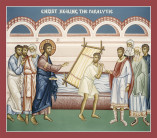
The Fourth Sunday of Pascha, or the Sunday of the Paralytic
Mode Three — Fifth Eothinon
Epistle
The Reading is from the Acts of the Apostles [§ 23]. In those days:
9 32It came to pass, as Peter passed through all quarters, he went down also to the saints that dwelt at Lydda. 33And there he found a certain man, by name Æneas, who kept his bed for eight years, and was paralyzed. 34And Peter said to him, “Æneas, Jesus the Christ healeth thee; rise up and make up thy bed for thyself.” And straightway he rose up. 35And all those inhabiting Lydda and the Sharon Plain, who saw him, turned to the Lord. 36Now there was in Joppa a certain disciple, by name Tabitha, which, being interpreted, is called Dorcas. She was full of good works and of alms which she used to do. 37And it came to pass in those days she fell sick and died. And after they washed her, they laid her in an upper room. 38And since Lydda was near to Joppa, and the disciples heard that Peter was in it, they sent forth two men to him, beseeching him not to delay to come over to them. 39And Peter, having risen up, went with them, whom after he came, they brought him into the upper room. And all the widows stood by him weeping, and showing howsoever many tunics and garments Dorcas used to make while she was with them. 40But Peter put them all forth, and kneeled down, and prayed. And turning to the body, he said, “Tabitha, rise up.” And she opened her eyes; and after she saw Peter she sat up. 41And he gave her his hand and raised her up; and after he called the saints and the widows, he presented her alive. 42And it became known throughout all of Joppa; and many believed on the Lord.
Gospel
The Reading is from the Holy Gospel according to Saint John [§ 14]. At that time:
5 1Jesus went up to Jerusalem. 2Now there is in Jerusalem by the gate a sheep pool, which is surnamed in Hebrew, Bethesda, having five porches. 3In these was lying a great multitude of the infirm, blind, lame, withered, awaiting the moving of the water. 4For an angel used to come down from time to time into the pool and trouble the water; then after the troubling of the water, the one who first entered became well of whatsoever disease he was held by. 5And a certain man was there, who had been thirty and eight years in his infirmity. 6Jesus saw this one lying there, and knew that he had already been much time in that condition, and He said to him, “Dost thou wish to become well?” 7The sick man answered Him, “Sir, I have no man in order that whenever the water is troubled he may put me into the pool; but while I am coming, another goeth down before me.” 8Jesus saith to him, “Rise, take up thy bed and be walking.” 9And straightway the man became well, and took up his bed, and went on walking. And on that day it was a sabbath. 10The Jews therefore were saying to him who had been healed, “It is a sabbath; it is not lawful for thee to take up the bed.” 11He answered them, “The One Who made me well, the same said to me, ‘Take up thy bed and be walking.’” 12Then they asked him, “Who is the Man Who said to thee, ‘Take up thy bed and be walking?’” 13But the one who was healed knew not Who it was, for Jesus turned aside, because a crowd was in the place. 14After these things Jesus findeth him in the temple, and said to him, “Behold, thou hast become well; no longer go on sinning, lest a worse thing should befall thee.” 15The man went away, and told the Jews that Jesus was the One Who made him well.
Menaion — Fixed Calendar
The commemoration of the Virgin-martyrs Agape, Irene, and Chionia in Illyria.
No readings given.
Lives of the Saints (Prologue)
April 29th – Civil Calendar
April 16th – Church Calendar
1. The Holy Martyrs Agapia, Chionia and Irene.
They were sisters from the region of Aquileia. When the Emperor Diocletian was staying in Aquileia, he ordered that the famous spiritual guide, Chrysogonus, be executed. An old priest named Zoilus received a vision in which he was shown where the body of Chrysogonus lay unburied. The old man hurried off, found the body of the martyr, placed it in a coffin and carried it to his home. On the thirtieth day after that, St. Chrysogonus appeared to him and told him that the three maidens would be martyred in the next nine days, and that he, Zoilus, would himself enter into rest during that time. Anastasia the Clairvoyant also received the same tidings in a vision sent by Chrysogonus, who had been her teacher. The elder Zoilus did indeed find his rest after nine days, and the three sisters were brought to trial before the emperor. The emperor urged the holy maidens to worship idols, but they all refused, confessing their firm faith in Christ. Irene told the emperor that it was ridiculous to bow down to things made of wood and stone, made to order at an agreed price by the hands of a mortal man. The furious emperor flung them into prison. Now, when the emperor travelled to Macedonia, he took all his slaves and servants with him, including the three sisters. He gave them to Dulcitius, a general, for torture. Inflamed with a dark passion, he desired to defile the maidens, but when he tried to go into the prison, he lost his mind and fell upon the pots and cauldrons in front of the gate, embracing and kissing them, and was completely blackened with soot. When the emperor heard of this happening, he ordered another general to undertake the trial of the sisters. After terrible torture, the judge condemned the first two sisters to death by fire, but kept Irene for a time, hoping to defile her. But, when he sent Irene to the brothel along with some soldiers, an angel of God turned the soldiers back and led her out onto a high hill. The next day the general went out to the hill with his soldiers, and being unable to climb it, ordered that Irene be shot at with arrows. St. Anastasia gathered all three bodies together in one place and gave them burial. They suffered for Christ their King and Lord in about 304.
2. The Holy Martyr Leonides and those with him: Charissa, Nike, Galina, Kallis, Nunechia, Vasilissa and Theodora.
They were thrown into the sea, but it refused to receive them. They walked upon the sea as if it were dry land and sang praises to God: ‘I have won one battle, O Lord, and the soldiers have persecuted me, O Lord, and I have not denied Thee, O Lord; save Thou my soul!’ The pagans were at first astounded to behold this, but they then tied stones around their necks and again threw them into the deep, where they were drowned. They all suffered with honor for Christ our King and Lord in 281.
FOR CONSIDERATION
A story of the elder Barlaam: A man had three friends; two of these he loved sincerely, but avoided the third because he found him boring. It so happened that the emperor summoned the man to pay a debt. He turned to the first friend for aid, but he refused and went away. He asked help of the second, but he would not help him either. Somewhat shamefacedly, he turned to his third friend, who went willingly with him to the emperor. The meaning is this: the first friend is riches, the second is friends and family, and the third is the good deeds of a man in this world. The emperor is God, Who sends out His summons by means of death and demands payment of the debt. A man on the point of death looks for help from his riches, but they simply turn their back on him and pass into the hands of another. Then he turns to his kinsmen, but they go with him for a short distance, but then turn their backs on him, send him off and stay behind themselves tending to their own affairs. Then he begins to think on his good deeds, which he performed so grudgingly—and straightway these come with him on the road to the presence of the King and Judge. He who has ears to hear, let him hear. The soul’s only companions into the other world are his deeds, be they good or bad. All that which was dear and precious to a man abandons him and turns its back on him; only his deeds, down to the very last one, go with him. He who has a mind to understand, let him understand.
Daily Scripture Readings taken from The Orthodox New Testament, translated and published by Holy Apostles Convent, Buena Vista, Colorado, copyright © 2000, used with permission, all rights reserved.
Daily Prologue Readings taken from The Prologue of Ochrid, by Bishop Nikolai Velimirovic, translated by Mother Maria, published by Lazarica Press, Birmingham, England, copyright © 1985, all rights reserved. Edited by Dormition Skete.